
Challenges of Machining Nylon
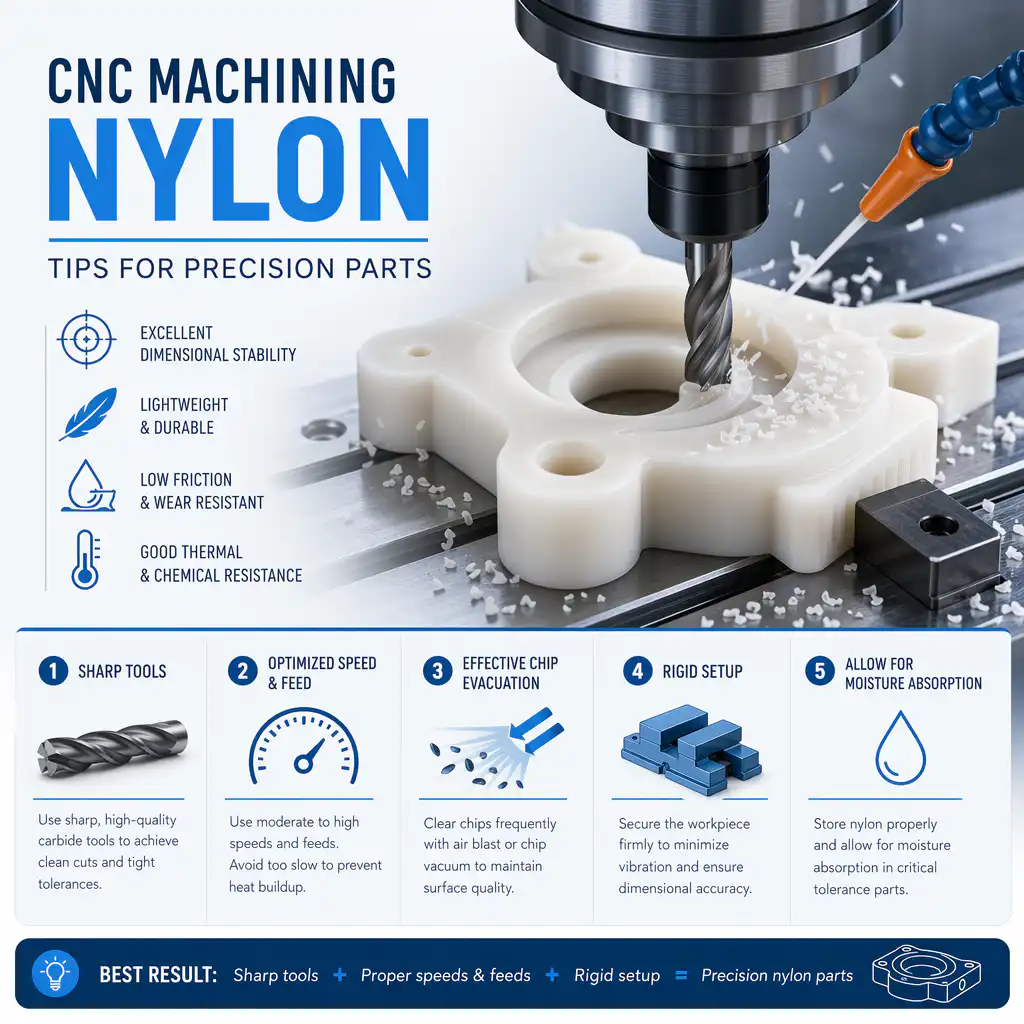
- Softness and flexibility cause deflection
- High thermal expansion affects tolerances
- Moisture absorption changes dimensions
Recommended Parameters
| Operation | Speed (m/min) | Feed |
|---|---|---|
| Milling | 150-300 | 0.1-0.3 mm/tooth |
| Turning | 150-400 | 0.1-0.4 mm/rev |
Achievable Tolerances
- ±0.05mm: Standard
- ±0.02mm: Precision
FAQ
When is CNC Machining Nylon — Tips for Precision Parts the right choice?
CNC Machining Nylon — Tips for Precision Parts is the right choice when the part requires machined accuracy, controlled surfaces, repeatable features, and a material that can be cut reliably.
What should be confirmed before ordering CNC Machining Nylon — Tips for Precision Parts?
Confirm the drawing version, material grade, tolerances, quantity, critical dimensions, surface finish, and inspection requirements before production starts.
What usually drives cost in CNC Machining Nylon — Tips for Precision Parts?
Cost is usually driven by material, setup time, machine time, tolerance difficulty, fixturing, tool access, finishing, inspection, and order quantity.
How can quality risk be reduced in CNC Machining Nylon — Tips for Precision Parts?
Quality risk is reduced by marking critical features clearly, avoiding unnecessary tight tolerances, confirming manufacturability early, and using inspection data for important dimensions.
CNC Machining Nylon — Frequently Asked Questions
Is nylon easy to machine?
Moderately easy. Requires attention to flexibility and thermal properties.
Where can I get precision-machined nylon parts?
Nylonplastic offers CNC machining with tolerances to ±0.02mm.
 English
 Dutch
Dutch German
 French
 Korean
 Russian
 Japanese
 Spanish
 Vietnamese
 Chinese
 Portuguese
 Arabic