Every plastic part design reaches a fork in the road: machine it or mold it. CNC machining delivers parts in days with no tooling investment and plus or minus 0.05 mm precision. Injection molding requires a $5,000-80,000 mold and 2-8 weeks of lead time, but produces parts at $0.50-5.00 each at volumes where CNC costs $15-50 each. The decision is not about which process is better – it is about which process matches your volume, timeline, tolerance, and material requirements at the lowest total cost.
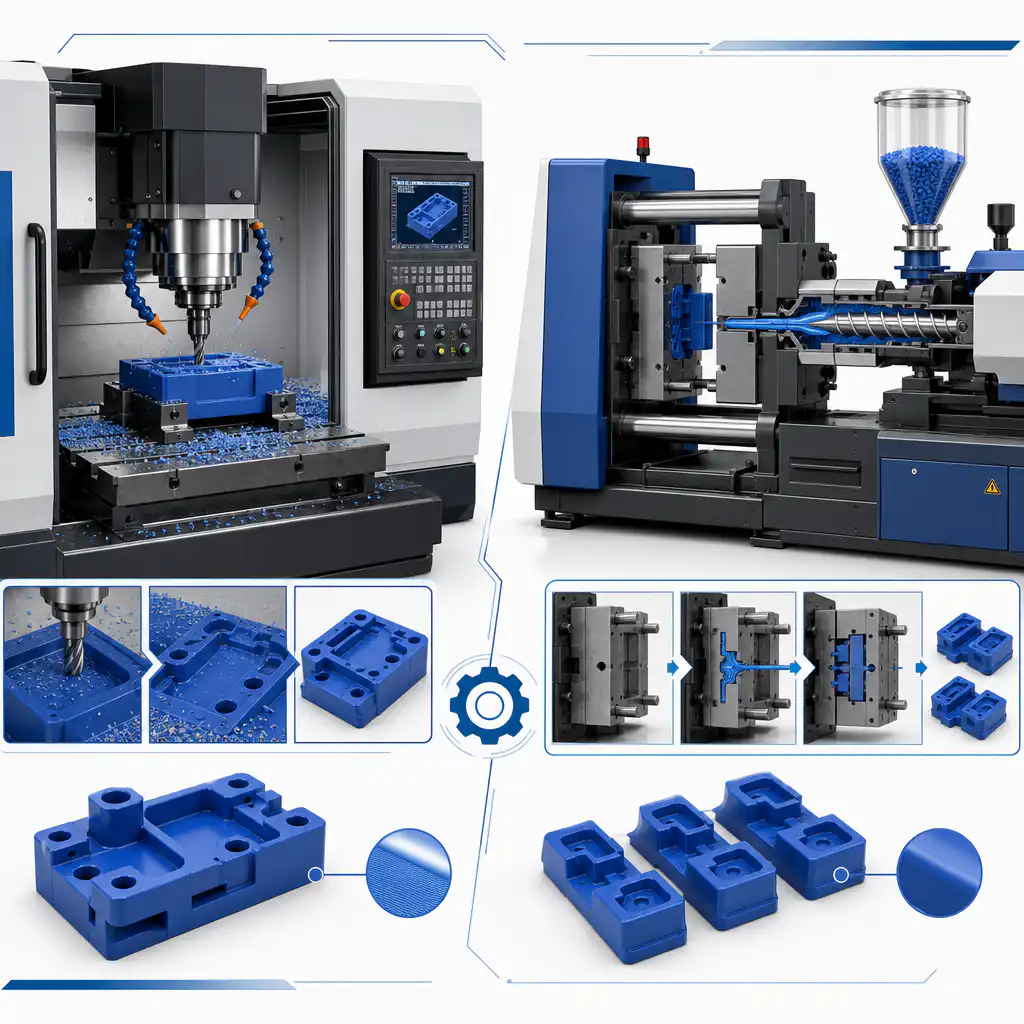
This guide lays out the process comparison data, volume breakpoints, and hybrid strategies that Nylon Plastic uses with customers every day. The goal is not to steer you toward molding (which is our largest business) or machining – but to help you choose the right process for where you are in the product lifecycle.
Process Comparison at a Glance
| Factor | CNC Machining | Injection Molding | Winner |
|---|---|---|---|
| Tooling cost | $0 (no mold required) | $5,000-80,000+ | CNC for under 500 pcs |
| Per-part cost (100 pcs) | $15-50 | $20-60 (tooling dominates) | CNC |
| Per-part cost (10,000 pcs) | $15-50 | $0.80-4.00 | Injection Molding |
| Lead time (first parts) | 3-10 days | 15-30 days (mold) + 1-5 days (parts) | CNC |
| Tolerance | plus or minus 0.05-0.10 mm | plus or minus 0.10-0.30 mm | CNC |
| Surface finish | As-machined Ra 0.8-3.2 um | SPI A3-D3 (0.01-8.0 um Ra) | Injection (cosmetic) |
| Material options | Any rigid plastic (sheet/rod/block) | Any injection-grade thermoplastic | Injection (broader) |
| Design changes | Free (revise CAM program) | $1,000-10,000+ (steel-safe mods only) | CNC |
| Minimum wall | 1.0 mm (2.0 mm preferred) | 0.5 mm (1.0 mm preferred for structure) | Injection Molding |
| Scalability | Linear cost with volume | Amortized tooling, low marginal cost | Injection (10,000+) |
Volume Break-Even Analysis
The break-even point where injection molding becomes cheaper than CNC machining depends on part complexity and size. Rule of thumb for a palm-sized part (50-100g): Below 250 pcs: CNC is cheaper. 250-1,000 pcs: costs are roughly equal; choose based on timeline, tolerance, and whether design is locked. Above 1,000 pcs: injection molding pulls ahead and the gap widens rapidly. Above 10,000 pcs: injection molding is 3-10x cheaper per part.
Detailed example – 75g PA66 bracket, 50x50x30 mm: CNC machining: $22/part (1 hr setup + 15 min/part at $60/hr + $8 material). Injection molding: $12,000 mold + $1.20/part (material $0.35 + machine time $0.45 + labor $0.40). Total cost: 100 pcs: CNC $2,200 vs IM $12,120. 500 pcs: CNC $11,000 vs IM $12,600. 1,000 pcs: CNC $22,000 vs IM $13,200. 10,000 pcs: CNC $220,000 vs IM $24,000. The mold pays for itself between 500-600 parts.
When to Choose CNC Machining
Prototyping and design iteration (1-50 pcs): No mold means design changes cost zero in tooling. CNC parts in 3-5 days let you test, modify, and re-make overnight. Bridge production (50-500 pcs): While the injection mold is being built (3-6 weeks), CNC parts keep your assembly line, testing program, or customer demos running. Large-format parts (over 500×400 mm): CNC machines handle large plastic sheets and blocks that would require enormous and expensive injection presses. Ultra-tight tolerances (plus or minus 0.05 mm or better): CNC holds tighter tolerances than injection molding for most geometries. Low annual volume ongoing: If annual demand stays below 500 pcs, the mold may never amortize – CNC is the permanent production solution.
When to Choose Injection Molding
Production volumes above 1,000 pcs/year: The mold cost amortizes to pennies per part at scale. Per-part cost drops 80-95% versus CNC at volume. Cosmetic surface quality: Molded surfaces replicate polished mold steel – CNC leaves tool marks that require secondary finishing for cosmetic parts. Thin walls and fine detail: Injection molding achieves wall thicknesses down to 0.3-0.5 mm and replicates sub-millimeter detail that CNC tools cannot physically reach. Material properties through orientation: Glass-filled materials gain directional strength from fiber orientation in molding – machined parts have random fiber orientation from the stock material. Consistent batch-to-batch quality: Once the mold is qualified, every shot produces the same part. CNC parts have operator-to-operator and setup-to-setup variation.
For the tooling behind the molded route, review core and cavity design before releasing the part geometry.
Design Rules for Process Selection
- Start with CNC, transition to molding: The most cost-effective product development path: CNC machine 10-50 prototypes for design validation, then invest in an injection mold once the design is locked. The prototype phase informs gate location, wall thickness sensitivity, and tolerance requirements – all valuable inputs for mold design that reduce the risk of mold modifications.
- Design for your production process from day one: Even if you are starting with CNC, design the part as if it will eventually be molded: uniform wall thickness (avoid thick sections that are easy to machine but impossible to mold without sink), draft angles on vertical surfaces, and generous radii instead of sharp internal corners. A part that machines beautifully but cannot be molded requires redesign before tooling – doubling your engineering cost.
- CNC for complex 3D surfaces: Freeform surfaces, undercuts (accessible by 5-axis), and deep pockets with flat bottoms are CNC strengths. Injection molding the same features may require side actions, lifters, or collapsible cores that add thousands to mold cost. If the part has complex 3D geometry that requires 3+ side actions to mold, CNC may be cheaper even at moderate volumes (1,000-2,000 pcs).
- Mold for multi-cavity cost reduction: A single-cavity mold produces one part per cycle. A 4-cavity mold produces four parts per cycle with roughly 50-70% more mold cost – not 4x. For high-volume parts (50,000+/yr), multi-cavity molds are the standard. CNC has no equivalent – 4 parts always cost 4x as much as 1 part.
- Material stock availability limits CNC: CNC machining requires the material to be available in sheet, rod, or block form. Some engineering plastics (PPS, PPA, specialty grades) are not stocked in machinable forms and must be injection molded. Check material availability before committing to a CNC-only strategy for exotic thermoplastics.
- Combine both for hybrid manufacturing: The hybrid model: injection mold a near-net-shape blank with all cosmetic surfaces and fine details, then CNC machine only the critical tolerance features (bearing seats, seal faces, mating surfaces). This delivers injection molding per-part economy with CNC precision where it matters. The approach is standard in automotive and medical – the blank costs $1-3 from molding, and the machining adds $2-8 for the tight features. Total: $3-11/part versus $15-50 for full CNC.
If a printed prototype is also an option, compare CNC machining, 3D printing and injection molding against the purpose of the sample.
Process Selection by Application
Compare ABS, PC, PP and PA for injection molding when the resin family is still open.
Cost Decision Framework
Cost comparison formula: CNC total cost = (Setup time x Shop rate) + (Cycle time/part x Shop rate x Quantity) + (Material cost/part x Quantity). Injection total cost = Mold cost + (Material cost/part + Machine cost/part + Labor cost/part) x Quantity.
Typical shop rates: CNC plastic machining: $50-80/hr (3-axis), $80-150/hr (5-axis). Injection molding: machine rate $25-50/hr (shared across cavities).
Decision rule: If (CNC unit cost x Quantity) is greater than (Mold cost + IM unit cost x Quantity), injection molding is cheaper. Solve for the break-even quantity: Q = Mold cost / (CNC unit cost – IM unit cost). For our 75g bracket example: Q = $12,000 / ($22 – $1.20) = 577 parts. Below 577, CNC wins; above, injection molding wins. Every part has its own number – this formula gives you the answer in 30 seconds.
Common Mistakes and Solutions
| Defect | Appearance | Root Cause | Solution |
|---|---|---|---|
| Designing a CNC-only part blind to molding | Part has non-uniform walls and zero draft | Designing only for the immediate process | Design with molding rules from day one – uniform walls, draft, radii |
| Underestimating mold lead time | Project delayed because the mold is taking forever | Assuming mold = 2 weeks; reality is 3-8 weeks | Plan 6 weeks for mold build; use CNC bridge production in parallel |
| Choosing injection too early | Mold modification cost exceeds original mold cost | Design not yet validated; changes require steel-safe mods | Use CNC prototypes to validate design before committing to mold steel |
| Choosing CNC for annual volume over 2,000 | Per-part cost never decreases; margin erodes | No tooling to amortize; labor and material cost linear | Run the break-even calculation; if volume supports it, invest in mold |
Glass-filled nylon: material reference for process review
Use this additional material reference when the part requires reinforced nylon. Review the exact grade and its manufacturing and conditioning data alongside the process comparison; these general examples are not a grade-specific production release.
Adding glass fiber to nylon transforms a tough, wear-resistant engineering plastic into a structural material that competes with die-cast metals. At 30% glass loading, PA66-GF30 doubles tensile strength (80 to 165-185 MPa), triples flexural modulus (2.8 to 8-9 GPa), and pushes the heat deflection temperature from 75 degree C to over 240 degree C. These numbers explain why glass-filled nylon has replaced aluminum in automotive intake manifolds, power tool housings, and structural brackets across every industry where weight reduction meets structural demand.
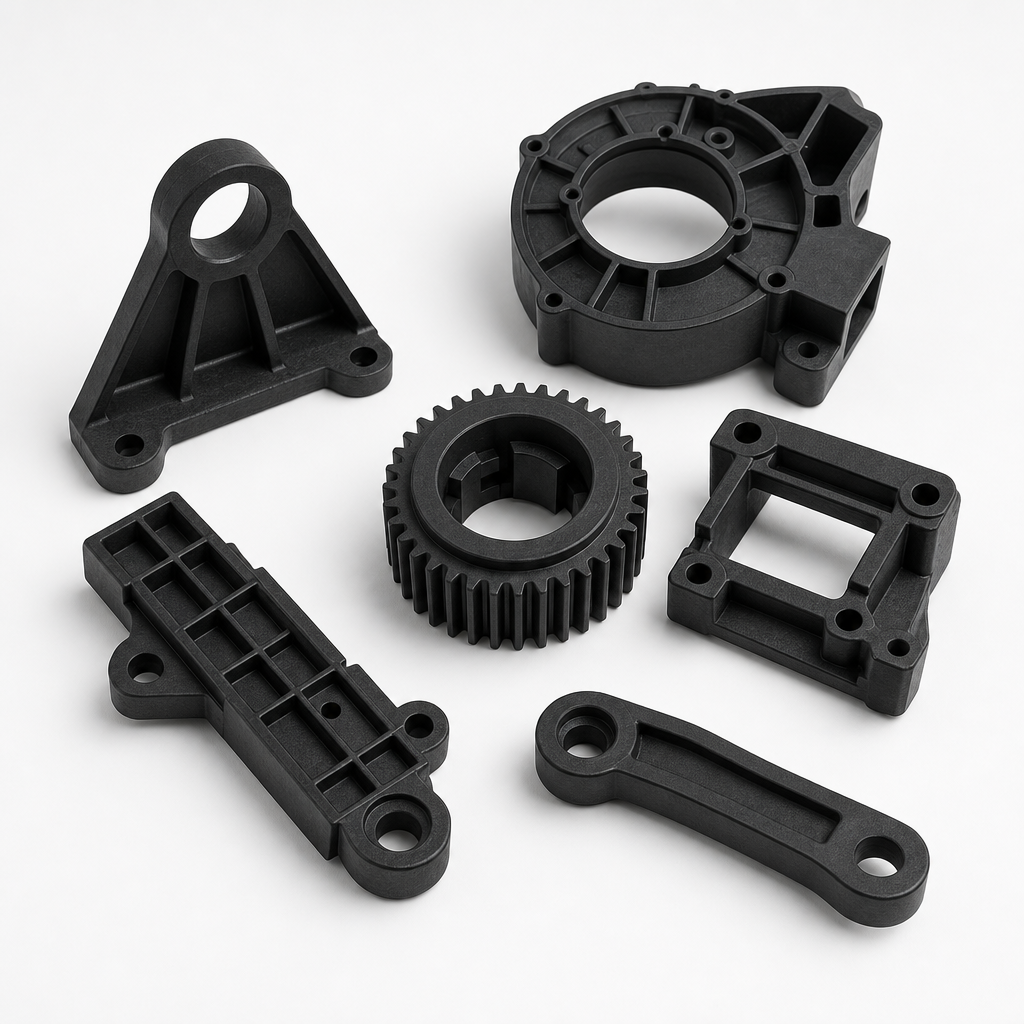
But glass fibers are a double-edged sword: they make nylon anisotropic (strength varies with flow direction), abrasive to molds and tooling, and more brittle at low temperatures. This guide covers the grades, design rules, and processing considerations that separate a reliable GF nylon part from one that fails at the knit line.
Glass Fiber Loading: What Each Percentage Delivers
PA66-GF15: Tensile 120-130 MPa, flex modulus 5-6 GPa. Best balance of toughness and stiffness. Used for clips, fasteners, and snap-fit components that need strength improvement without becoming too brittle. PA66-GF30: The industry workhorse. Tensile 165-185 MPa, flex modulus 8-9 GPa, HDT (1.82 MPa) 240-250 degree C. Used for intake manifolds, engine covers, structural brackets. PA66-GF50: Tensile 210-230 MPa, flex modulus 14-16 GPa. Approaching die-cast aluminum stiffness at one-third the weight. Used for structural mounts and high-load bearing applications. Trade-off: impact strength drops 40-50% versus GF30, and flowability decreases significantly.
Property Comparison by Glass Loading
| Property | PA66 Unfilled | PA66-GF15 | PA66-GF30 | PA66-GF50 | Aluminum (ref) |
|---|---|---|---|---|---|
| Tensile Strength (MPa) | 80-85 | 120-130 | 165-185 | 210-230 | 240-320 |
| Flexural Modulus (GPa) | 2.8-3.0 | 5.0-6.0 | 8.0-9.0 | 14.0-16.0 | 70 |
| HDT @ 1.82 MPa (deg C) | 70-80 | 230-240 | 240-250 | 250-255 | N/A |
| Notched Izod (kJ/m2) | 4-6 | 5-7 | 8-12 | 10-14 | N/A |
| Density (g/cm3) | 1.14 | 1.23 | 1.37-1.38 | 1.55-1.57 | 2.70 |
| Mold Shrinkage (%) | 1.5-2.0 | 0.4-0.8 | 0.2-0.6 | 0.1-0.3 | N/A |
| CTE (10^-6/deg C) | 70-90 | 30-40 | 20-30 | 15-20 | 21-24 |
Fiber Orientation: The Hidden Design Variable
Glass fibers align with the melt flow direction during injection, creating anisotropic mechanical properties. A PA66-GF30 tensile bar tested parallel to flow direction shows 180 MPa; the same material tested perpendicular to flow shows 80-100 MPa – a 45-55% reduction. This anisotropy must be accounted for in part design and FEA analysis. Design implication: orient the part in the mold so that the primary load path aligns with the flow direction. Use multiple gates to control fiber orientation when loads are multi-axial, but be aware that knit lines (where flow fronts meet) contain no fiber bridging and have only 50-60% of the base strength.
Design Rules for Glass-Filled Nylon
- Account for anisotropic shrinkage: GF nylon shrinks 2-4x more in the transverse direction than along flow. A 100 mm feature parallel to flow may shrink 0.3 mm; the same feature perpendicular may shrink 1.0 mm. Apply different shrinkage factors for flow and transverse directions in mold design, or use mold flow simulation to predict differential shrinkage.
- Avoid sharp corners at knit lines: Knit lines in GF nylon contain no fiber bridging – the two flow fronts meet with only matrix polymer at the interface. A radius of 0.5 mm minimum at knit line locations reduces stress concentration from Kt=3-4 down to Kt=1.5-2. Move knit lines away from high-stress areas by repositioning gates.
- Specify hardened mold steel: GF30 and above is abrasive. P20 steel (HRC 28-32) wears measurably after 50,000-100,000 shots. Use H13 (HRC 48-52) or D2 (HRC 58-62) for cavities expected to exceed 100,000 cycles. For GF50, even H13 shows wear at 50,000 cycles – consider stainless steel with nitriding or hard chrome plating on wear surfaces.
- Design for warpage control: The differential shrinkage between flow and transverse directions causes GF nylon parts to warp. Three countermeasures: (1) Uniform wall thickness (plus or minus 15% maximum variation). (2) Balanced filling with symmetric gate locations. (3) Cooling channels positioned for uniform temperature across the cavity. Mold flow simulation is strongly recommended for GF30+ parts with wall sections over 2 mm.
- Gate location determines part strength: Position gates to align fiber orientation with primary load paths. Edge gates produce unidirectional orientation parallel to flow; fan gates produce radial orientation – choose based on whether loads are uniaxial or multi-axial. A poorly placed gate that creates a knit line at a load-bearing boss can reduce local strength by 50% versus the datasheet value.
- Moisture conditioning still matters: GF nylon absorbs less moisture than unfilled (1.5-2.5% vs 2-8% at saturation) because glass fibers displace hygroscopic polymer. But the PA66 matrix still absorbs water and swells – dimensional change is roughly proportional to the nylon fraction by volume. A GF30 part (70% nylon by volume) experiences roughly 70% of the moisture expansion of an unfilled part. Condition GF nylon parts to equilibrium moisture before critical dimensional inspection.
Industry Application Matrix
| Industry | Typical Parts | Material/Grade | Key Requirement |
|---|---|---|---|
| Automotive | Intake manifolds, engine covers, radiator end tanks, mirror housings | PA66-GF30 | 250 deg C HDT, glycol resistance, weld-line strength |
| Power Tools | Housings, gear cases, handle frames | PA6-GF30 | Impact at -20 deg C, vibration damping, UL 94 HB |
| Industrial Equipment | Pump housings, structural brackets, conveyor components | PA66-GF50 | Creep resistance under sustained load, chemical exposure |
| Consumer Goods | Appliance structural frames, furniture mechanisms | PA6-GF15 or GF30 | Cost-to-strength ratio, colorability, tactile feel |
Cost Decision Framework
Material cost: PA66-GF30: $4.50-7.00/kg (vs $3.00-4.50 for unfilled PA66). PA66-GF50: $6.00-9.00/kg. The glass fiber premium is 50-100% over unfilled, but the strength improvement is 100-150% – the strength-per-dollar ratio actually improves with GF content for load-bearing parts.
Processing cost: GF grades require 10-20 deg C higher melt temperatures, slightly longer cycle times, and more frequent screw/barrel replacement (every 500-1,000 tons of material vs 2,000-3,000 for unfilled). The mold steel upgrade (P20 to H13) adds $2,000-8,000 to mold cost but is essential for volumes above 100,000.
Decision rule: Start with GF15 if the part needs better stiffness than unfilled but must retain toughness (snap-fits, clips). Use GF30 as the default structural grade – it is the most widely available and best-characterized. Reserve GF50 for parts where stiffness is the primary design driver and impact requirements are secondary. Consider that GF50 poor flow may require larger gates and thicker walls, partially offsetting the stiffness advantage.
Common Defects and Solutions
| Defect | Appearance | Root Cause | Solution |
|---|---|---|---|
| Warpage / bowing | Part curves or twists | Anisotropic shrinkage: flow vs transverse | Gate centrally for symmetrical fill; use mold flow analysis; uniform cooling |
| Knit line weakness | Part cracks at flow-front meeting line | No fiber bridging; stress concentration | Move gate to relocate knit line; add radius over 0.5mm; increase melt temp 10-15 deg C |
| Surface glass fiber appearance | Visible fibers on part surface; roughness | Low mold temperature; high fiber content at surface | Increase mold temp to 120-140 deg C; use fast fill speed; GF15 max for cosmetic surfaces |
| Mold wear / erosion | Cavity dimensions growing; flashing increasing | Glass fiber abrasion on P20 steel | Upgrade to H13 or D2 steel; hard chrome plate gate area; inspect after 50K shots |
Frequently Asked Questions
When should I choose CNC machining over injection molding?
Choose CNC when: (1) Quantity is under 250-500 pcs – the mold cost dominates and CNC is cheaper in total. (2) You need parts in under 2 weeks – CNC delivers in 3-10 days versus 3-8 weeks for molding. (3) The design is not yet finalized – CNC lets you iterate without tooling modification cost. (4) Tolerances must be tighter than plus or minus 0.10 mm. (5) The part is very large (over 500 mm) or requires complex 3D surfaces that would need expensive mold side actions. (6) Annual volume stays below 500 pcs ongoing – the mold never amortizes.
What is the cost break-even volume between CNC and injection molding?
For a typical palm-sized part (50-100g): break-even is between 250 and 1,000 pcs. A simple part with a $5,000 mold breaks even at roughly 150 pcs. A complex part with a $30,000 mold breaks even at roughly 2,000 pcs. Use the formula: Break-even Q = Mold cost / (CNC unit cost – IM unit cost). For quick estimates: if the mold costs $10,000, CNC unit cost is $25, and IM unit cost is $2, the break-even is 10,000/(25-2) = 435 parts. Below this number, CNC is cheaper; above it, injection molding is cheaper. The formula accounts for all variables and takes 30 seconds to calculate.
Which process produces more precise parts – CNC or injection molding?
CNC machining produces more dimensionally precise parts in nearly all cases: plus or minus 0.05-0.10 mm typical versus plus or minus 0.10-0.30 mm for injection molding. However, injection molding produces more consistent parts batch-to-batch – once the mold is qualified, every shot is nearly identical. CNC parts vary with setup, tool wear, and operator. For absolute dimensional accuracy on a single part: CNC wins. For part-to-part consistency at volume: injection molding wins. The ideal combination: injection mold to near-net shape, then CNC machine only the critical tolerance features.
Can I combine CNC machining and injection molding on the same part?
Yes – this is called hybrid manufacturing and it is widely used in automotive, medical, and industrial applications. The most common approach: injection mold the part blank with all cosmetic surfaces, thin walls, and fine details, then CNC machine only the critical tolerance features – bearing seats, seal faces, flatness-critical mounting surfaces. The molded blank costs $1-3, and the machining adds $2-8 for the precision features. Total per part: $3-11 versus $15-50 for full CNC or plus or minus 0.15 mm tolerance from molding alone. This approach is standard for high-volume precision components and worth considering any time you need molding economics with machining precision.
Related Reading
Compare CNC and Injection Molding for Your Part
When comparing CNC machining vs injection molding, use the same drawing, functional requirements and demand forecast. Nylon Plastic can review a machined prototype, molded production or a molded part with selected machined features as one project.
What to include and agree before quotation
- Provide CAD and revision, resin grade or permitted alternative, initial quantity, annual demand, repeat-order pattern and expected design changes.
- Mark critical fits, cosmetic zones, inserts and assembly features. State temperature, moisture, chemicals, load and the material or conditioning state used for approval.
- Ask each route to identify stock or resin, fixtures or tooling, sample stages, correction assumptions, secondary operations, inspection and packaging.
- Define tool ownership, transfer and maintenance scope where relevant, and who accepts the prototype, mold samples and recurring parts.
Manufacturing and delivery:
- Precision Manufacturing: 30+ CNC & injection molding cells under one roof
- ISO 9001:2015 Certified: Certified quality system, full inspection reports
- 15-25 Day Lead Time: Fast turnaround with expedited options available
- Global Shipping: Air & sea freight to North America, Europe, Asia
A useful comparison is total project cost under common assumptions, including design changes and sample acceptance. A universal quantity threshold cannot replace a part-specific quotation.