Plastic parts do not hold tolerances like metal parts – and expecting them to is the single most common cause of production delays, cost overruns, and supplier disputes in injection molding and CNC machining. A turned aluminum part can reliably hold plus or minus 0.025 mm; an injection molded PA66 part in the same geometry will struggle to hold plus or minus 0.15 mm once moisture conditioning, mold wear, and process variation are factored in.
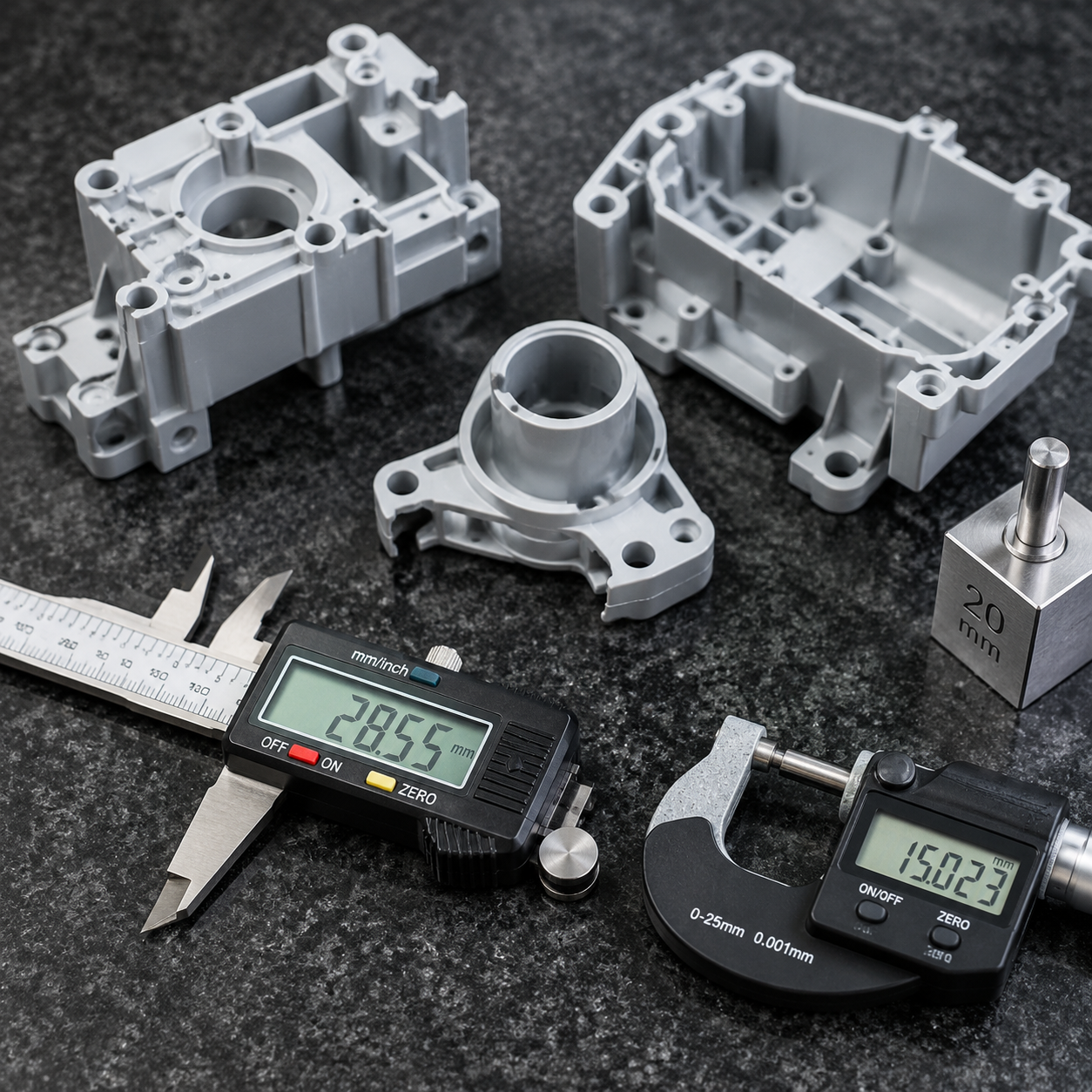
This engineering tolerance guide connects material movement, manufacturing route and the functional drawing. The original tables below are planning examples, not guaranteed acceptance limits or a substitute for the specified standard and edition. Confirm the exact grade, geometry, measurement condition and validated process capability before quotation.
Tolerance Capability by Manufacturing Process
| Process | Typical Tolerance | Best Case | Worst Case | Key Limiting Factor |
|---|---|---|---|---|
| CNC Machining (plastic) | plus or minus 0.05-0.10 mm | plus or minus 0.025 mm | plus or minus 0.25 mm | Thermal expansion during cutting |
| CNC Machining (metal) | plus or minus 0.025-0.05 mm | plus or minus 0.005 mm | plus or minus 0.15 mm | Tool deflection |
| Injection Molding (unfilled) | plus or minus 0.10-0.30 mm | plus or minus 0.05 mm | plus or minus 0.50 mm | Shrinkage variation 0.1-0.3% |
| Injection Molding (GF30) | plus or minus 0.08-0.20 mm | plus or minus 0.05 mm | plus or minus 0.40 mm | Anisotropic shrinkage; mold wear |
| 3D Printing (SLS nylon) | plus or minus 0.15-0.30 mm | plus or minus 0.10 mm | plus or minus 0.50 mm | Layer resolution; powder bed shrinkage |
| 3D Printing (SLA resin) | plus or minus 0.10-0.20 mm | plus or minus 0.05 mm | plus or minus 0.30 mm | Post-cure shrinkage; support marks |
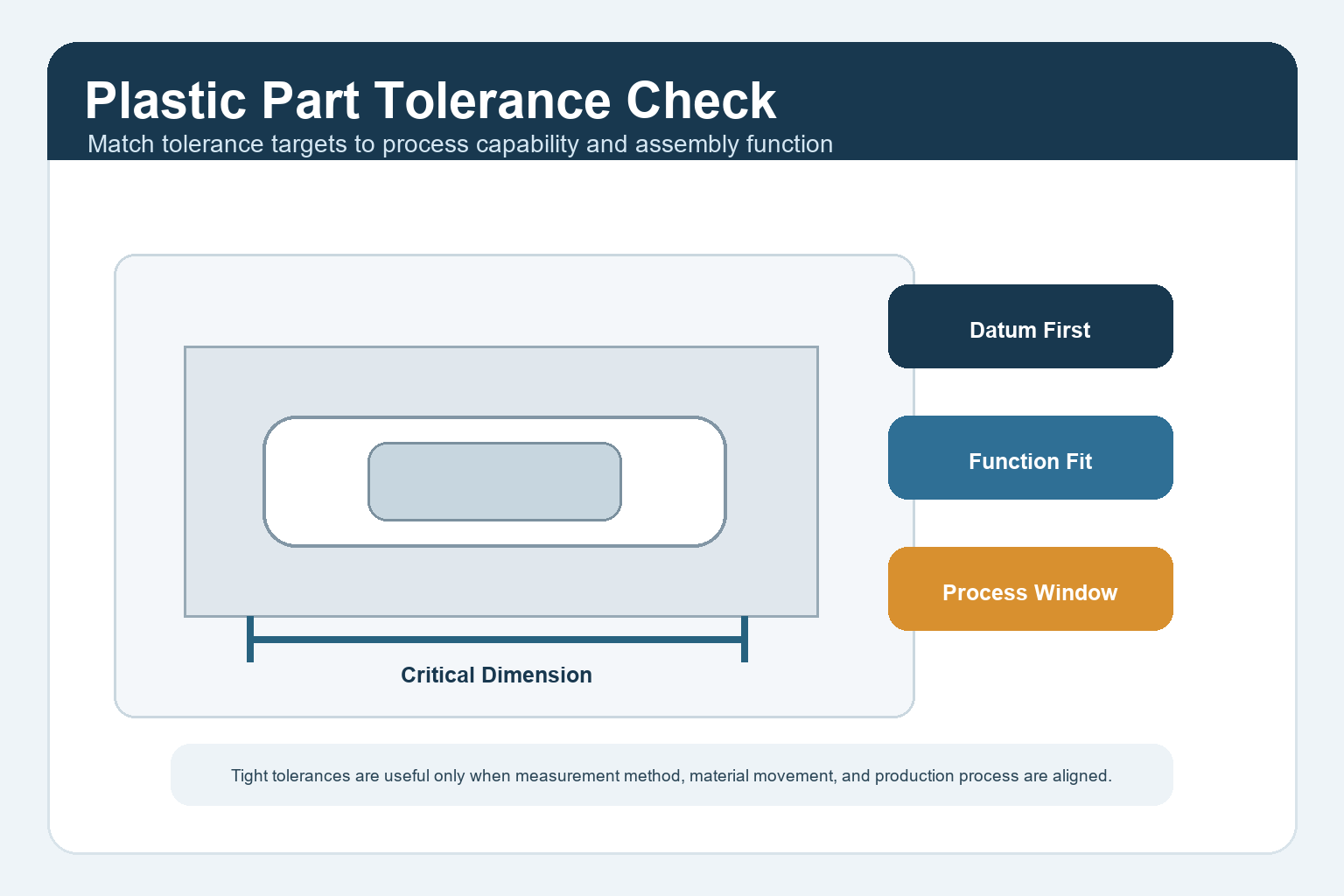
For machined features, review the 3-axis CNC machining guide alongside the process capability and inspection requirement.
Material-Specific Tolerance Guidance
Not all plastics are created equal when it comes to dimensional stability. The key differentiators are: shrinkage (higher = wider tolerance band), moisture absorption (nylon swells, PP does not), and coefficient of thermal expansion (CTE) (determines how much a part changes size between molding and room temperature). The table below shows realistic tolerance expectations for a 100 mm long feature in a well-designed production mold.
| Material | Tolerance (100mm feature) | Shrinkage Range | CTE (10^-6/deg C) | Moisture Effect |
|---|---|---|---|---|
| ABS (unfilled) | plus or minus 0.08-0.15 mm | 0.4-0.7% | 70-90 | Minimal (under 0.1%) |
| PC (unfilled) | plus or minus 0.08-0.15 mm | 0.5-0.7% | 65-70 | Minimal (under 0.15%) |
| PA66 (unfilled, dry) | plus or minus 0.12-0.25 mm | 1.5-2.0% | 70-90 | +0.5-1.5% dimension at 50% RH |
| PA66-GF30 | plus or minus 0.08-0.18 mm | 0.2-0.6% | 20-30 | +0.3-0.8% (reduced by glass content) |
| PP (unfilled) | plus or minus 0.15-0.35 mm | 1.0-2.5% | 100-150 | Negligible |
| POM (Delrin, acetal) | plus or minus 0.08-0.20 mm | 1.8-2.5% | 100-120 | Minimal (under 0.2%) |
| PEEK (unfilled) | plus or minus 0.10-0.20 mm | 1.0-1.5% | 47-55 | Minimal (under 0.1%) |
DIN 16901 and Current Molded-Part Tolerance Specifications
DIN 16901:1982-11 is withdrawn; DIN Media recommends DIN 16742:2013-10 for its former users. The current international molded-part document is ISO 20457:2026, which covers dimensional and geometrical tolerances and acceptance conditions. Specify the standard, edition and applicable requirements with the supplier rather than automatically putting a legacy DIN number on a new drawing.
For an existing drawing that calls up DIN 16901, preserve the contractual reference until the customer and supplier agree a revision. The old example for a 100 mm feature and approximately plus or minus 0.18 mm should be read as a historical comparison, not a current ISO tolerance assignment or a guarantee for unfilled PA66. See DIN Media’s DIN 16901 status and ISO 20457:2026.
Design Rules for Plastic Tolerances
- Specify tolerances only where needed: Do not apply blanket tolerances to entire parts. Every tolerance on a drawing costs money – the mold maker must hold it, the molder must verify it, and both will charge for it. Agree the applicable standard and edition for non-functional features and specify tolerances for bearing fits, seal surfaces and assembly interfaces. For molded parts, review the molded-part standard and supplier capability rather than treating a machined-part general tolerance as automatically achievable.
- Add 0.05 mm per 100 mm for moisture-sensitive materials: Nylon (PA6/PA66) parts change dimension by 0.5-1.5% between dry-as-molded and 50% RH equilibrium. A 100 mm PA66 feature that measures 100.00 mm fresh from the mold will measure 100.50-101.50 mm after conditioning. Either specify the measurement condition (dry or conditioned) or widen the tolerance to absorb the moisture effect.
- Mold tolerance is not part tolerance: A mold cavity machined to plus or minus 0.01 mm will not produce parts at plus or minus 0.01 mm. The molding process adds variation from: shrinkage (1-2% of dimension), mold temperature fluctuations (plus or minus 3 deg C = plus or minus 0.03 mm on 100 mm), and packing pressure variations. Budget 3-5x the mold tolerance for the final part tolerance.
- Critical tolerances go near the gate: Dimensions closer to the gate see higher packing pressure and lower shrinkage variation. A 100 mm long part with tolerance-critical features at the far end (opposite the gate) will have 2-3x the dimensional variation of the same features located near the gate. Design the gate location to feed critical features first.
- Account for mold wear over life: Mold cavities erode 0.001-0.003 mm per 10,000 shots for unfilled plastics, and 0.005-0.015 mm per 10,000 shots for glass-filled grades. Over a 200,000-shot life, GF30 can open a cavity by 0.1-0.3 mm. Design to the middle of the tolerance band at mold launch so the part stays in-spec as the cavity wears toward the upper limit.
- GD&T for plastics: use profile, not position: Plastic parts flex, shrink unevenly, and have draft angles. True position (plus or minus circular zone) is physically meaningful for rigid metal parts but not for a molded plastic boss that tilts after ejection. Use surface profile tolerances instead – they define a 3D zone the surface must lie within without assuming it is perfectly oriented. Concentricity and symmetry should be avoided entirely on plastic parts; they are not physically verifiable on non-rigid parts.
Functional Tolerance and Acceptance Plan
Plastic-part tolerances should be assigned from function, not by applying the tightest drawing value to every feature. A useful tolerance plan identifies the mating condition, functional datum, material state, service temperature and inspection method before the tool is released. This separates dimensions that control assembly or sealing from cosmetic variation that does not affect performance.
| Feature type | Primary control | Acceptance question | Evidence to request |
|---|---|---|---|
| Mounting holes | Position to functional datums, size and perpendicularity | Will the mating part assemble without forcing the hole pattern? | Datum-based dimensional report and functional assembly check |
| Sealing face | Flatness, profile, surface finish and seal compression | Will the seal remain effective after temperature and pressure cycling? | Profile or flatness data plus the agreed leak or pressure test |
| Snap-fit or latch | Clearance, deflection, return force and fatigue | Does the feature work across resin, temperature and moisture variation? | Force/displacement test in the specified conditioning state |
| Bearing or shaft bore | Size, roundness, position and surface condition | Is clearance valid at assembly and service temperature? | Conditioned bore measurement and mating-component fit check |
| Cosmetic surface | Texture, gloss, flash boundary and color uniformity | Which variation is visible, and which is functionally harmless? | Approved limit sample, viewing condition and cosmetic-zone drawing |
During sample approval, record actual values by cavity and define whether parts are measured dry as molded, after conditioning or at a controlled laboratory state. For critical dimensions, request a short-run capability study after the process window is stable. Measurement equipment and fixtures should be appropriate to the tolerance and the flexibility of the part; detailed method selection remains covered by the separate plastic-parts inspection and metrology guide.
Specify appearance separately from dimensional acceptance using the SPI surface finish guide.
Industry Application Matrix
| Industry | Typical Parts | Material/Grade | Key Requirement |
|---|---|---|---|
| Medical Devices | Syringe plungers, luer fittings, inhaler bodies | plus or minus 0.05-0.10 mm on critical seals | ISO 13485; functional rather than dimensional validation |
| Automotive | Connector housings, sensor brackets, fluid fittings | plus or minus 0.10-0.20 mm | Temperature range -40 to +120 deg C; must fit after thermal cycling |
| Consumer Electronics | Phone cases, laptop housings, wearable bands | plus or minus 0.08-0.15 mm on cosmetic gaps | Gap-and-step visible quality metric; 0.1 mm gap visible to user |
| Industrial Equipment | Gear housings, bearing seats, pump bodies | plus or minus 0.10-0.25 mm | Must maintain fit after oil/chemical exposure and temperature cycling |
Cost Decision Framework
Tolerances drive mold cost non-linearly: A mold designed for plus or minus 0.20 mm might cost $12,000. The same part geometry tightened to plus or minus 0.10 mm adds $5,000-8,000 for higher-precision machining, hardened steel, and conformal cooling. Tightening further to plus or minus 0.05 mm adds another $8,000-15,000 – bringing the total to 2-3x the cost for a 4x tighter spec.
The process trade-off: If the part truly needs plus or minus 0.05 mm or better, injection molding may be the wrong process. CNC machining from plastic stock achieves plus or minus 0.05 mm at lower tooling cost ($0 mold, $15-50/part machining) for volumes under 500. Above 5,000 pcs, the per-part machining cost usually exceeds the amortized mold cost.
Decision rule: Design parts at plus or minus 0.15 mm for injection molding as the baseline. Tighten only the features that absolutely require it – bearing seats, seal grooves, snap-fit engagement surfaces. Each tightened tolerance adds cost; each unnecessary tolerance guarantees disputes.
Common Defects and Solutions
| Defect | Appearance | Root Cause | Solution |
|---|---|---|---|
| Out-of-tolerance after conditioning | Part measures in-spec dry but out-of-spec after moisture | Nylon absorbed 1.5-2.5% moisture, swelling 0.5-1.5% | Specify conditioning before measurement; widen tolerance or use GF grade |
| Mold shrinkage variation | Cavity-to-cavity or shot-to-shot variation over 0.1 mm | Process instability: melt temp plus or minus 5 deg C, hold pressure drift | Stabilize process within plus or minus 3 deg C and plus or minus 50 PSI; add SPC on critical dimensions |
| Warpage causing out-of-spec | Part twists after ejection, dimensions shift | Differential cooling; anisotropic GF orientation | Use mold flow analysis; balance cooling; reposition gates for symmetric fill |
| Tool wear exceeding tolerance | Cavity dimensions growing over production run | GF abrasion on soft steel; high injection velocity at gate | Upgrade to H13/D2; hard chrome wear surfaces; monitor every 25K shots |
Frequently Asked Questions
What is the tightest achievable tolerance for plastic injection molded parts?
For unfilled amorphous materials (ABS, PC) on a well-designed mold: plus or minus 0.05 mm is achievable on features under 50 mm near the gate. For semi-crystalline materials (PA66, POM, PP): plus or minus 0.08-0.10 mm is the practical floor. These numbers assume: hardened mold steel (H13+), tight process control (plus or minus 3 deg C, plus or minus 50 PSI), and measurement at a defined moisture content. Commercial molding at competitive prices should budget plus or minus 0.15 mm as the standard tight tolerance – anything tighter requires negotiation, higher cost, and documented capability studies.
Why are plastic tolerances wider than metal tolerances?
Three physical reasons: (1) Shrinkage – plastics shrink 0.5-2.5% during cooling, and that shrinkage varies with process parameters and part geometry. Metals shrink far less and at a consistent rate. (2) Moisture absorption – nylon absorbs 2-8% water by weight, swelling 0.5-1.5% in dimension. Metals do not absorb water. (3) Viscoelasticity – plastics creep under load and relax after ejection. A molded plastic part measured 5 minutes after ejection will measure differently 24 hours later as internal stresses relax. None of these three factors apply to metals in the same magnitude.
Can I use GD&T (geometric dimensioning and tolerancing) on plastic parts?
Yes. Use datums and geometric requirements that describe the assembly function, and agree how a flexible part is supported or restrained during measurement. Specify temperature, moisture conditioning and time after manufacture where they affect acceptance. Identify the drawing standard and edition; use the applicable molded-part tolerance specification alongside the agreed geometric controls. DIN 16901 is a legacy reference, not an automatic requirement for a new drawing.
Do different plastic materials require different tolerance expectations?
Yes, significantly. Amorphous plastics (ABS, PC, PS) shrink less and more uniformly than semi-crystalline plastics (PA, PP, POM, PEEK). For the same 100 mm feature, ABS can hold plus or minus 0.08-0.15 mm while unfilled PP needs plus or minus 0.15-0.35 mm. Glass-reinforced grades shrink less but more anisotropically – the flow-direction tolerance may be tighter than unfilled while the cross-flow tolerance is wider. Nylon adds moisture-driven dimensional change that must be accounted for regardless of glass content. Always specify tolerances by material, not as a blanket note – the supplier needs to know which material the tolerance applies to.
Related Reading
Request a Plastic Part Tolerance Review
Use this engineering tolerance guide with a controlled drawing before prototype approval, mold release or production quotation. Nylon Plastic can review which fits are critical, how the part will be measured and which material and manufacturing route should be quoted.
What to include and agree before quotation
- Part definition: 2D drawing or CAD, revision, nominal dimensions, functional interfaces and the features that control assembly.
- Material and condition: Resin family or exact grade, reinforcement, dry or conditioned state, service temperature, humidity and chemical exposure.
- Process and project stage: CNC machining, prototype, new mold or molded production, plus tool status, sample stage and required quantity.
- Acceptance requirements: Datums or GD&T, critical dimensions, mating-part checks, measurement condition, sampling and required inspection records.
- Specify the drawing standard and edition, free-state or restrained inspection, functional stack-up, part age and conditioning procedure. Agree capability evidence and the sample approval stage before production.
The review can identify drawing clarifications, material or process risks, measurement assumptions and quotation scope. Final capability requires part-specific validation at the agreed sample stage; a general tolerance table is not a guarantee for every feature.