Introduction to Chamfer and Fillet Design
Chamfer vs fillet decisions affect moldability, stress concentration, assembly fit, and part durability in plastic components.
Chamfers and fillets are the most ubiquitous geometric features in injection-molded part design, yet they are among the least systematically specified. A chamfer—a flat, angled cut replacing a sharp 90° corner—and a fillet—a concave or convex radius transition—each serve distinct mechanical, manufacturing, and assembly functions that cannot be swapped without consequence. In a 2023 survey of mold flow analysis reports across 500+ production molds, improperly specified corner transitions ranked as the third most common root cause of part rejection, behind only sink marks and short shots. The financial impact is measurable: sharp internal corners increase mold steel stress concentrations by 3–5×, driving up tool maintenance frequency and reducing cavity life from a typical 500,000–1,000,000 shots to as few as 50,000 shots before crack initiation.
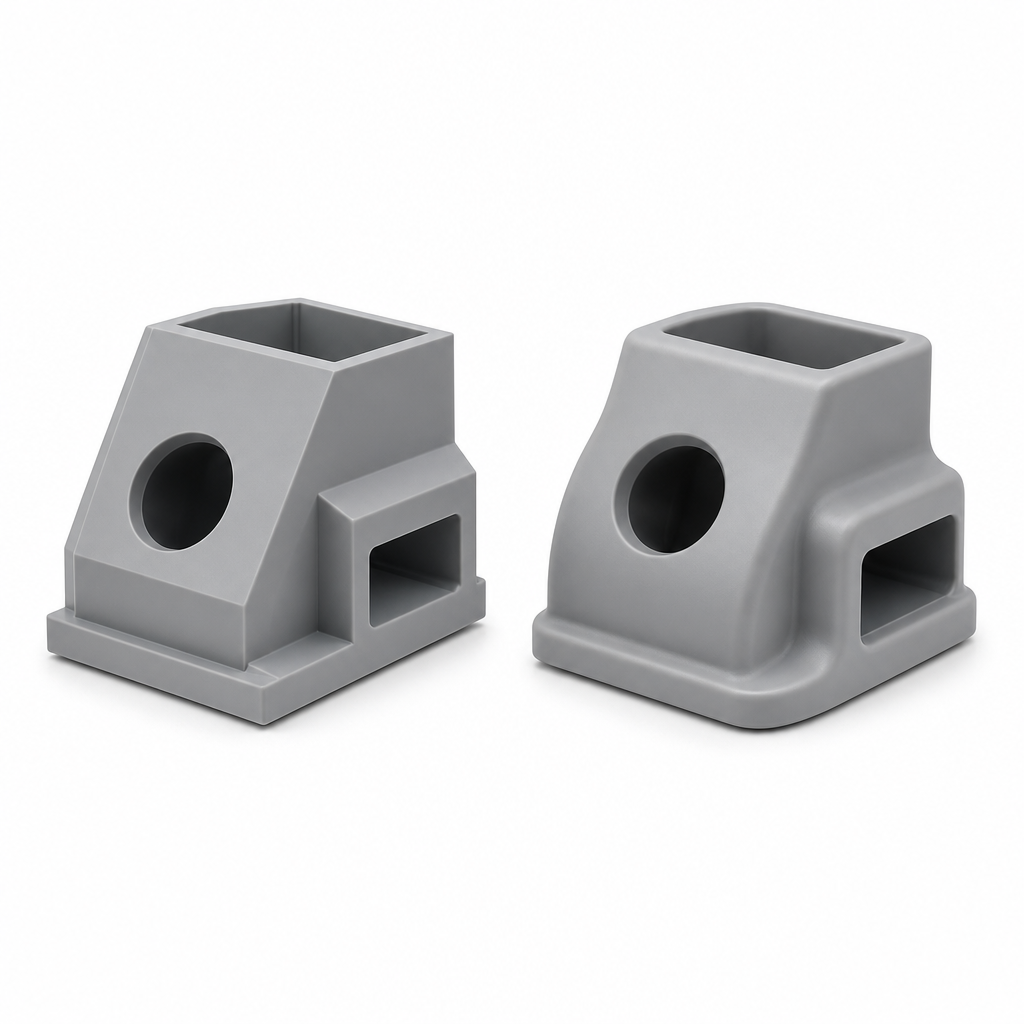
This guide provides a structured, quantitative approach to chamfer and fillet specification for injection-molded parts. We examine the stress concentration mechanics that govern fillet sizing, the mold flow and demolding forces that dictate chamfer placement, and the critical interactions with draft angles that determine whether your part releases cleanly from the tool or requires a hammer and colorful language. By the end, you will have a rules-based framework and reference tables that eliminate the guesswork from rounding corners—literally and figuratively.
When to Use a Chamfer vs. a Fillet
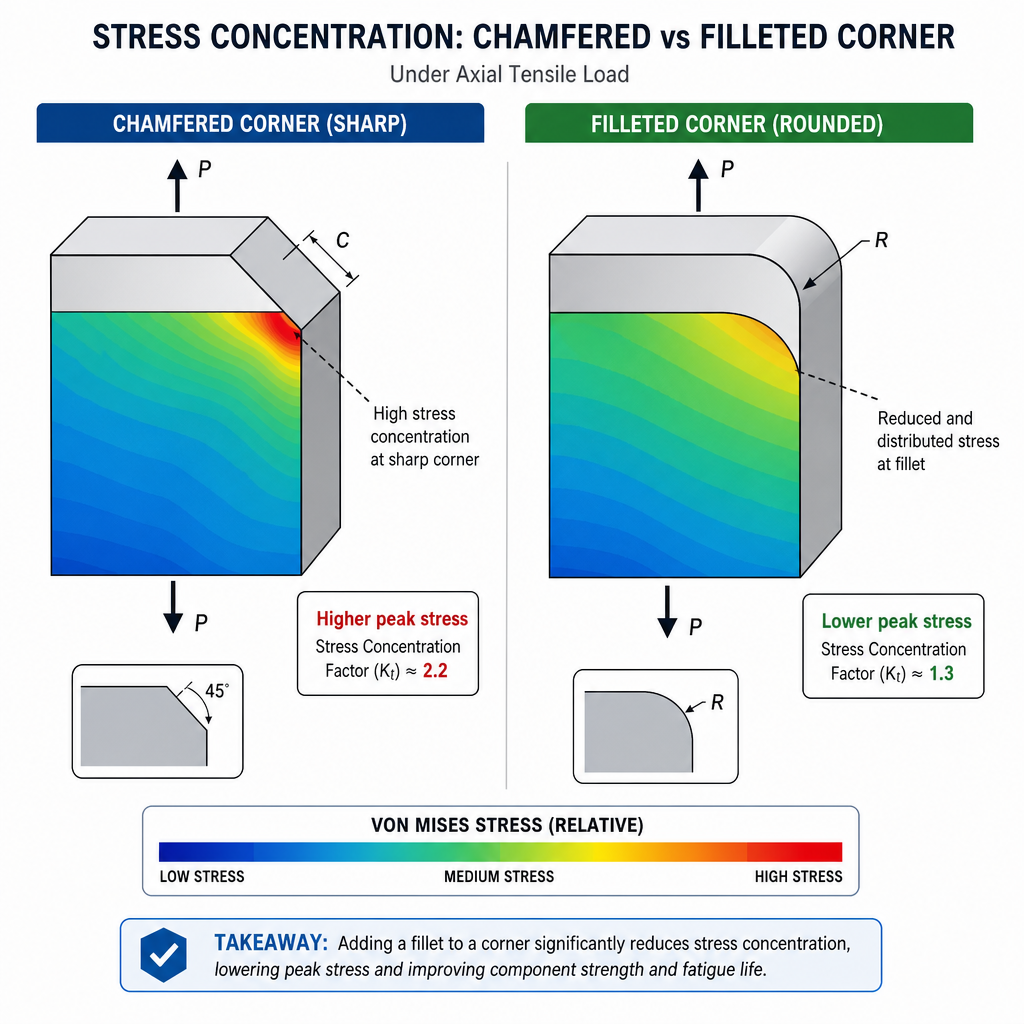
The decision between chamfer and fillet hinges on the function the corner must perform. Fillets (rounded transitions) are the default choice for internal corners subjected to mechanical load, because the smooth radius distributes stress over a larger cross-sectional area, reducing the stress concentration factor (Kt) from 3.0–5.0 for a sharp corner to 1.2–1.8 for a properly sized fillet. Fillet radii should be specified as a function of the adjacent wall thickness: a minimum of 0.5× wall thickness for internal corners and 0.25× wall thickness for external corners is the industry-standard starting point. For cyclically loaded features such as snap-fit roots and living hinges, internal fillet radii of 0.6–1.0× wall thickness are recommended to suppress crack initiation at cycle counts above 10⁵.
Chamfers (angled flats) serve three distinct purposes that fillets cannot replicate: (1) lead-in for assembly—a 30°–45° chamfer on a pin or boss entry face reduces the insertion force by 50–70% compared to a square edge by providing a self-centering ramp; (2) mold parting line cleanup—a 0.5–1.0 mm × 45° chamfer at the parting line masks the inevitable flash witness line (typically 0.03–0.08 mm) that would otherwise be visible as a cosmetic defect; and (3) ejector pin pad relief—a 0.3–0.5 mm chamfer on the edge of an ejector pad prevents the pad from digging into the cavity steel during the ejection stroke. Chamfers are also preferred over fillets when the corner must provide a defined, non-rolling reference surface for automated assembly fixturing or optical alignment, where a radius would create positional ambiguity.
For a clip or enclosure joint, compare the corner decision with the assembly requirements in the snap-fit design guide.
Stress Concentration Factors: The Quantitative Case for Fillets
The stress concentration factor Kt quantifies how much a geometric discontinuity amplifies the nominal stress in a loaded component. For a sharp 90° internal corner in a plastic part under tensile or bending load, Kt values range from 3.0 to 5.0 depending on the exact geometry, meaning the local stress at the corner tip is 3–5× the average stress calculated from the net cross-sectional area. For amorphous thermoplastics such as PC and PMMA, which exhibit limited plastic yielding before brittle fracture, this amplification directly translates to a proportional reduction in load-carrying capacity—a sharp-cornered PC bracket that FEA predicts will hold 200 N based on bulk material properties may actually crack at 40–67 N due to the stress concentration.
Introducing a fillet radius (r) equal to the wall thickness (t) reduces Kt to approximately 1.3–1.5, recovering roughly 70% of the lost strength. The relationship follows a diminishing-return curve: increasing r/t from 0 to 0.5 drops Kt from ~3.5 to ~1.6 (a 54% reduction), while increasing r/t from 0.5 to 1.0 drops Kt from ~1.6 to ~1.3 (only a 19% further reduction). The practical design implication: specify r/t ≥ 0.5 for structural features, and r/t ≥ 0.75 for fatigue-loaded features. Below is the relationship in tabular form for injection-molded ABS (yield strength 45 MPa) as a representative case:
| r/t Ratio | Kt (Tension) | Kt (Bending) | Effective Strength (% of Bulk) | Recommended Application |
|---|---|---|---|---|
| 0 (sharp) | 3.5–5.0 | 3.0–4.5 | 20–30% | Never for loaded features |
| 0.25 | 2.5–3.0 | 2.2–2.8 | 33–40% | Non-structural cosmetic parts |
| 0.50 | 1.6–2.0 | 1.5–1.8 | 50–62% | General structural features |
| 0.75 | 1.3–1.5 | 1.3–1.5 | 67–77% | Fatigue-loaded, snap-fits, living hinges |
| 1.00 | 1.2–1.35 | 1.2–1.35 | 74–83% | Critical safety components, high-cycle (>10⁶) |
Mold Flow Effects: How Corners Influence Fill and Part Quality
Internal fillets and chamfers are not merely stress management tools—they fundamentally affect the polymer melt flow during injection. A sharp internal corner creates a flow stagnation zone where the melt velocity drops to near zero, causing a local reduction in packing pressure of 20–40% compared to adjacent straight-wall sections. This under-packed region is the breeding ground for sink marks (visible on the opposite surface), voids (internal porosity exceeding 1% by volume), and residual stress concentrations that manifest as warpage after ejection. Computational fluid dynamics simulations run on typical ABS and PP mold filling show that a fillet radius of 0.5 mm increases the local flow velocity at the corner by 15–25% relative to a sharp corner, sufficient to eliminate the stagnation zone for part thicknesses up to 3 mm.
Chamfers interact with mold flow differently than fillets: the flat surface of a chamfer creates a more abrupt flow direction change than a radius, generating a shear rate spike of 2–4× the nominal value at the transition points where the chamfer meets the adjacent walls. For shear-sensitive materials—notably flame-retardant grades with brominated or phosphorus-based additives, and highly glass-filled compounds above 40% GF—this shear rate spike can cause localized material degradation (discoloration, molecular weight reduction, or additive decomposition) and should be mitigated by adding a small radius (r = 0.2–0.5 mm) at each end of the chamfer. This “radiused chamfer” hybrid approach preserves the functional flat lead-in surface while eliminating the high-shear discontinuities.
Draft Angle Interaction: The Hidden Dependency
Draft angles and corner features are deeply interdependent in injection mold design, yet they are often specified by different stakeholders at different stages of the design process—the product designer specifies the chamfer, and the tooling engineer specifies the draft, often without considering how the two interact. The fundamental rule: any surface that is parallel to the mold opening direction must have draft, including chamfered surfaces. A 45° chamfer on a vertical wall without draft will create an undercut that locks the part in the cavity, requiring a side action ($3,000–$8,000 per action) or, worse, manual extraction. The minimum draft on a chamfered surface is typically 0.5°–1° for the chamfer face itself, which translates to an effective draft on the boundary edges that depends on the chamfer angle.
For external chamfers intended to provide assembly lead-in, the draft must be applied such that the chamfer width at the parting line remains within ±0.1 mm of the nominal dimension to ensure consistent insertion force. This often requires specifying the chamfer dimension at the parting line as the reference dimension and allowing the dimension at the molded face (which varies with draft) to be a derived value. The interaction table below provides a quick reference for draft-chamfer compatibility:
| Feature Type | Draft Requirement | Min Feature at Parting Line | Side Action Needed? |
|---|---|---|---|
| External fillet (vertical wall) | 0.5°–1° on both faces | r ≥ 0.25 × wall thickness | No |
| Internal fillet (vertical wall) | 1°–2° on both faces | r ≥ 0.5 × wall thickness | No |
| Chamfer parallel to draw | 1°–2° draft angle | C ≥ 0.5 mm for cosmetic, C ≥ 1.0 mm for functional | No |
| Chamfer perpendicular to draw | Requires side action if internal | C ≥ 0.3 mm | Often |
| Bottom fillet (rib-to-wall) | 0.5° per face minimum | r = 0.25–0.40 × rib thickness | No |
Review core and cavity design when checking how the selected edge will be formed and released by the mold.
Six Design Rules for Chamfers and Fillets
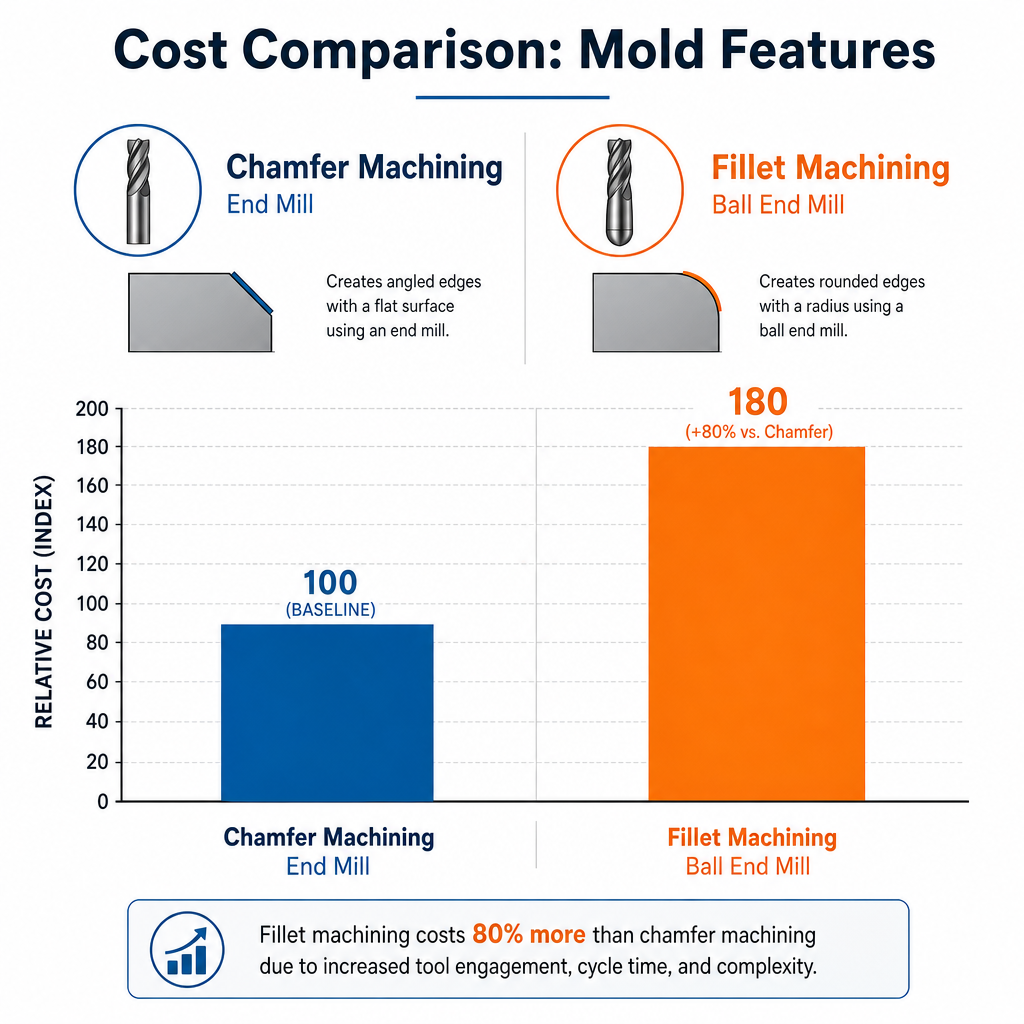
- Internal Corner Fillets: r ≥ 0.5 × t (minimum), r ≥ 0.75 × t (fatigue): Never leave internal corners sharp. The cost of a fillet in mold making is negligible (a ball end mill pass adds ~30 seconds of CNC time per corner), but the cost of a cracked tool or a fractured part from a sharp corner is measured in tens of thousands of dollars in mold repair and production downtime. For parts molded in PC, PS, or acrylic—which are notch-sensitive—use r ≥ 0.6 × t even for non-structural features.
- Assembly Lead-In Chamfers: 30°–45° with 0.5–1.5 mm Face Width: For pin-in-hole assemblies (clearance fit), a 30° chamfer provides the lowest insertion force. For boss-and-screw assemblies, a 45° chamfer with 0.5–1.0 mm face width is standard. For snap-fit lead-in angles, the chamfer angle should match the snap entry angle (typically 25°–30° for cantilever snaps) to avoid a step change in insertion force.
- Never Mix Fillets and Chamfers on the Same Edge Cascade: A sequence of edge treatments—for example, a fillet transitioning into a chamfer and back to a fillet—creates CAD tangency discontinuities that generate visible witness lines on the molded part and cause toolpath chatter during CNC finishing. Choose one edge treatment strategy per continuous edge chain and apply it consistently.
- External Corners Can Be Smaller Than Internal Corners: External fillets (on the outside of a boss or rib) need only r ≥ 0.25 × wall thickness because the stress concentration at an external corner is inherently lower (Kt ≤ 2.0 vs. Kt ≥ 3.0 for internal). However, never go below r = 0.25 mm for external fillets, as smaller radii are indistinguishable from sharp corners after mold polishing to SPI B-1 or finer.
- Specify the Fillet-to-Wall Tangent Transition Clearly: The point where a fillet tangent transitions into the straight wall is a common source of ambiguity. On the 2D drawing, dimension the fillet radius and add a note: “FILLET TANGENT TO ADJACENT SURFACES, BLEND SMOOTH ±0.1 mm.” This prevents the toolmaker from interpreting the fillet as a separate geometric element that stops short of tangency, creating a step in the steel.
- Chamfer the Parting Line, Not the Aesthetic Surface: If a chamfer is needed for mold parting line cleanup, apply it to the non-cosmetic (inside) surface whenever possible. An external chamfer at the parting line that varies in width by ±0.3 mm due to tool wear will be visible to the end user as a quality defect. An internal chamfer performing the same function is invisible and equally effective.
Use the plastic-part tolerance and inspection guide to define which edge dimensions need acceptance criteria.
Industry Application Matrix
| Industry | Primary Feature | Typical Specification | Critical Requirement |
|---|---|---|---|
| Consumer Electronics | External fillets, cosmetic chamfers | r = 0.5–2.0 mm, C = 0.3–0.5 mm × 45° | Uniform appearance, no witness lines, consistent surface finish |
| Automotive Interior | Assembly chamfers, structural fillets | C = 1.5–3.0 mm × 30°, r ≥ 0.6 × t | Low insertion force, squeak-and-rattle prevention, crash safety |
| Medical Devices | Internal fillets, lead-in chamfers | r ≥ 0.75 × t, C = 1.0–2.0 mm × 30° | Sterilizable, no particulate traps, biocompatible finish |
| Industrial Housings | Sealing chamfers, rib fillets | C = 0.5–1.0 mm, r = 0.4–0.6 × rib thickness | IP65/IP67 gasket seating, structural integrity at -20°C to +80°C |
Where the edge is also a cosmetic surface, specify the appearance reference using the SPI mold surface-finish guide.
Cost Decision Framework
How much do fillets and chamfers cost—and what do they save?
Adding fillets and chamfers to a mold design carries negligible incremental tooling cost—a ball end mill pass on a 3-axis CNC adds approximately $0.50–$2.00 per corner depending on corner depth, representing less than 0.5% of a typical $25,000–$60,000 mold. The cost of not including proper fillets is far higher: sharp internal corners increase mold steel stress by 3–5×, reducing cavity life from 500K–1M shots to as few as 50K shots and adding $5,000–$15,000 in unscheduled mold repair over the tool’s life. For the molded part, a well-filleted snap-fit design that survives 100K+ cycles versus a sharp-cornered design that fractures at 5K cycles can save $50,000–$250,000 in warranty claims for a mid-volume (100K units/year) consumer product.
Design investment vs. lifetime savings: Properly specified corner features add ~2–4 hours of engineering time per part ($300–$600 at standard rates) and return $5,000–$25,000 in avoided mold repair, reduced scrap (<0.5% vs. 3–5% for sharp-cornered molds), and eliminated warranty claims over a 5-year production run.
Chamfer & Fillet Troubleshooting Guide
| Problem | Likely Cause | Diagnostic Check | Corrective Action |
|---|---|---|---|
| Part cracking at internal corner | Fillet radius too small (r/t < 0.3) or stress concentration from sharp transition | Measure r/t ratio, run FEA at corner, review loading direction | Increase fillet to r ≥ 0.5× t immediately, r ≥ 0.75× t if cyclically loaded |
| Visible sink mark opposite chamfer | Chamfer creates local thick section exceeding 1.3× nominal wall | Measure wall thickness at chamfer root vs. nominal | Reduce chamfer width or add core-out behind chamfer to maintain uniform wall thickness |
| Difficulty ejecting part from mold | Insufficient draft on chamfered surface or fillet tangent face creating undercut | Measure draft angle, check for negative draft with mold flow analysis | Add 0.5°–1° draft to chamfer face, ensure fillet tangent face has positive draft throughout |
| Inconsistent assembly insertion force | Chamfer width variation exceeding ±0.15 mm due to draft or mold wear | Measure chamfer width at 8 points around circumference on 30 parts | Dimension chamfer at parting line as reference, tighten cavity tolerance to ±0.05 mm |
Frequently Asked Questions
What is the actual difference between a chamfer and a fillet?
A chamfer is a flat, angled cut that replaces a sharp 90° corner with a straight line, typically specified by its face width (0.5–3.0 mm) and angle (commonly 30°, 45°, or 60°). A fillet is a curved radius transition, specified by its radius value (r). Functionally, chamfers are linear features that provide lead-in or clearance; fillets are curved features that distribute stress. A chamfer cut at 45° with a 1 mm face width removes less material and creates less of a visual “rounding” effect than a fillet of radius 1 mm—the chamfer produces a beveled edge, while the fillet produces a smooth rolling corner. In injection molding, chamfers are preferred for parting lines and assembly interfaces; fillets are mandatory for internal corners subject to mechanical load.
Does adding a fillet really reduce stress in plastic parts?
Yes, and the effect is both well-characterized and quantitatively significant. For a loaded internal corner in a typical injection-molded thermoplastic, increasing the fillet radius from 0 (sharp) to 0.5× the wall thickness reduces the stress concentration factor (Kt) from 3.5–5.0 to 1.6–2.0—a stress reduction of 50–65%. In practical terms, this means a part that would crack at 10 N of load with a sharp corner can survive 25–30 N with a proper fillet. For cyclic loading, the fatigue life improvement is even more dramatic: a part with r/t = 0.75 can often survive 10× more cycles than one with r/t = 0.25 because crack initiation is delayed by the lower peak stress. This is not a marginal improvement—it is the difference between a part that fails during assembly testing and one that survives 10 years in the field.
What is the minimum fillet radius for injection molding?
The manufacturing minimum for a fillet radius in injection molding is approximately 0.1–0.2 mm—any smaller and the feature is indistinguishable from a sharp corner after mold polishing. However, the functional minimum is much larger: for structural features, use r ≥ 0.5× wall thickness; for non-structural internal corners, r ≥ 0.25 mm is acceptable for walls up to 2 mm; for cosmetic external corners, r ≥ 0.3–0.5 mm provides a visible “soft edge” that is expected in modern consumer products. Below r = 0.25 mm, the fillet may not form reliably during molding because the polymer melt cools and solidifies before completely filling the tiny radius, resulting in a truncated feature that looks sharp under magnification. For mold makers, an end mill of 0.5 mm diameter is the practical lower limit for cutting fillets into cavity steel without excessive tool breakage.
Should I use a chamfer or fillet for assembly lead-in features?
Use a chamfer (30°–45°, 0.5–1.5 mm face width) for assembly lead-in features. A chamfer provides a defined, linear ramp that guides the mating part into position with a predictable insertion force reduction of 50–70% versus a square edge. A fillet provides a curved lead-in surface that creates a non-linear force ramp—the contact point shifts along the radius during insertion, making the insertion force profile harder to predict and control for automated assembly. However, add a small radius (r = 0.2–0.3 mm) at the transition where the chamfer meets the straight wall to eliminate the sharp edge that would otherwise create a stress riser and a cosmetic defect. For snap-fit lead-in, match the chamfer angle to the snap arm’s entry angle (typically 25°–30°); for press-fit assemblies with cylindrical parts, a 15°–20° chamfer reduces the peak insertion force by ensuring gradual compression of the interference rather than a sudden shear event.
Related Reading
Request a Molded-Part Edge Review
For chamfer vs fillet decisions on an injection-molded housing, bracket or mating component, send the controlled drawing and the purpose of each critical edge. Nylon Plastic can review the material, part geometry and mold access before quotation.
What should I mark on a drawing for a chamfer or fillet DFM review?
Identify the corner's function: stress relief, assembly lead-in, seal, appearance or tool access. Mark the mating component, load direction, material, permitted radius or edge-break range and the features that must be inspected. The review should distinguish a functional dimension from an optional cosmetic edge, so the quote does not add unnecessary tool work or inspection to every corner.
- Identify load-bearing roots, seal faces, assembly lead-ins, touch surfaces and cosmetic edges. Show both mating parts and mark where design changes are allowed.
- Specify the drawing authority for radius, chamfer distance/angle or a permitted edge-break range, plus datum and inspection access. Identify existing tooling and any features that must remain unchanged.
- State resin and grade, conditioning and service environment, sample and production quantities, destination and timing. Separate design changes, tooling or tool rework, part manufacture and functional inspection in the quote.
Manufacturing and delivery:
- Precision Manufacturing: 30+ CNC & injection molding cells under one roof
- ISO 9001:2015 Certified: Certified quality system, full inspection reports
- 15-25 Day Lead Time: Fast turnaround with expedited options available
- Global Shipping: Air & sea freight to North America, Europe, Asia
Agree which corners need dimensional inspection and which need an approved appearance or assembly sample. A generic radius recommendation or predicted stress reduction does not qualify the actual component without its load and geometry.