This gear manufacturing services complete guide explains practical considerations for material selection, design review, manufacturing, and sourcing decisions.
Introduction to Plastic Gear Manufacturing
Plastic gears have displaced metal gears in a rapidly expanding range of applications—from automotive power window mechanisms and printer paper feeds to robotic actuators and medical infusion pumps—driven by advantages that include 40–70% weight reduction, inherent corrosion resistance, self-lubricating behavior, and the ability to consolidate multiple features (gear teeth, shaft, bearing journal, and cam profiles) into a single injection-molded component. The global plastic gear market, valued at approximately $3.8 billion in 2024, continues to grow at 6–8% CAGR as electric vehicle subsystems, collaborative robots, and miniaturized medical devices create demand for precision power transmission components that cannot be economically produced in metal.
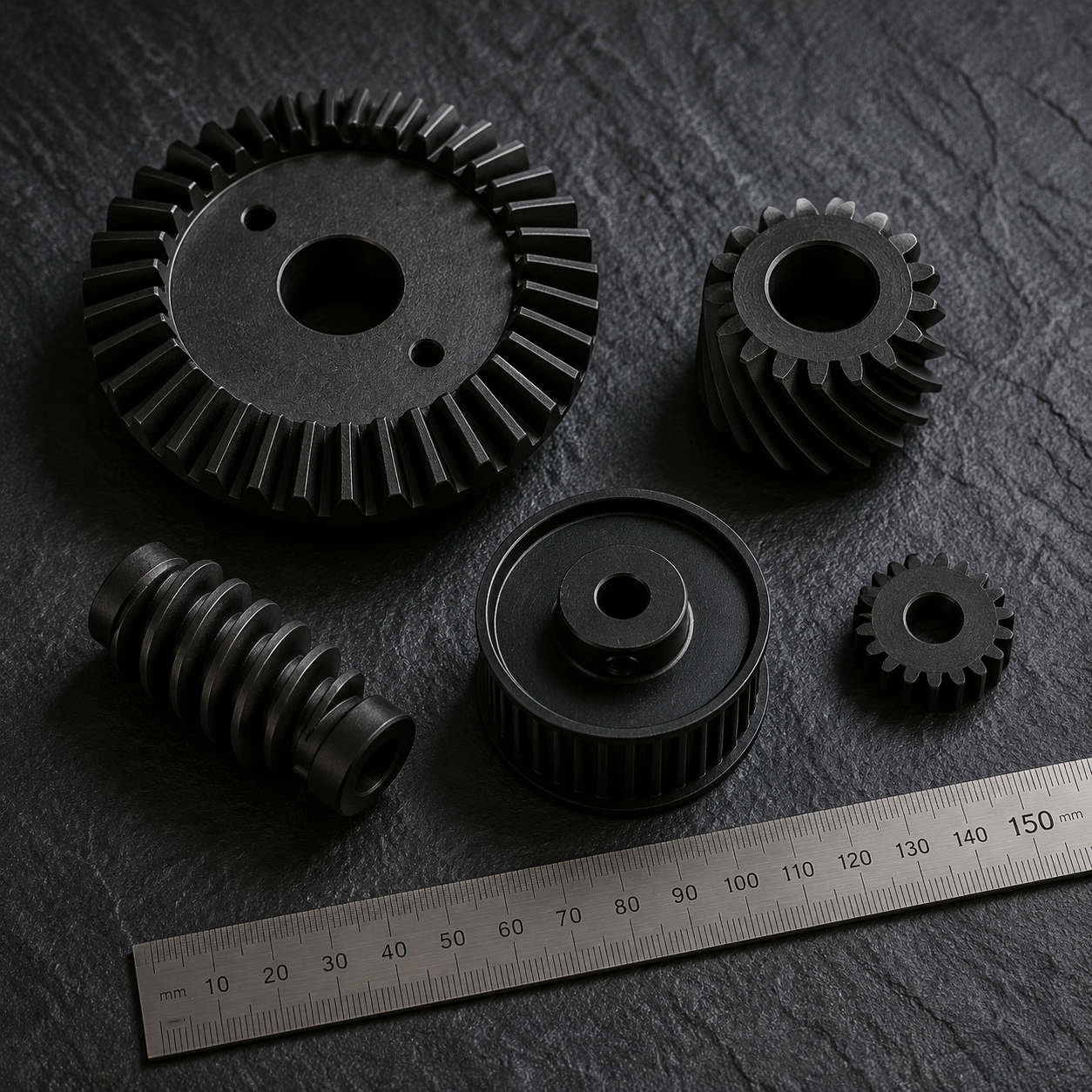
However, the transition from specifying a metal gear to producing a plastic gear that meets AGMA quality level Q8–Q10 at 100,000-cycle durability targets requires navigating a complex design space that spans gear geometry selection (spur, helical, worm, bevel), material compounding (unfilled, glass-reinforced, internally lubricated), manufacturing process trade-offs (injection molding versus CNC machining), and quality validation protocols. This guide provides a structured, data-driven framework for making those decisions with confidence, based on real production data and established gear engineering standards.
For the manufacturing operations behind a custom gear, review the gear manufacturing service scope.
Gear Types: Geometry and Application Matching
Spur gears remain the workhorse of plastic power transmission, accounting for roughly 65% of all plastic gear applications. Their straight teeth running parallel to the rotation axis offer the simplest mold construction (two-plate mold with no side actions), the lowest tooling cost ($8,000–$25,000 for single-cavity), and the highest manufacturing consistency. The primary limitation is noise: at pitch line velocities above 8 m/s, the instantaneous tooth engagement generates audible whine in the 800–2,500 Hz range. For noise-sensitive applications such as automotive HVAC actuators and office equipment, helical gears reduce sound pressure levels by 8–15 dB(A) through gradual tooth engagement, at the cost of generating axial thrust loads (typically 15–35% of the tangential load) that require thrust bearing surfaces in the housing design.
Worm gears enable high reduction ratios (10:1 to 60:1 in a single stage) within a compact envelope, making them the default choice for positioning mechanisms in automotive seat adjusters and industrial valve actuators. The sliding contact inherent to worm gear meshing demands materials with low coefficients of friction: acetal (POM) running against nylon (PA6 or PA66) with internal lubricant (PTFE or silicone at 2–5 wt%) is the standard pairing, delivering 70–75% efficiency at lead angles of 15–20°. Bevel gears, typically produced at 1:1 to 3:1 ratios for 90° axis changes in handheld power tools and marine steering systems, present the greatest molding challenge due to their conical geometry. Straight bevel gears can be molded with two side actions; spiral bevel gears almost invariably require post-mold CNC machining of the tooth flanks to achieve AGMA Q8 or higher.
Material Selection: Matching Polymer to Load and Environment
Material selection for plastic gears begins with quantifying the operating torque, speed, ambient temperature range, and chemical exposure. For low-to-moderate loads (Lewis bending stress <20 MPa at the root fillet), unfilled acetal (POM) provides excellent fatigue resistance, dimensional stability, and self-lubricating behavior at continuous operating temperatures up to 85°C. Nylon 6 and Nylon 66 (unfilled) extend the temperature ceiling to 120°C and offer superior impact resistance (Charpy notched impact >5 kJ/m²), but absorb 2.5–3.5% moisture at saturation, which can change the gear’s pitch diameter by 0.5–1.5% depending on geometry—a critical consideration for precision timing applications where backlash must be maintained below 0.10 mm.
When torque demands push Lewis bending stresses above 30 MPa, glass-fiber reinforced grades become necessary. PA66-GF30 (30% glass-filled nylon 66) delivers a flexural modulus of 8,500–9,500 MPa (versus 2,800 MPa for unfilled) and a tensile strength of 160–180 MPa at 23°C, making it the go-to material for automotive power liftgate actuators and electric power steering (EPS) worm gears operating at intermittent torques of 3–8 N·m. The trade-off is abrasive wear on the mating gear: a glass-filled gear running against an unfilled partner will machine the softer tooth flank, so mating material compatibility must be engineered as a system. For the most demanding applications—continuous duty above 100°C, aggressive chemicals, or high-vacuum environments—PEEK (unfilled or carbon-fiber reinforced) provides flexural modulus of 4,100 MPa, continuous service temperature of 250°C, and negligible moisture absorption (<0.1%), albeit at 10–15× the raw material cost of PA66.
Injection Molded vs. Machined Plastic Gears
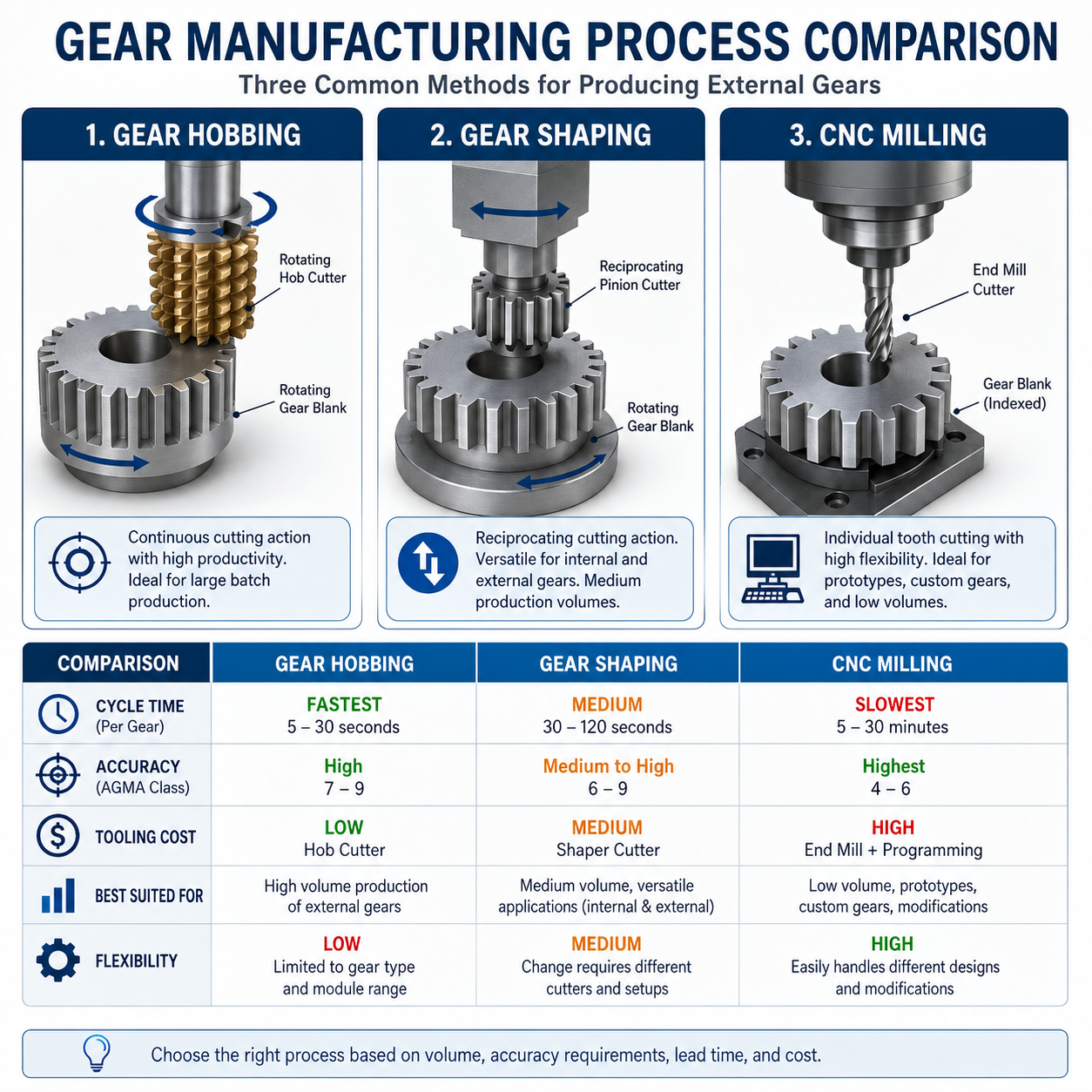
The manufacturing process decision—injection molding or CNC machining—cuts to the heart of the production economics and quality capability. Injection molding amortizes the tooling cost ($15,000–$60,000 for a multi-cavity mold with gear-specific features such as three-plate design for center gating and gas-assist for sink mark control) across the production volume, yielding per-part costs of $0.15–$1.50 at volumes above 10,000 units. Molded gears can achieve AGMA Q8–Q10 when produced with precision-ground mold cavities (±2–5 μm tooth profile tolerance), optimized gate location (center diaphragm or three-point pin gating to minimize out-of-roundness), and controlled cooling to limit post-mold shrinkage variation to <0.3% of the nominal dimension.
CNC machined plastic gears serve three distinct markets: prototyping (1–500 units), where the $50–$150 per-part machining cost is dwarfed by the $15,000–$60,000 tooling avoidance; ultra-precision applications requiring AGMA Q12–Q14 that exceeds molding capability; and large gears (pitch diameter >250 mm) where mold flow length limitations make molding impractical. Machined gears also enable material flexibility—PEEK, PTFE, and glass-filled laminates that are difficult or impossible to injection mold can be hobbed or shaped using standard gear cutting equipment with carbide tooling at cutting speeds of 80–150 m/min. The primary limitation is that machined gears expose cut fiber ends on the tooth surface, which can increase the coefficient of friction by 0.05–0.10 compared to the resin-rich surface of a molded gear, accelerating wear in unlubricated applications.
AGMA Quality Levels: What They Mean for Plastic Gears
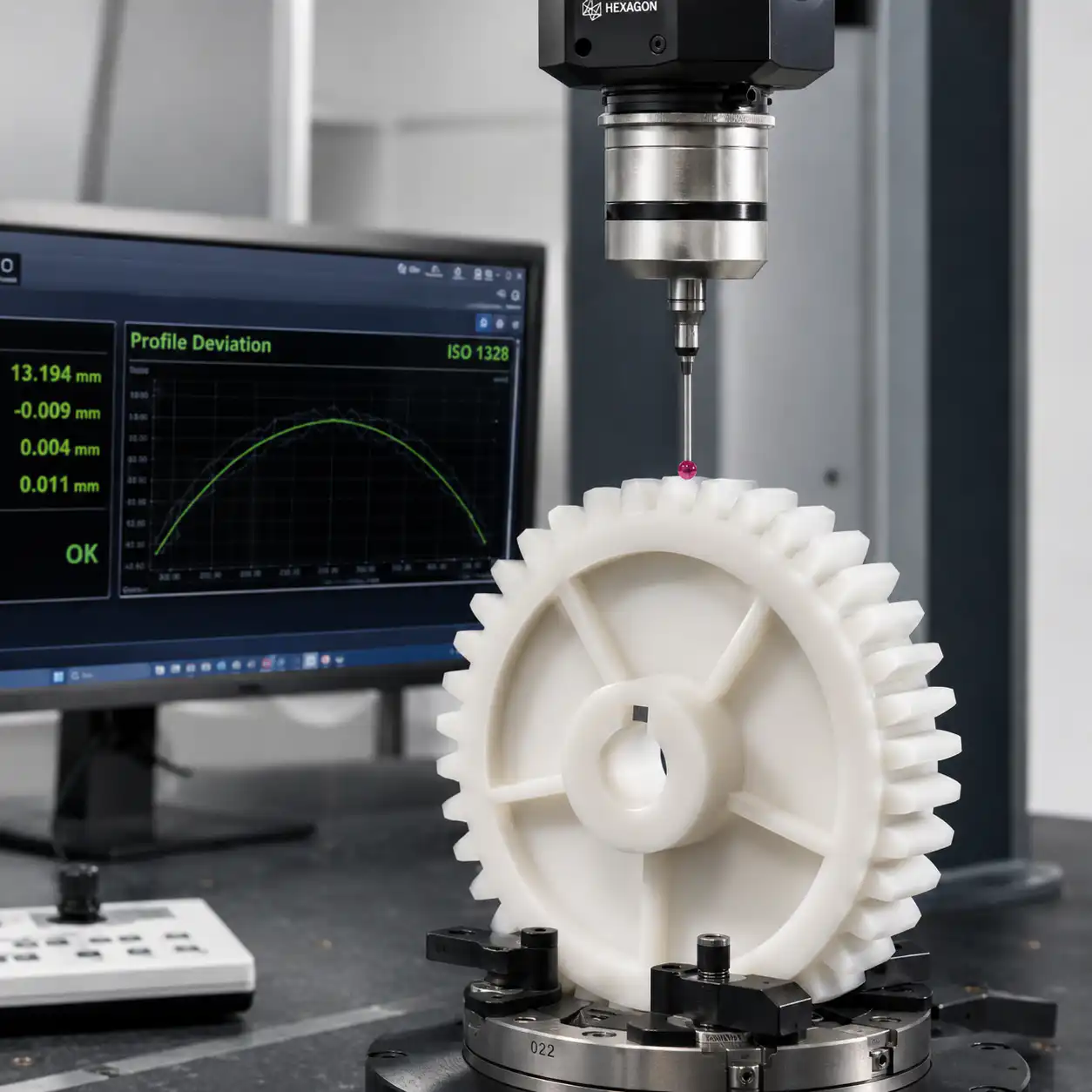
The American Gear Manufacturers Association (AGMA) quality system, defined in ANSI/AGMA 2015 and ISO 1328, classifies gear accuracy from Q3 (coarse, agricultural machinery) to Q15 (ultra-precision, aerospace guidance systems). For plastic gears, the practical range is Q6–Q12. Q6–Q7 (total composite error 32–45 μm for a 25 mm pitch diameter gear) is adequate for low-speed, non-critical consumer applications such as toy mechanisms and simple appliance timers at pitch line velocities below 1 m/s. Q8–Q9 (total composite error 16–25 μm) represents the sweet spot for automotive actuators, power tools, and office equipment, delivering acceptable noise (<65 dB(A) at 1 m), reasonable efficiency (>90% for spur gears), and tooth-to-tooth load sharing within 15% of the ideal.
Q10 (total composite error 10–14 μm) is the highest quality level reliably achievable with injection molding and requires precision-ground mold cavities (Ra <0.1 μm on the tooth flank), tight process control on melt temperature (±2°C), and statistical process control on shrinkage variation. This level is specified for electric power steering worm gears, medical infusion pump dosage gears, and robotic joint harmonic drive flex-splines. Q11–Q12 is achievable only through post-mold CNC machining (hobbing, shaping, or grinding) or direct machining from stock, and is reserved for applications where the marginal improvement in transmission error and noise justifies the 3–6× cost premium over Q9–Q10 molded gears.
For the drawing dimensions around the gear, use the plastic-part tolerance and inspection guide.
Material Selection by Load and Torque
| Material | Max Continuous Torque (N·m)* | Flexural Modulus (MPa) | Service Temp. (°C) | Moisture Absorption (%) | Cost Index |
|---|---|---|---|---|---|
| POM (Acetal, unfilled) | 0.5–2.5 | 2,600–2,900 | 85 | 0.2–0.3 | 1.0× |
| PA6 / PA66 (unfilled) | 0.8–3.0 | 2,600–3,000 | 120 | 2.5–3.5 | 1.0× |
| PA66-GF30 (30% GF) | 3.0–8.0 | 8,500–9,500 | 130 | 1.5–2.0 | 1.4× |
| PBT (unfilled) | 0.6–2.0 | 2,400–2,700 | 120 | 0.1–0.2 | 1.2× |
| PEEK (unfilled) | 2.0–6.0 | 4,100 | 250 | <0.1 | 10–15× |
| PA46 (Stanyl, unfilled) | 1.5–4.0 | 3,200 | 160 | 3.0–4.0 | 3.0× |
| PA12 (unfilled) | 0.5–1.5 | 1,500 | 90 | 0.5–0.8 | 1.8× |
| LCP (Vectra) | 0.3–1.0 | 11,000–13,000 | 240 | <0.03 | 5–8× |
*Based on 20 mm pitch diameter, 1.5 module spur gear. Derate for smaller modules or higher speeds.
Six Design Rules for Plastic Gears
- Design the Hub Before the Teeth: The hub-bore interface and the transition to the web must be designed to manage shrinkage stress and avoid sink marks that distort the involute tooth profile. Hub wall thickness should be 0.5–0.7× the tooth thickness at the root, and the web thickness should be 0.4–0.6× the tooth thickness. Center-gate the gear with a diaphragm gate (0.8–1.2 mm thick) to balance radial flow and minimize out-of-roundness to within ±0.03 mm on the pitch diameter.
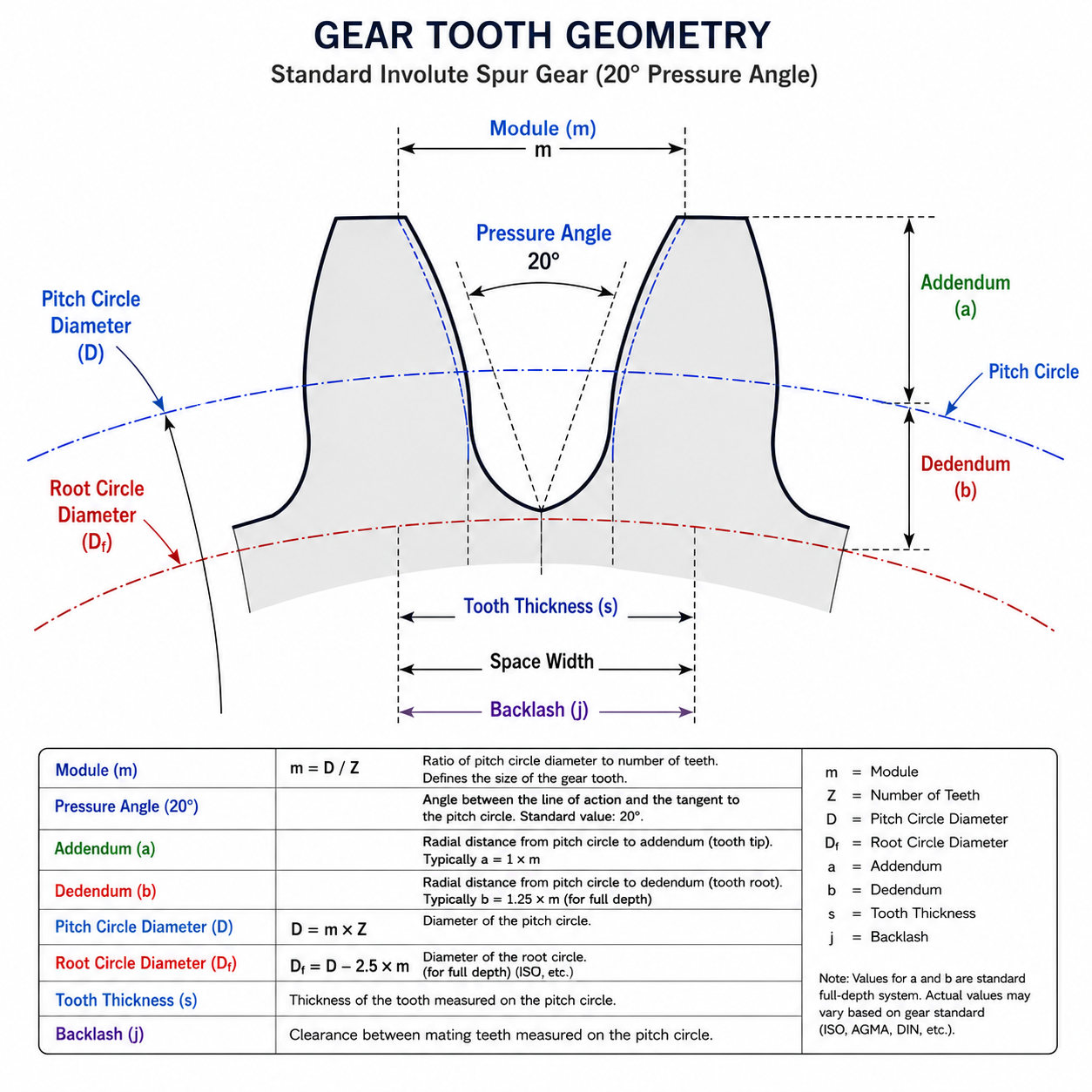
- Add a Root Fillet Radius of 0.35–0.45 × Module: The root fillet is the highest-stress region in a plastic gear tooth. Generous fillets (minimum 0.3 module, ideally 0.38 module) reduce the stress concentration factor from Kt ≈ 2.5 (sharp corner) to Kt ≈ 1.4, doubling fatigue life. Full-round root fillet designs, where the fillet radius equals half the root clearance, can further improve fatigue life by 30–50% over standard trochoid fillets for high-cycle applications above 10⁶ cycles.
- Specify AGMA Quality Level Based on Pitch Line Velocity, Not Wishful Thinking: Q6 for v < 1 m/s, Q8 for v = 1–3 m/s, Q9 for v = 3–8 m/s, Q10 for v > 8 m/s. Specifying Q12 for a 0.5 m/s application wastes money without delivering perceivable performance improvement. The cost multiplier from Q8 to Q10 is approximately 2–3× when molding, and 4–6× when machining.
- Account for Moisture Expansion in the Housing Design: Nylon gears can grow 0.5–1.5% in pitch diameter as they absorb moisture from the air or lubricant. Design the center distance with 0.3–0.5% additional backlash at the dry condition to prevent binding when the gear reaches equilibrium moisture content. For precision timing applications, specify PA12 or PBT for their lower moisture absorption (0.1–0.8%).
- Run-in Gears Before Measuring Efficiency: Plastic gear efficiency improves by 3–8 percentage points after a break-in period of 5,000–10,000 mesh cycles as asperities on the tooth surface wear smooth and the real contact area increases. Testing efficiency on a green gear will underestimate steady-state performance. The break-in should be performed at 50% of the rated torque to avoid scuffing during the high-friction initial phase.
- Never Use Molded Plastic Gears Against Metal Without Lubrication: A steel pinion running against an unfilled POM gear at 1,500 RPM will raise the plastic tooth flank temperature by 15–35°C due to the higher thermal conductivity of steel drawing heat away from the contact zone, concentrating it in the plastic. This accelerates wear and can cause local melting at the flank. Always use grease (NLGI Grade 0 or 00 for low-speed, Grade 1 or 2 for >3 m/s) or specify an internally lubricated plastic grade (PTFE-filled at 15–20 wt%, or silicone oil at 2–5 wt%).
Industry Application Matrix
| Industry | Typical Gear Type | Preferred Material | Quality Target |
|---|---|---|---|
| Automotive (Actuators) | Helical, Worm | PA66-GF30, POM | AGMA Q8–Q9, 200K cycle durability at -30°C to +85°C |
| Medical Devices (Pumps) | Spur, Helical | PEEK, PEI (Ultem) | AGMA Q9–Q10, ISO 10993, autoclavable 500 cycles |
| Industrial Robotics | Spur, Planetary | PA66-GF30, PA46 | AGMA Q9–Q10, <0.05° backlash, 5M cycle life |
| Consumer Electronics | Spur, Face | POM, LCP | AGMA Q7–Q8, noise <45 dB(A), low cost |
Cost Decision Framework
Should you mold or machine your plastic gears?
For volumes below 500 units, CNC machining from stock ($50–$150/gear) is the clear economic choice—the $15,000–$60,000 tooling investment for injection molding cannot be amortized at these quantities. Between 500 and 5,000 units, evaluate: if the gear is a standard shape (spur or simple helical, OD <100 mm, module 0.5–2.0), consider a single-cavity prototype mold ($8,000–$12,000) that can also serve as a bridge tool. Above 5,000 units, multi-cavity injection molding (2–8 cavities, $25,000–$60,000) delivers per-part costs of $0.15–$0.80, achieving payback within 12–18 months. For gears above 250 mm pitch diameter, molding becomes impractical due to clamp tonnage requirements (>500 tons) and flow-length limitations—CNC machining or fabricating the gear from bonded segments is the standard approach.
Total cost per gear at volume (including tooling amortization over 3 years): 1K units: $12–$55 (machined) vs $8–$30 (molded) | 10K units: $8–$35 (machined) vs $0.50–$2.50 (molded) | 100K units: $5–$25 (machined) vs $0.15–$0.80 (molded)
Gear Manufacturing Troubleshooting
| Problem | Likely Cause | Diagnostic Check | Corrective Action |
|---|---|---|---|
| Excessive noise / gear whine | Tooth profile error, out-of-roundness, or insufficient quality level for pitch line velocity | Double-flank roll test, measure total composite error (TCE) | Upgrade to AGMA Q9+, add tip/root relief of 10–20 μm, increase contact ratio to >1.4 |
| Premature tooth wear (<50K cycles) | Inadequate lubrication, abrasive mating material, or excessive contact stress | SEM of worn flank surface, calculate Hertzian contact stress | Switch to internally lubricated grade, reduce contact stress to <40 MPa, increase module by 25% |
| Tooth root fracture | Insufficient root fillet radius, overload, or material degradation | Measure root fillet vs. drawing, calculate bending stress vs. material fatigue limit | Increase fillet to 0.38–0.45 × module, upgrade to GF30 grade, verify melt temperature within spec |
| Dimensional instability in service | Moisture absorption (nylon) or thermal expansion exceeding design allowance | Measure pitch diameter dry vs. conditioned, log ambient humidity | Switch to PA12/PBT, increase designed backlash by 0.1–0.3%, add environmental sealing to housing |
Frequently Asked Questions
Can plastic gears really replace metal gears?
Yes, for applications where the transmitted torque is below 8 N·m and operating temperatures remain below 120°C for nylon-based materials (250°C for PEEK), plastic gears not only match but often outperform metal in several key metrics. Plastic gears eliminate the need for external lubrication in 60–70% of applications, reduce system weight by 40–70%, absorb shock loads that would dent metal tooth flanks, and operate 3–8 dB(A) quieter in the 500–3,000 Hz range. The limitations are torque capacity (metal gears handle 50–500× the torque for the same envelope) and thermal conductivity (plastic conducts heat ~100× slower than steel, limiting continuous-duty power density). For high-torque, high-temperature, or continuous-duty applications, metal remains necessary—but for the estimated 35–40% of power transmission applications falling within plastic’s performance envelope, the conversion delivers compelling system-level cost and weight savings.
What is the best plastic material for gears?
There is no single “best” material—the optimal choice depends on the operating conditions. For general-purpose, low-cost applications at moderate loads: unfilled POM (acetal) offers the best balance of strength, fatigue resistance, dimensional stability, and self-lubrication. For higher loads and temperatures: PA66-GF30 (glass-filled nylon 66) delivers 2–3× the strength of unfilled grades but requires a lubricated mating pair. For high-temperature continuous duty (above 120°C): PEEK is the gold standard, albeit at 10–15× the material cost. For precision miniature gears (module <1.0) requiring extreme dimensional stability: LCP (liquid crystal polymer) provides vanishingly low moisture absorption (<0.03%) and moldability to AGMA Q10+. The material decision should be paired with the specific mating gear material, lubrication strategy, and environmental exposure evaluated as a complete tribological system.
What tolerance standards apply to plastic gears?
Plastic gears follow the same AGMA (ANSI/AGMA 2015) and ISO (ISO 1328) quality classification systems used for metal gears, but the achievable quality levels differ. Injection-molded gears can reliably achieve AGMA Q8–Q10 (total composite error 10–25 μm for a 25 mm pitch diameter reference gear) with precision-ground mold cavities. CNC-machined plastic gears can reach AGMA Q10–Q12 but rarely exceed Q12 due to the material’s lower elastic modulus causing deflection during cutting. The key difference from metal gear tolerancing is that plastic gear dimensions are specified at a defined conditioning state (typically “dry as molded” or “conditioned to 50% RH at 23°C”) because moisture and temperature-induced dimensional changes of 0.2–1.5% can swamp the manufacturing tolerance. Always define the measurement conditions in the drawing notes.
Do plastic gears need lubrication?
The lubrication requirement depends on the material pairing, speed, and load. Unfilled POM running against POM or PA can often operate unlubricated at pitch line velocities below 3 m/s and contact stresses below 20 MPa, thanks to POM’s low coefficient of friction (μ ≈ 0.2–0.3 dry). Nylon-on-nylon gears generally require lubrication for any continuous-duty application to prevent stick-slip and heat buildup. Glass-filled materials must always be lubricated when running against metal or another glass-filled gear due to the abrasive nature of exposed glass fibers. For applications where external grease is unacceptable (cleanroom, food contact, vacuum), specify internally lubricated grades: PTFE-filled POM (Delrin AF) at 15–20 wt% PTFE, or silicone oil-infused PA66 at 2–5 wt% silicone, which provide μ ≈ 0.08–0.15 without external lubricant. Grease-packed gearboxes using NLGI Grade 00 semi-fluid grease provide the best heat dissipation and longest service life for enclosed plastic gear trains.
Related Reading
Request a Custom Plastic Gear Review
For gear manufacturing services, share the gear drawing and the mating mechanism. Nylon Plastic can review the polymer, machined or molded route, shaft interface and inspection scope for the actual load and production plan.
What to include and agree before quotation
What is needed to quote custom plastic gears?
Provide the tooth system, module or diametral pitch, pressure angle, mating gear, torque, speed, duty cycle, temperature and lubrication conditions with the drawing. State whether the need is a prototype or recurring molded production. Compare material choice, prototype route, tool scope and the agreed noise, backlash, wear and dimensional checks before approving a gear from one material property.
- Provide tooth system, module or diametral pitch, tooth count, pressure angle, face width, bore or hub and controlled drawing revision.
- Identify the mating gear and shaft, torque, speed, duty cycle, starts or shock loads, temperature, moisture, chemicals and lubrication.
- Include prototype and annual quantities, exact grade or permitted alternative, destination and timing; define backlash, noise, tooth/contact checks, wear-life test and the agreed conditioning state.
Manufacturing and delivery:
- Precision Manufacturing: 30+ CNC & injection molding cells under one roof
- ISO 9001:2015 Certified: Certified quality system, full inspection reports
- 15-25 Day Lead Time: Fast turnaround with expedited options available
- Global Shipping: Air & sea freight to North America, Europe, Asia
Compare material, prototype machining, tooling, molded production and inspection as separate quote items. Agree the sample checks in the mating assembly before recurring production; a material property alone does not qualify the gear train.