Introduction to Plastic Welding
Plastic welding encompasses a family of joining processes that fuse thermoplastic components through the application of heat, pressure, and time. Unlike metal welding, which melts the base material at temperatures exceeding 1,000°C, plastic welding operates within the relatively narrow thermal processing window of each polymer—typically between 180°C and 350°C. Selecting the right method from among hot plate, ultrasonic, vibration, and laser welding can mean the difference between a hermetic, load-bearing joint and a brittle failure point that cracks under the first thermal cycle. For design engineers working in automotive, medical device, or consumer electronics sectors, understanding these distinctions is not optional—it is fundamental to meeting IP67 sealing requirements, passing drop tests, and maintaining consistent production yields above 98%.
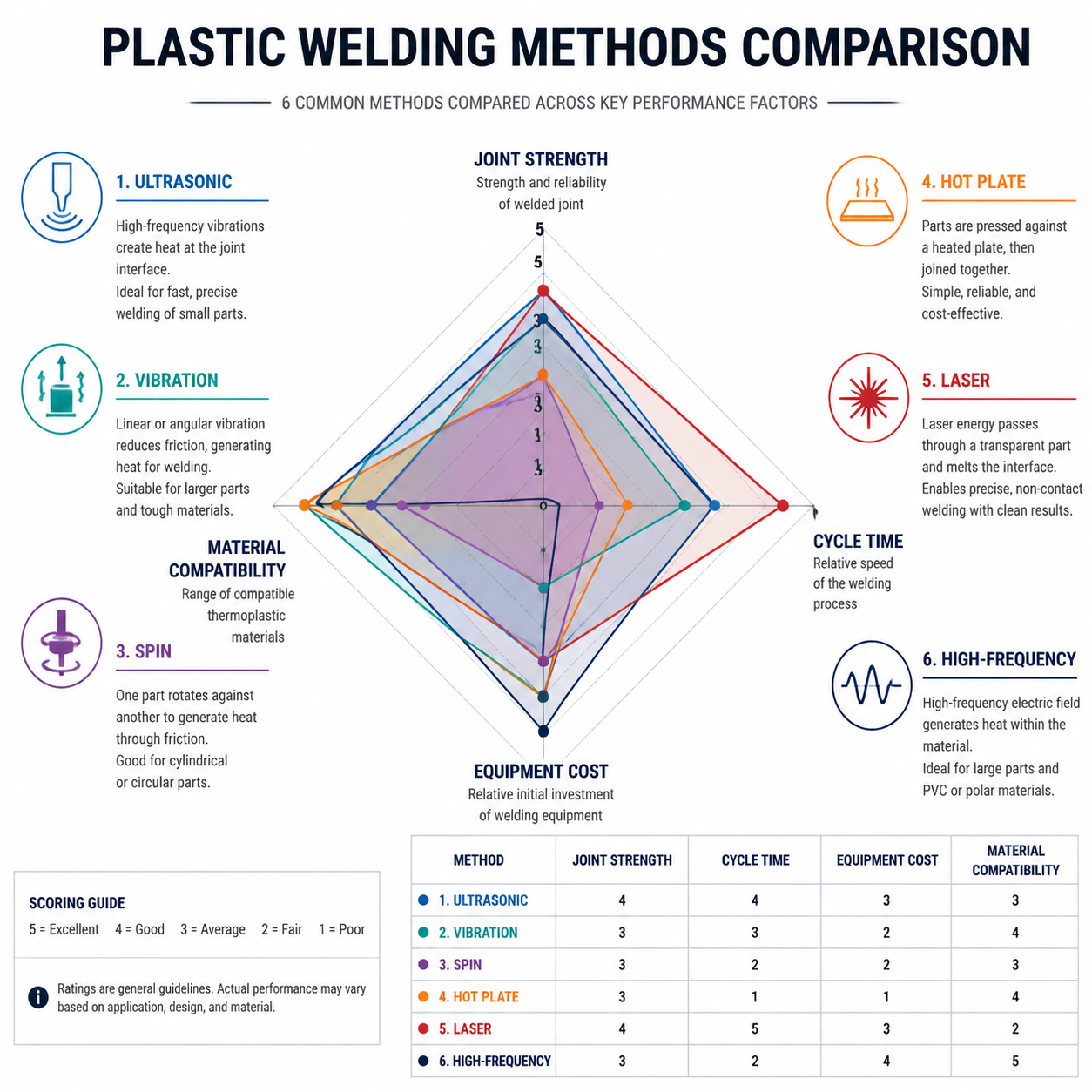
This guide provides a structured comparison of the four dominant industrial plastic welding methods, with actionable data on material-weld compatibility charts, joint geometry design rules, and destructive testing protocols. Whether you are transitioning from adhesive bonding to achieve faster cycle times, or evaluating whether your glass-filled nylon housing can be laser-welded to a transparent polycarbonate lens, the reference tables and design guidelines that follow are drawn from real production experience across thousands of welded assemblies. By the end, you will have a clear decision framework based on part geometry, material pairings, annual volume targets, and budget constraints.
If the assembly must be opened again, compare the requirements in the snap-fit design guide before selecting a permanent joint.
Hot Plate Welding: Principles and Applications
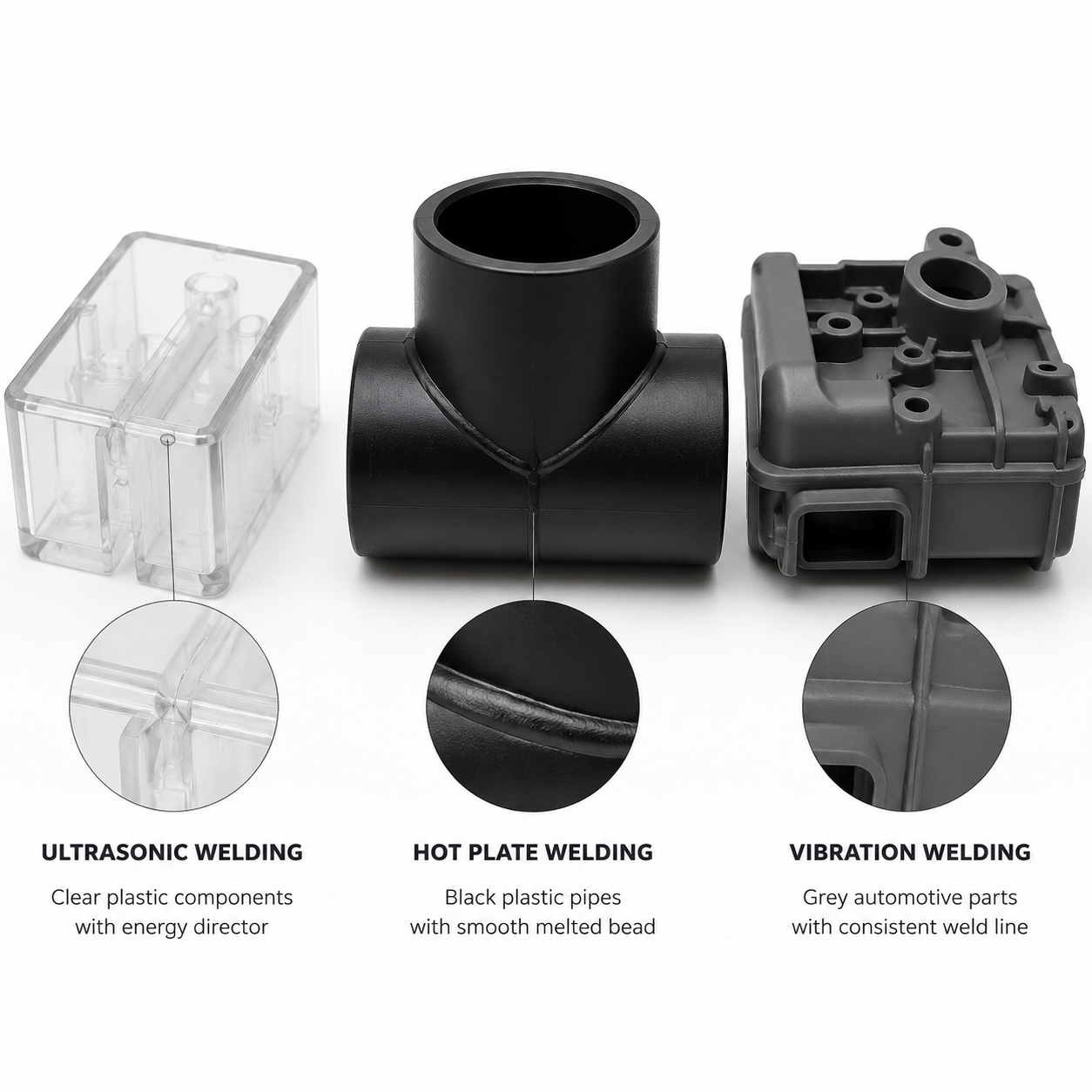
Hot plate welding, also known as heated tool welding, is the oldest and most mechanically straightforward plastic joining technique. A heated platen—typically aluminum with a PTFE non-stick coating—is inserted between the two parts to be joined. The parts are pressed against the platen at controlled pressure (0.1–0.5 MPa), allowing a melt layer of 0.5–2.0 mm to form on each face. The platen is then withdrawn, and the parts are pressed together under higher force (0.15–0.8 MPa) for a controlled cooling period ranging from 10 to 60 seconds depending on wall thickness. This sequential melt-seal-cool cycle produces joints with tensile strengths reaching 85–95% of the parent material for compatible polymers such as PP, PE, and unfilled PA6.
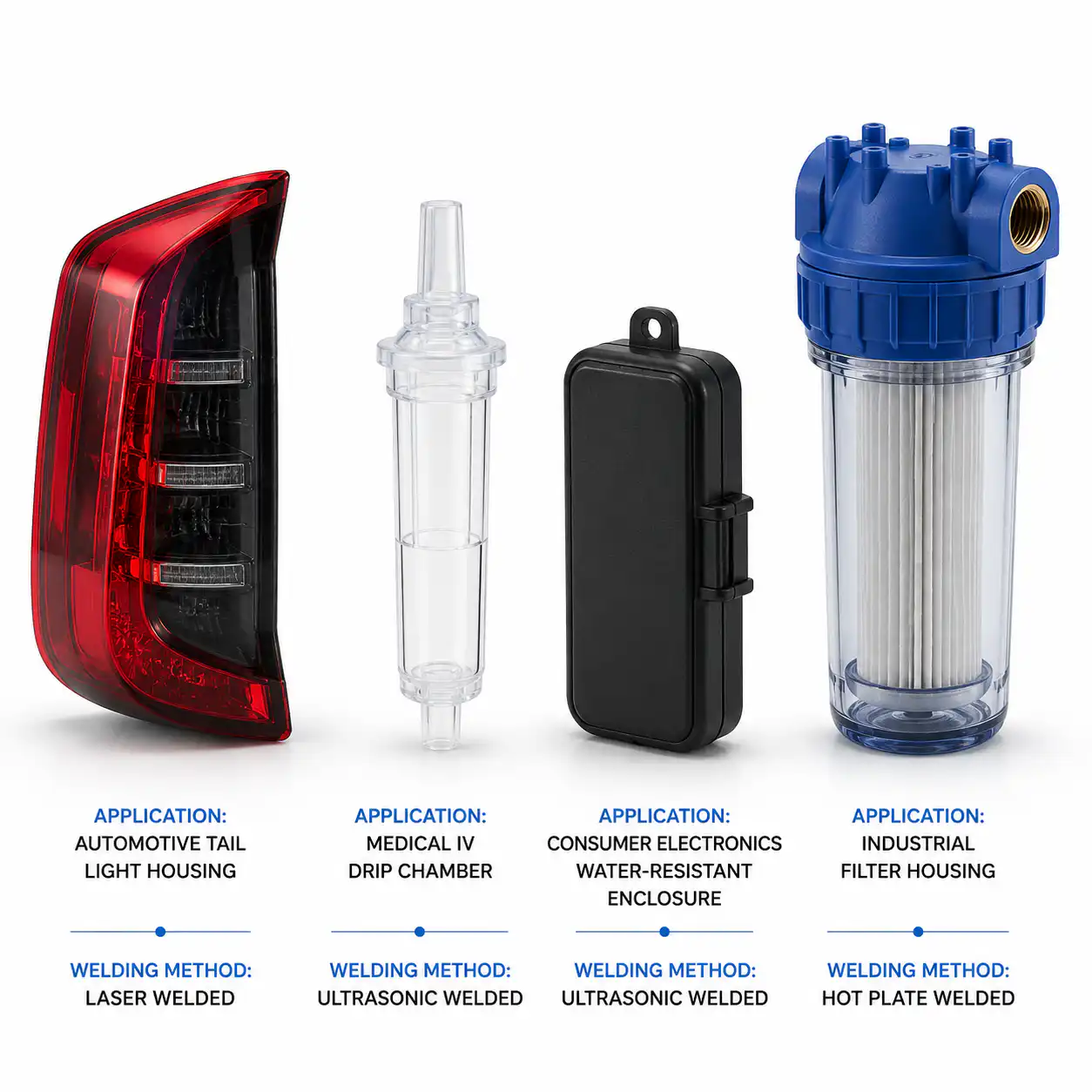
The primary advantage of hot plate welding lies in its tolerance for large, complex parting line geometries. Parts with non-planar joint surfaces, variable wall thicknesses ranging from 1.5 mm to 15 mm, and overall dimensions exceeding 1,200 mm can be welded with a single-cycle tool. Automotive intake manifolds, tail lamp housings, and fluid reservoirs are classic applications. However, the cycle time penalty is real: a typical hot plate weld cycle runs 20–60 seconds, compared to 0.5–3 seconds for ultrasonic welding. Stringing and flash formation around the weld line requires secondary trimming operations in cosmetic applications, adding 5–15% to the per-part cost.
Ultrasonic Welding: High-Speed Precision Joining
Ultrasonic welding delivers high-frequency mechanical vibrations—typically 15 kHz, 20 kHz, 30 kHz, or 40 kHz—through a titanium or aluminum horn (sonotrode) directly into the joint interface. These vibrations, at amplitudes ranging from 20 to 120 μm (peak-to-peak), generate localized frictional heating at the energy director or shear joint, causing the polymer to melt within 0.1–0.5 seconds. The entire cycle—including the hold time for solidification—completes in 0.5–3.0 seconds, making ultrasonic welding the fastest plastic joining method available. Joint strengths for amorphous thermoplastics such as ABS, PC, and PMMA routinely achieve 90–100% of the base material strength when the energy director geometry is correctly specified.
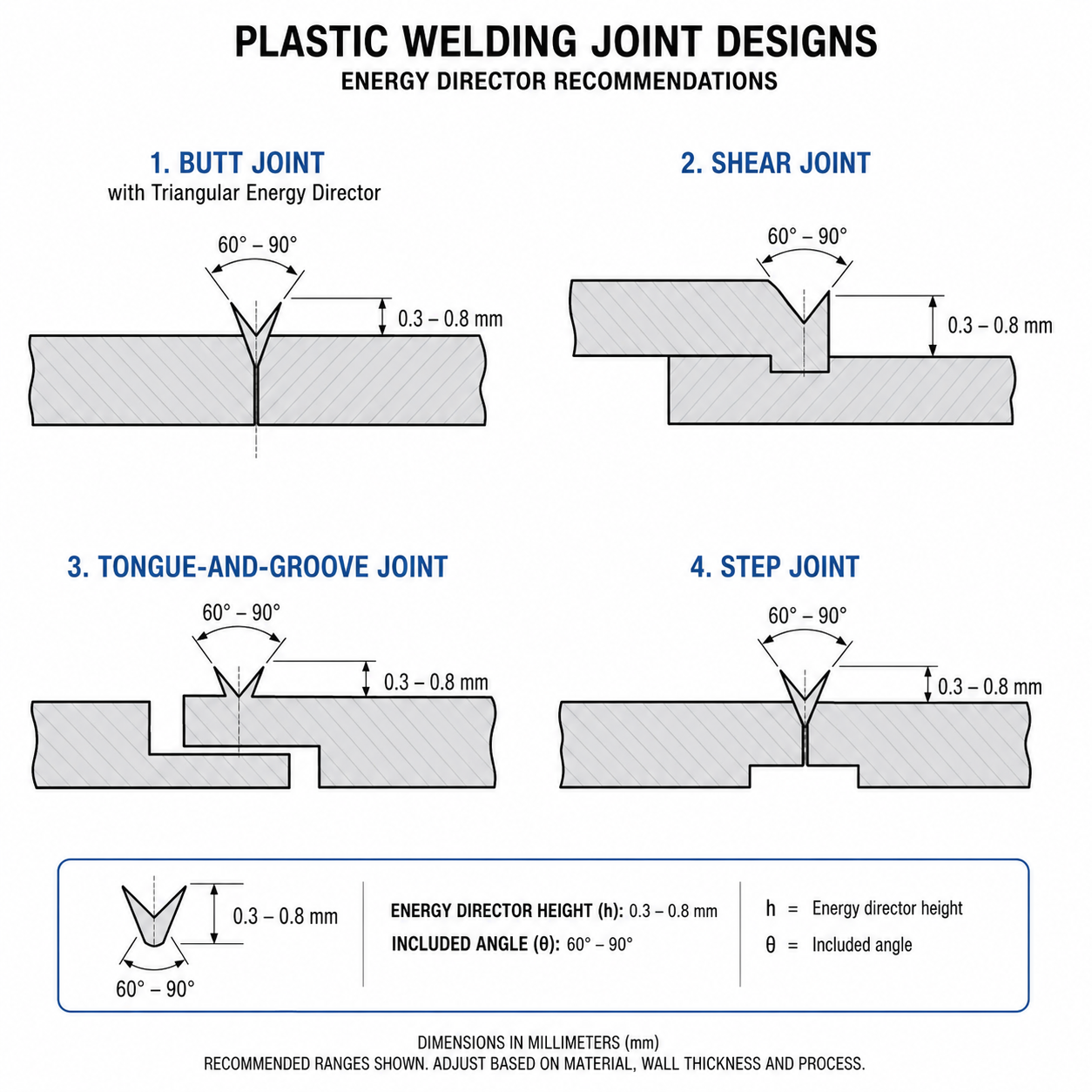
The critical design element in ultrasonic welding is the energy director: a triangular ridge (typically 0.25–0.75 mm tall with a 60° or 90° included angle) molded into one of the mating surfaces. This ridge concentrates ultrasonic energy at a precise line, ensuring rapid, controlled melt initiation. For semi-crystalline polymers such as nylon (PA6, PA66), POM, and PBT—which absorb more ultrasonic energy in transit and require higher amplitudes of 30–70 μm—a shear joint design is strongly preferred over an energy director. Shear joints create an interference fit (0.2–0.4 mm) where the horn forces the parts to slide past one another, generating frictional heat across the entire cylindrical interface rather than at a single point. This approach improves weld consistency and reduces particulate generation, which is especially important in medical device and electronic enclosure applications.
For the joint drawing and process review, use the ultrasonic welding guide alongside this comparison of joining methods.
Vibration Welding: Large-Part Linear Friction Joining
Vibration welding operates on the principle of linear friction: one part is clamped stationary while the mating part oscillates horizontally at frequencies of 100–240 Hz with amplitudes of 1.0–4.5 mm under controlled pressure of 0.5–2.0 MPa. The resulting frictional heat melts the polymer at the joint interface within 1–5 seconds, after which vibration stops and the parts are held under pressure for 2–5 seconds to solidify. The process is particularly well-suited for parts with joint surface areas ranging from 50 cm² to over 1,500 cm²—think intake manifolds, instrument panels, and battery trays—where the large contact area demands a process that can deliver high power (1–15 kW) across an extended weld zone.
Compared to ultrasonic welding, vibration welding sacrifices speed for area coverage and material versatility. Semi-crystalline thermoplastics including PP, PA6, PA66, POM, and PBT weld reliably with vibration, though the 1–4.5 mm of melt displacement (collapse distance) must be designed into the part from the start. This displacement requirement means that vibration-welded assemblies need an additional 2–5 mm of material above the joint plane, which can add 3–8% to the part weight. Flash control is managed through trap grooves and flash containment channels molded into the joint design; without these, loose particulate can become a contamination concern in fluid-handling assemblies such as washer bottles and coolant reservoirs.
Laser Welding: Precision for Transparent-to-Opaque Joints
Laser transmission welding (LTW) uses a near-infrared diode laser (typically 808–980 nm wavelength, 20–200 W) to pass through a laser-transparent upper part and heat a laser-absorbing lower part at the joint interface. Carbon black is the most common absorbing additive at 0.2–0.5 wt%, though colorless Clearweld® absorbers enable transparent-to-transparent welds for aesthetic applications. The laser beam is traversed along the weld contour at speeds of 50–500 mm/s, generating a precise, flash-free weld seam typically 0.5–2.5 mm wide. The absence of mechanical vibration makes laser welding ideal for assemblies containing sensitive electronics, MEMS sensors, or pre-loaded components that cannot tolerate the g-forces of ultrasonic or vibration processes.
The primary constraint of laser welding is material pairing: the upper part must transmit at least 20% of the incident laser energy at the operating wavelength, while the lower part must absorb efficiently. Natural (unfilled) PA6 and PA66 transmit 60–80% at 940 nm in sections up to 3 mm thick, making them excellent upper-part candidates. Glass-filled nylons, however, scatter the laser beam due to refractive index mismatch between the glass fibers and the polymer matrix, limiting practical transmission thickness to 1.0–1.5 mm. For glass-fiber content above 30%, laser welding becomes unreliable and alternative methods should be considered. The capital equipment cost—ranging from $80,000 to $350,000 depending on laser power, clamping sophistication, and automation level—positions laser welding as a medium-to-high-volume solution where quality and aesthetics justify the investment.
Material-Weld Compatibility Matrix
| Material | Hot Plate | Ultrasonic | Vibration | Laser | Joint Strength (% Base) |
|---|---|---|---|---|---|
| ABS (unfilled) | ✅ Excellent | ✅ Excellent | ✅ Excellent | ⚠ Needs absorber | 90–100% |
| PA6 / PA66 (unfilled) | ✅ Excellent | ⚠ Shear joint only | ✅ Excellent | ✅ Excellent | 85–95% |
| PA6 GF30 (glass-filled) | ✅ Excellent | ⚠ High amplitude | ✅ Excellent | ❌ Poor transmission | 75–90% |
| PP (unfilled) | ✅ Excellent | ❌ Not recommended | ✅ Excellent | ❌ Not recommended | 80–90% |
| PC (unfilled) | ⚠ Pre-drying needed | ✅ Excellent | ✅ Excellent | ✅ Excellent | 90–100% |
| POM (Acetal) | ⚠ Degradation risk | ⚠ Shear joint only | ✅ Excellent | ❌ Not recommended | 70–85% |
| PMMA (Acrylic) | ⚠ Stress cracking | ✅ Excellent | ⚠ Crazing risk | ✅ Excellent | 85–95% |
| TPE / TPU | ⚠ Stick to platen | ❌ Energy dissipation | ⚠ Low modulus | ❌ Not recommended | 50–70% |
For an assembly exposed outdoors, review the service conditions in the outdoor plastic material selection guide as well as weld compatibility.
Six Design Rules for Reliable Plastic Welds
- Match Welding Method to Polymer Type: Amorphous thermoplastics (ABS, PC, PMMA, PS) weld well with all four methods. Semi-crystalline polymers (PA, PP, POM, PBT) require higher energy input and perform best with hot plate or vibration welding. Always consult the material supplier’s weldability datasheet before finalizing a process choice.
- Design the Joint, Not Just the Part: Incorporate weld features—energy directors (0.25–0.75 mm height, 60° or 90° angle), shear joints (0.2–0.4 mm interference), flash traps (1.5× weld bead volume), and alignment features—into the 3D CAD model during the initial design phase, not as an afterthought during tooling kickoff.
- Control Moisture Content Before Welding: Hygroscopic materials (PA6, PA66, PC, PBT) must be dried to <0.15% moisture content before welding. Moisture flashing to steam during heating creates voids and porosity in the weld zone, reducing tensile strength by 20–40%. Pre-weld drying at 80°C for 2–4 hours is standard practice.
- Maintain Uniform Wall Thickness at the Joint: Weld interface wall thickness should not vary by more than ±15% around the perimeter. Thicker sections act as heat sinks during cooling, creating residual stress gradients that can cause delayed cracking or warpage. For parts requiring wall thickness transitions, taper them over a distance of at least 3× the thickness differential.
- Validate Weld Strength with Destructive Testing: Establish a burst pressure or tensile pull test protocol during process development. Sample size should be n≥30 per cavity, with a CpK target ≥1.33 for critical-to-quality weld dimensions. Cross-section the weld and inspect for void content <5% of the weld zone area under 10× magnification.
- Account for Thermal Expansion Mismatch: When welding dissimilar materials—for example, PC (CTE ~65 μm/m·°C) to ABS (CTE ~85 μm/m·°C)—the differential expansion during post-weld cooling can generate residual stresses of 5–15 MPa. If the stress exceeds the weaker material’s yield strength at the service temperature, the joint will fail in thermal cycling. Use FEA to evaluate CTE mismatch before committing to a dissimilar-material weld design.
Industry Application Matrix
| Industry | Typical Weld Method | Common Materials | Key Requirement |
|---|---|---|---|
| Automotive | Vibration, Hot Plate | PA6-GF30, PP-TD20, POM | Burst pressure >5 bar, thermal cycling -40°C to +120°C |
| Medical Devices | Ultrasonic, Laser | PC, COC/COP, PEEK | ISO 10993 biocompatibility, particulate <50 μm |
| Consumer Electronics | Ultrasonic | PC/ABS, PMMA, PA | IP67/IP68 sealing, cosmetic weld line |
| Fluid Handling | Hot Plate, Vibration | PP, PE-HD, PVDF | Chemical resistance, leak rate <1 cc/min at 3 bar |
Cost Decision Framework
Which welding method delivers the best ROI for your application?
For annual volumes below 50,000 units, ultrasonic welding offers the lowest capital investment ($15,000–$45,000 for a complete 20 kHz system with tooling) and the fastest amortization. For 50,000–500,000 units, hot plate and vibration welding become competitive due to multi-cavity tooling that processes 2–8 parts per cycle. Laser welding crosses the ROI threshold at above 200,000 units where the elimination of secondary flash removal, combined with 99.5% first-pass yield, offsets the higher equipment cost ($80,000–$350,000). Factor in $0.08–$0.25 per part for energy and consumables (PTFE platens, sonotrode wear, laser optics maintenance) when building your total cost model.
Quick budget guide per method (system + tooling): Ultrasonic: $18K–$55K | Hot Plate: $35K–$120K | Vibration: $60K–$200K | Laser: $90K–$380K
Welding Troubleshooting Guide
| Problem | Likely Cause | Diagnostic Check | Corrective Action |
|---|---|---|---|
| Low weld strength (<70% of base) | Insufficient melt depth, moisture in resin, or low weld pressure | Cross-section analysis, moisture analyzer reading | Increase weld time by 0.5–1.0 sec, dry material to <0.15% moisture, verify pressure transducer calibration |
| Excessive flash / particulate | Over-welding, insufficient flash trap volume, or incorrect energy director geometry | Measure collapse distance, inspect flash trap fill | Reduce amplitude 10–15%, enlarge flash traps to 1.5× bead volume, verify energy director height within ±0.05 mm |
| Inconsistent weld quality (part-to-part) | Part dimensional variation, inconsistent clamp force, or material lot variation | Measure 30 consecutive parts at joint interface, review melt flow index data | Tighten molding tolerances at joint to ±0.05 mm, implement SPC on weld parameters, lock in single material lot for validation |
| Cracking at weld line after cooling | Residual stress from differential shrinkage, inadequate hold time | Photoelastic stress analysis, cross-section for void content | Extend hold time by 50%, reduce cooling rate with heated fixture (40–60°C), anneal parts at 60–80°C for 1 hour post-weld |
Frequently Asked Questions
Which plastic welding method produces the strongest joint?
Hot plate welding and vibration welding produce the highest absolute joint strengths for most engineering thermoplastics, typically reaching 85–95% of the parent material’s tensile strength. For unfilled amorphous polymers (ABS, PC, PMMA), ultrasonic welding with a properly designed energy director can achieve 90–100% base material strength. Laser welding follows at 80–95%, but its advantage lies in consistency (CpK ≥ 2.0 is achievable) and flash-free aesthetics rather than absolute peak strength. The strongest method for a specific application depends more on material compatibility and joint design geometry than on the process itself.
Which plastic materials can be welded together?
Only thermoplastics can be welded—thermosets cannot be remelted and must be joined mechanically or with adhesives. Same-material welds (e.g., ABS-to-ABS, PA6-to-PA6) are the most reliable and predictable. Some dissimilar polymer combinations are weldable if their melting temperatures overlap within a ~20°C window and they share similar chemical compatibility: ABS-to-PC, PMMA-to-ABS, and PC-to-PBT (with compatibilizer) are proven combinations. PP-to-PE, PA-to-POM, and PC-to-PA are generally incompatible and produce brittle, unreliable joints. Always verify dissimilar-material weldability with lap shear testing before committing to production tooling.
How does plastic welding compare to adhesive bonding?
Plastic welding offers several operational advantages over adhesive bonding: (1) cycle times of 0.5–60 seconds versus 30 seconds to 24 hours for adhesive cure; (2) no VOC emissions, mixing, or dispensing equipment; (3) immediate handling strength enabling in-line testing; (4) joint strengths that match or exceed adhesive bonds for compatible materials; and (5) no shelf-life constraints on consumables. Adhesives retain advantages in joining dissimilar materials, bonding thermosets and composites, distributing stress over larger bond areas, and requiring minimal capital equipment investment for low volumes (<5,000 parts/year). The crossover point where welding becomes more cost-effective is typically at annual volumes above 15,000–25,000 units.
What is the most important factor in weld joint design?
The single most critical factor is ensuring that the joint geometry matches both the welding process and the polymer’s thermal/rheological behavior. For ultrasonic welding, the energy director must concentrate energy at a single line (60° or 90° apex, 0.25–0.75 mm height) and the joint must include a means of controlling the collapse distance (typically 0.2–0.5 mm). For vibration welding, the joint must accommodate 1.0–4.5 mm of melt displacement and include flash containment channels. For laser welding, the clamping pressure must provide uniform contact (<0.1 mm gap) across the entire weld contour, and the near-IR transmission properties of the upper part must be characterized. Universally, alignment features (tongue-and-groove, pins, or molded guides) that maintain ±0.1 mm positional accuracy during the welding cycle are essential regardless of the process chosen.
Related Reading
Request a Plastic Assembly Joining Review
For plastic welding in a new component or repeat-production assembly, send both mating parts and the intended joint function. Nylon Plastic can review joining options alongside the material, molded-part geometry and inspection scope.
What to include and agree before quotation
- State whether the project is joint design, trial assemblies, joining supplied parts or manufacture and assembly together; identify the current tool or fixture and any design changes allowed.
- Mark the weld perimeter, horn or clamp access, cosmetic zones, seal interfaces and sensitive inserts or electronics. Give the exact grades and colors of both components.
- Provide prototype and annual quantities, destination and timing. Agree trial samples, leak or strength tests, visible flash limits, inspection records and who accepts the completed assembly.
Manufacturing and delivery:
- Precision Manufacturing: 30+ CNC & injection molding cells under one roof
- ISO 9001:2015 Certified: Certified quality system, full inspection reports
- 15-25 Day Lead Time: Fast turnaround with expedited options available
- Global Shipping: Air & sea freight to North America, Europe, Asia
Compare joint-design changes, fixtures, trials, component manufacture, joining and production inspection as separate scope items. The material family and a nominal process setting alone do not establish an acceptable welded assembly.