Electrical Discharge Machining (EDM) encompasses a family of non-contact processes that erode electrically conductive materials through controlled electrical sparks. While all EDM variants share the fundamental principle of spark erosion, each type is engineered for specific applications, geometries, and production requirements. Understanding the distinctions between Wire EDM, Sinker EDM (also called Ram EDM or Die Sinking EDM), and Hole Drilling EDM is essential for selecting the optimal process.
Wire EDM: Precision Profile Cutting
Key Capabilities:
- Cuts through hardened materials up to 16 inches thick without force
- Produces internal sharp corners and narrow slots impossible with rotating tools
- Achieves surface finishes of 16-32 Ra in single pass, finer with skim passes
- Maintains accuracy of ±0.0001 inches on precision machines
- Supports 4-axis cutting for tapered profiles and complex ruled surfaces
Primary Applications: Stamp dies, extrusion dies, progressive tooling, gear profiles, medical device components, and any application requiring through-cuts with tight tolerances in hardened materials.
Sinker EDM: 3D Cavity Machining
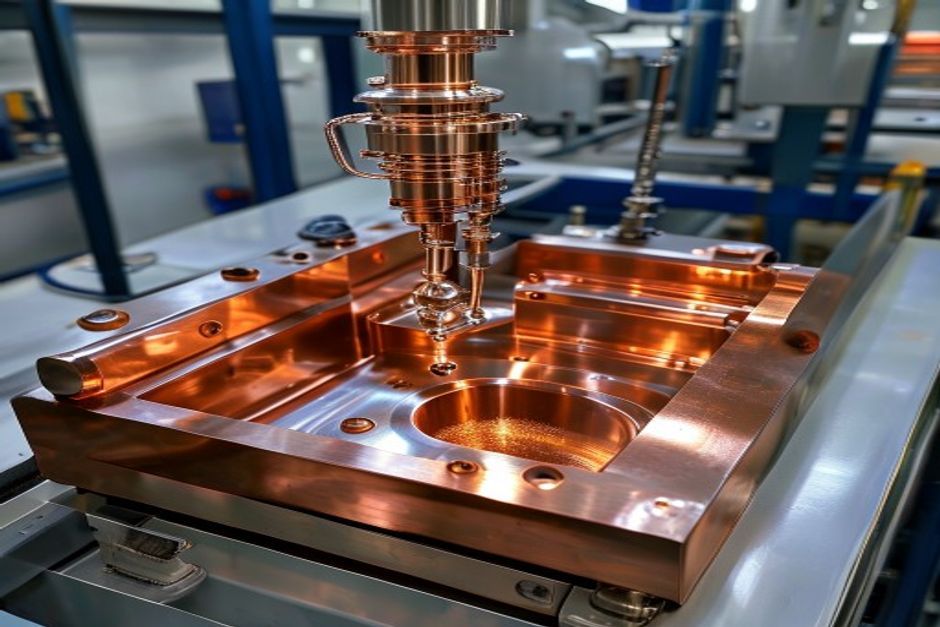
Sinker EDM (also called Ram EDM or Die Sinking EDM) uses a custom-shaped electrode — typically machined from graphite or copper — that descends into the workpiece, eroding a cavity that mirrors the electrode shape. Unlike Wire EDM that produces only through-cuts, Sinker EDM creates blind cavities, complex 3D surfaces, and intricate internal features.
Key Capabilities:
- Creates blind cavities with complex geometries and sharp internal corners
- Electrode wear is compensated through multi-electrode strategies or orbital motion
- Surface finishes from 32 Ra (roughing) to 4 Ra (fine finishing) with skim passes
- Electrode materials: graphite (most common, good wear resistance), copper (fine detail), copper-tungsten (high wear resistance, expensive)
- Orbital or planetary electrode motion enhances flushing and surface finish
Primary Applications: Injection mold cavities, die casting dies, forging dies, extrusion tooling, and complex 3D features in hardened materials that cannot be conventionally milled.
Hole Drilling EDM: Small and Deep Hole Creation
Hole Drilling EDM (also called Fast Hole EDM or Hole Popper EDM) specializes in producing small-diameter holes with high aspect ratios. A rotating tubular electrode — typically brass or copper, 0.012 to 0.250 inches in diameter — advances into the workpiece while dielectric fluid is pumped through the electrode center to flush debris from the cutting zone.
Key Capabilities:
- Creates holes as small as 0.004 inches in diameter
- Achieves depth-to-diameter ratios exceeding 100:1 in some materials
- Drills through hardened materials that would destroy conventional drill bits
- Creates holes at any angle — vertical, horizontal, or angled
- Penetrates curved or irregular entry surfaces without drill walking
- Cycle times of seconds to minutes depending on depth and diameter
Primary Applications: Cooling holes in turbine blades, wire EDM threading holes (start holes), fuel injector nozzles, medical cannulae, and any application requiring small, deep holes in hard or difficult-to-machine materials.
EDM Type Selection Guide
| Requirement | Recommended EDM Type |
|---|---|
| Through-profile cutting, 2D shapes | Wire EDM |
| Blind cavities, 3D forms | Sinker EDM |
| Small/deep holes (0.004-0.250 inch) | Hole Drilling EDM |
| Sharp internal corners (no radius) | Wire EDM |
| Hardened material (60+ HRC) | Any EDM (all types) |
| Injection mold cavity | Sinker EDM + CNC Milling |
EDM Limitations
FAQ
When is EDM Machining Types: Wire EDM vs Sinker EDM vs Hole Drilling EDM the right choice?
EDM Machining Types: Wire EDM vs Sinker EDM vs Hole Drilling EDM is the right choice when the part requires machined accuracy, controlled surfaces, repeatable features, and a material that can be cut reliably.
What should be confirmed before ordering EDM Machining Types: Wire EDM vs Sinker EDM vs Hole Drilling EDM?
Confirm the drawing version, material grade, tolerances, quantity, critical dimensions, surface finish, and inspection requirements before production starts.
What usually drives cost in EDM Machining Types: Wire EDM vs Sinker EDM vs Hole Drilling EDM?
Cost is usually driven by material, setup time, machine time, tolerance difficulty, fixturing, tool access, finishing, inspection, and order quantity.
How can quality risk be reduced in EDM Machining Types: Wire EDM vs Sinker EDM vs Hole Drilling EDM?
Quality risk is reduced by marking critical features clearly, avoiding unnecessary tight tolerances, confirming manufacturability early, and using inspection data for important dimensions.

