


Cost Components
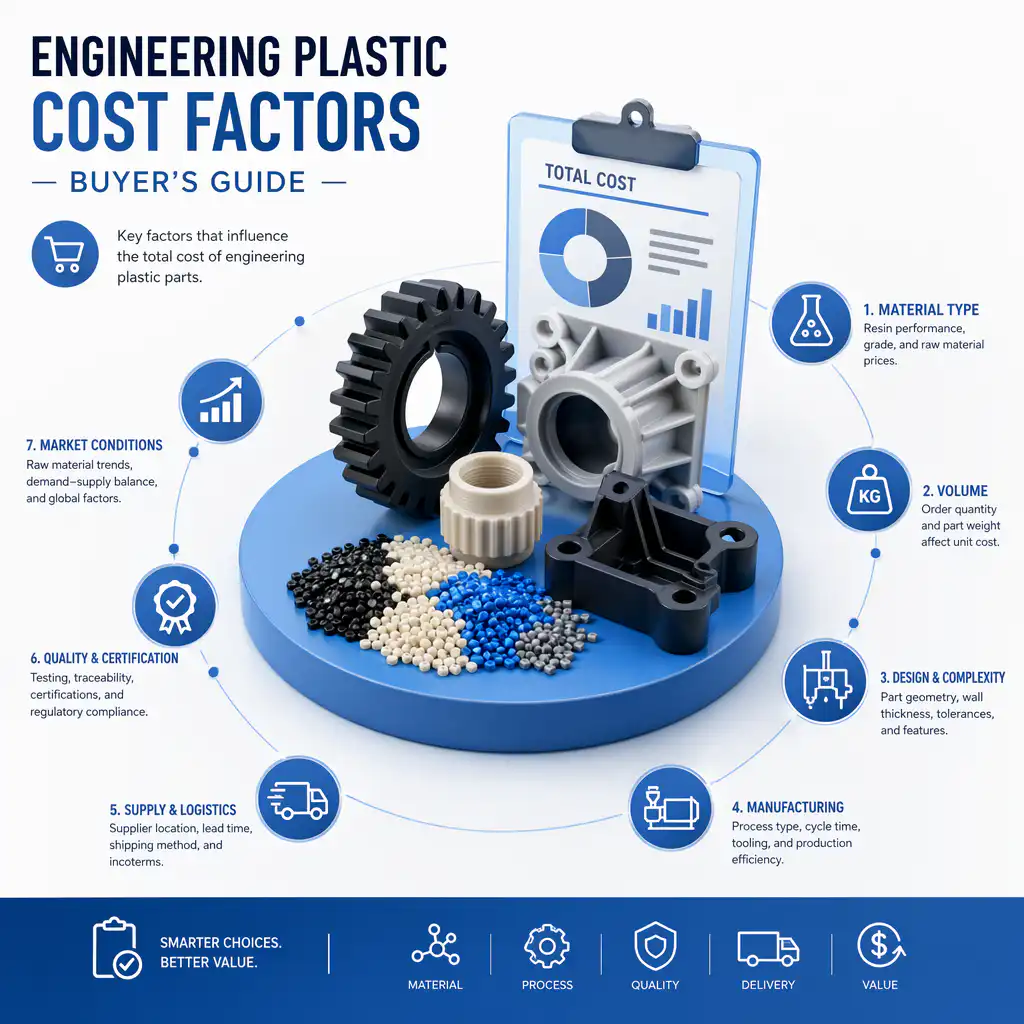
- Base Material Cost
- Additives & Fillers
- Volume Impact
- Specifications
Volume Pricing
- 1 ton: Base price
- 10 tons: -10-15%
- 100 tons: -20-30%
FAQ
When is Engineering Plastic Cost Factors — Buyer’s Guide a good option?
Engineering Plastic Cost Factors — Buyer’s Guide is a good option when fast iteration, complex geometry, low tooling cost, or low-volume production is more important than molded-part unit cost.
What should be checked before choosing Engineering Plastic Cost Factors — Buyer’s Guide?
Check part size, material properties, surface finish, dimensional tolerance, heat exposure, load direction, and whether post-processing is required.
How does Engineering Plastic Cost Factors — Buyer’s Guide compare with CNC machining?
3D printing can create complex shapes quickly, while CNC machining is often stronger for precise surfaces, tighter tolerances, and production-grade materials.
What affects the cost of Engineering Plastic Cost Factors — Buyer’s Guide?
Cost depends on material, build volume, print time, layer height, support removal, finishing, inspection, and the number of parts in the build.