
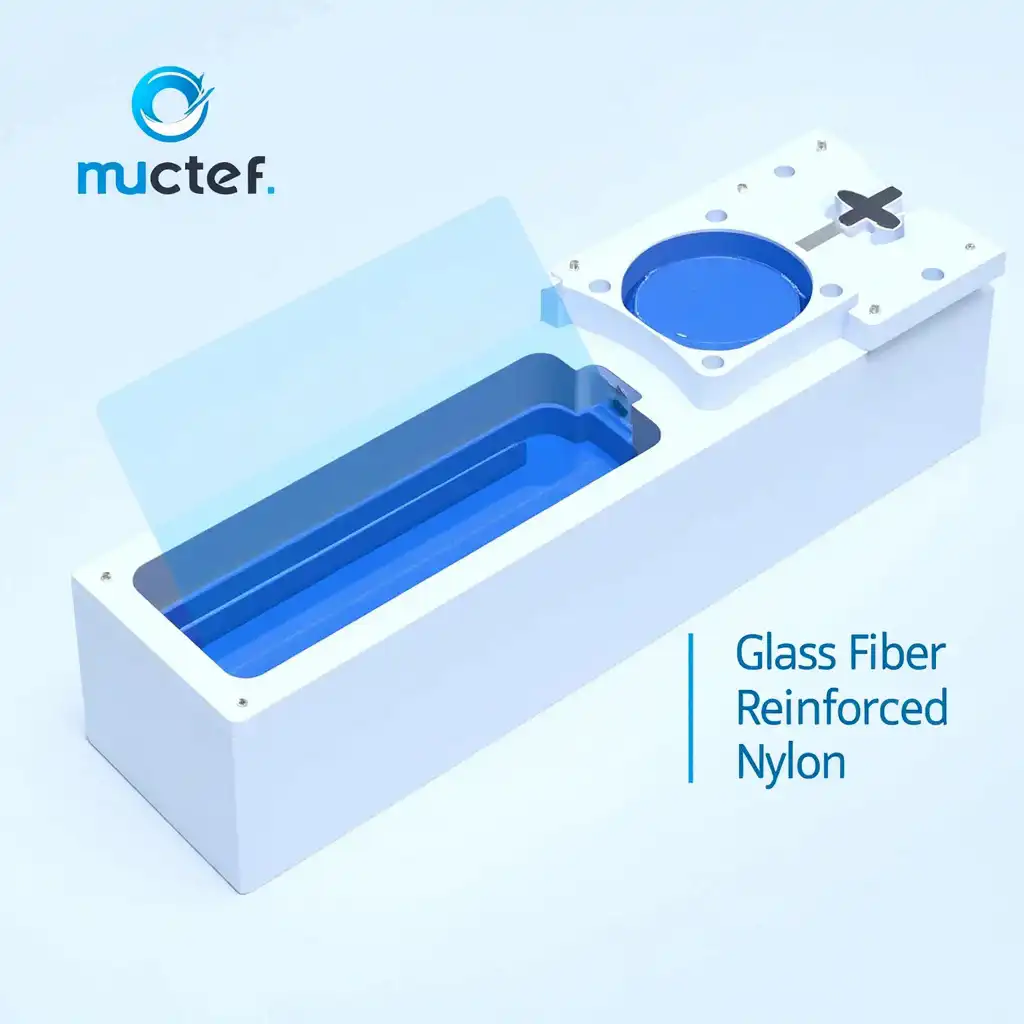

Why Glass Fiber Reinforcement?
Adding glass fiber to nylon dramatically improves mechanical properties, making it suitable for demanding applications that unreinforced nylon cannot handle.
Property Improvements
| Property | PA6 | PA6 + 30% GF |
|---|---|---|
| Tensile Strength | 75 MPa | 150 MPa |
| Flexural Modulus | 2.8 GPa | 7.5 GPa |
| HDT (1.8 MPa) | 70°C | 205°C |
| Moisture Absorption | 8% | 1.5% |
Applications
- Automotive: radiator end tanks, intake manifolds
- Electrical: high-temperature connectors
- Industrial: pump housings, valve bodies
Processing Guidelines
- Dry at 80-100°C for 4-6 hours
- Use wear-resistant screw
- Higher mold temperatures (60-90°C)
Glass Fiber Reinforced Nylon Selection Table
| Requirement | What glass fiber changes |
|---|---|
| Stiffness | Raises modulus and can reduce deflection along the fiber direction |
| Warpage | Reduces or redirects shrinkage, but orientation can create anisotropy |
| Surface and wear | May increase roughness and tool wear; validate cosmetic and mating surfaces |
| Moisture | Matrix absorption still matters; condition the grade and inspect dimensions |
Choose the fiber percentage and nylon matrix from the load path, temperature, moisture, surface and tolerance requirements of the finished part. Validate ribs, bosses, threads and snap fits rather than relying on a flat coupon.
FAQ
How do you know whether Glass Fiber Reinforced Nylon — When Standard Isn’t Enough fits a part?
Glass Fiber Reinforced Nylon — When Standard Isn’t Enough fits a part when its load capacity, temperature range, moisture exposure, wear behavior, and processing method match the real service conditions.
What properties should be checked for Glass Fiber Reinforced Nylon — When Standard Isn’t Enough?
Check strength, stiffness, impact resistance, heat resistance, moisture absorption, dimensional stability, friction, wear, and chemical compatibility.
What is the biggest selection risk for Glass Fiber Reinforced Nylon — When Standard Isn’t Enough?
The biggest risk is choosing from a datasheet value without considering actual environment, processing method, part geometry, and long-term use.
When should Glass Fiber Reinforced Nylon — When Standard Isn’t Enough be tested before production?
Testing is recommended when the part faces load, heat, chemicals, moisture, tight tolerances, regulatory requirements, or a new operating environment.

