
Nylon vs polypropylene: choose nylon when the part must carry more load, resist wear, or retain useful stiffness at higher temperature. Choose polypropylene when low moisture uptake, broad resistance to many aqueous chemicals, low density, and unit cost are the stronger priorities.
There is no universal winner. Define the service temperature, sustained load, fluid exposure, dimensional tolerance, and expected production volume before comparing grades.

At a Glance
| Decision Point | Nylon | Polypropylene | Engineering Check |
|---|---|---|---|
| Load and wear | Usually stronger | Better for lighter duty | Check creep and bearing stress |
| Moisture | Absorbs more water | Very low uptake | Define the conditioned dimensions |
| Heat | Usually retains more stiffness | Lower loaded-temperature margin | Compare the actual grade, not only the resin family |
| Chemical exposure | Good in oils and many hydrocarbons | Often stronger in acids, bases, and wet service | Verify concentration, temperature, and exposure time |
| Part cost | Higher resin and processing cost | Usually lower | Include density, cycle time, and reject risk |
Head-to-Head Property Comparison
| Property | PA66 (dry) | PA66 (cond) | PP Homopolymer | PP Copolymer |
|---|---|---|---|---|
| Tensile Strength (MPa) | 80-85 | 50-55 | 30-38 | 25-30 |
| Flexural Modulus (GPa) | 2.8-3.0 | 1.2-1.5 | 1.2-1.5 | 0.9-1.2 |
| Notched Izod Impact (kJ/m²) | 4-6 | 15-25 | 3-5 | 20-40 (NB at 23°C) |
| HDT @ 1.82 MPa (°C) | 70-80 | — | 50-60 | 45-55 |
| Continuous Use Temp (°C) | 100-130 | — | 80-100 | 80-100 |
| Density (g/cm³) | 1.14 | — | 0.90-0.91 | 0.90 |
| Water Absorption (24h, %) | 1.2-1.5 | — | <0.01 | <0.01 |
| Cost ($/kg, bulk) | 3.00-4.50 | — | 1.50-2.50 | 1.80-2.80 |

When Nylon Wins: Strength, Temperature, and Wear
Nylon dominates applications requiring mechanical load-bearing at elevated temperatures. At 80°C, dry PA66 retains 60-70% of its room-temperature tensile strength; PP drops to 30-40%. For gears, bearings, and structural brackets, nylon’s 2-3× higher flexural modulus means thinner walls for the same stiffness — reducing part weight even though nylon is 25% denser than PP. In wear applications (gears, sliding surfaces), unfilled nylon has a PV limit of ~0.09 MPa·m/s versus ~0.03 for PP, and adding internal lubricants (MoS₂, PTFE) can push nylon’s PV limit above 0.2 MPa·m/s.
When PP Wins: Chemical Resistance, Moisture, and Cost
Polypropylene is virtually immune to moisture absorption (<0.01% at saturation), making it the default choice for underwater, humid, and chemical-exposure applications. Nylon absorbs 2-8% moisture at saturation (depending on grade), losing 30-40% of its dry strength and swelling 0.5-1.5% dimensionally. PP also resists most acids, bases, and organic solvents at room temperature — nylon is attacked by strong acids, phenols, and oxidizing agents. In chemical tank applications, PP's chemical resistance alone eliminates nylon from consideration.
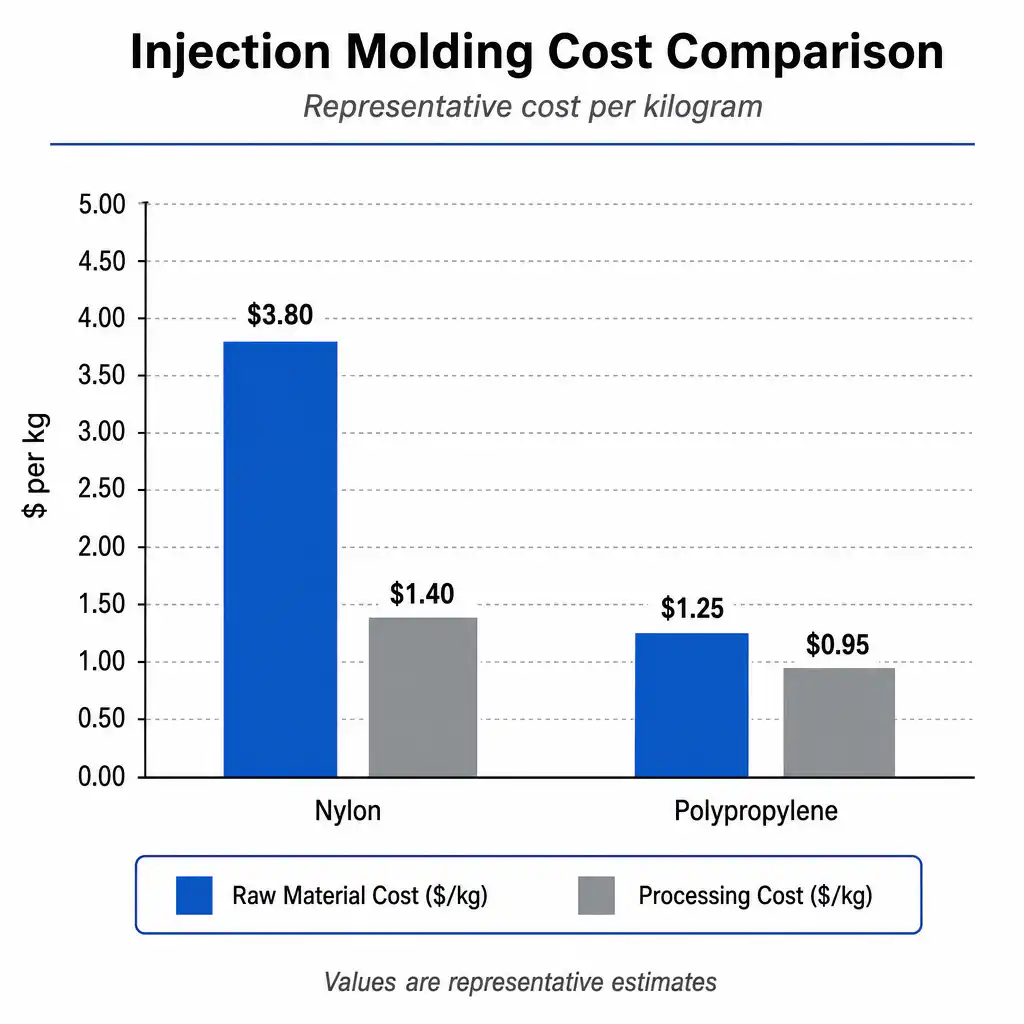
On cost, PP at $1.50-2.50/kg runs 40-60% cheaper than PA66 at $3.00-4.50/kg. For high-volume consumer goods where strength over 30 MPa is unnecessary, this cost gap is decisive. PP’s lower density (0.90 vs 1.14 g/cm³) stretches the per-part cost advantage further: a 100g PA66 part weighs 79g in PP — 21% less material per part.
Design Rules for Material Selection
- Use nylon when continuous temp exceeds 80°C: PP’s HDT drops to 50-60°C under load. For engine bay, power tool, or any application near a heat source, nylon (PA66 or PA6) is the floor — PPA or PPS may be needed above 130°C.
- Use PP for outdoor and wet environments: UV-stabilized PP grades (with 2-3% carbon black or HALS) handle years of outdoor exposure. Nylon requires UV stabilization and will still lose surface quality faster. For submerged or high-humidity parts, PP’s zero moisture absorption eliminates dimensional change.
- Run the density-adjusted cost comparison: Per-part material cost = (part volume in cm³) × (density in g/cm³) × (resin cost $/kg) ÷ 1000. A PP part at $2/kg × 0.90 density costs $1.80/L of material; PA66 at $4/kg × 1.14 density costs $4.56/L — a 2.5× difference that surprises designers comparing per-kg prices.
- Consider glass-filled grades for the middle ground: PP-GF30 reaches tensile strength of 70-90 MPa — approaching dry PA66 at 80 MPa — at roughly $2.50-3.50/kg. GFPP cannot match nylon’s temperature resistance but closes the strength gap significantly for ambient-temperature structural parts.
- Living hinges: PP only: Polypropylene’s unique combination of high fatigue resistance and low modulus makes it the only commodity plastic that reliably forms living hinges capable of 10⁶+ flex cycles. Nylon living hinges fail at a few hundred cycles due to notch sensitivity and higher stiffness.
- Check chemical compatibility with your full exposure list: Nylon fails in contact with: strong acids (HCl, H₂SO₄), phenols, aromatic hydrocarbons, and zinc chloride solutions. PP fails with: strong oxidizing agents (concentrated nitric acid, halogens), and swells in aromatic/chlorinated hydrocarbons. Test with your actual process chemicals, not just the datasheet.
Industry Application Matrix
| Industry | Typical Parts | Material/Grade | Key Requirement |
|---|---|---|---|
| Automotive Under-hood | Engine covers, intake manifolds, radiator tanks | PA66-GF30 | PPA or PA66 (HDT >200°C) |
| Consumer Packaging | Food containers, caps, closures | PP homo/copolymer | Cost <$2/kg + food contact approval |
| Power Tools | Housings, gear cases, fan impellers | PA6-GF30 | Impact at -20°C + heat from motor |
| Chemical Processing | Tanks, fittings, pump housings | PP homo or PP-GF20 | Chemical resistance across pH 1-14 range |

Cost Decision Framework
Raw material: PP is $1.50-2.80/kg; PA66 is $3.00-4.50/kg; PA6 is $2.50-3.50/kg. The gap widens for specialty grades — glass-filled PP adds $0.50-1.00/kg; glass-filled nylon adds $1.00-2.00/kg over unfilled base.
Processing cost: PP cycles 10-20% faster than nylon (lower melt viscosity, faster cooling). For a 50g part, PP at 20s cycle vs nylon at 24s cycle saves ~$0.02/part in machine time at $30/hr. Over a million parts, that is $20,000 in cycle time alone.
Cost-of-failure consideration: If a nylon part absorbs moisture and swells out of tolerance, the rework cost dwarfs the material savings. Conversely, if a PP part creeps under sustained load and a product fails in the field, the warranty cost makes the nylon premium look cheap. Choose based on the application’s dominant failure mode, not just the per-kg price.
Common Defects by Material
| Defect | Appearance | Root Cause | Solution |
|---|---|---|---|
| Warpage / distortion | Part bows or twists after demolding | Uneven cooling; anisotropic shrinkage | Optimize cooling layout; verify wall thickness uniformity <15% |
| Brittle failure | Part snaps with no yielding | Nylon: molded too dry. PP: degraded by UV/heat | Nylon: condition to 1.5-2.5% moisture. PP: add UV stabilizer |
| Surface delamination | Skin peels in layers | Contamination; incompatible regrind; mold release buildup | Purge barrel; limit regrind to <20%; clean mold surface |
| Creep / permanent set | Part deforms under sustained load | Insufficient modulus for load level | Switch to GF grade; add ribbing; specify creep modulus, not short-term |
Buyer Checklist Before You Select a Grade
- Record the continuous and peak service temperature.
- Separate sustained structural load from occasional impact.
- List every chemical, cleaner, oil, and humidity condition the part will see.
- Define whether dimensions apply dry-as-molded or after conditioning.
- Compare molded-part cost, not resin price alone.
Why Choose Nylon Plastic for Your Project
Precision Manufacturing
30+ CNC & injection molding cells under one roof
ISO 9001:2015 Certified
Certified quality system, full inspection reports
15-25 Day Lead Time
Fast turnaround with expedited options available
Global Shipping
Air & sea freight to North America, Europe, Asia
Download Our Nylon vs Polypropylene Guide
Free PDF reference guide with technical data, design rules, and supplier checklists.
Related Articles
Frequently Asked Questions
Which is stronger — nylon or polypropylene?
Nylon (PA66) is approximately 2-3× stronger than polypropylene. Dry PA66 has a tensile strength of 80-85 MPa versus 30-38 MPa for PP homopolymer. However, conditioned nylon (at 50% RH equilibrium) drops to 50-55 MPa — still roughly 50% stronger than PP. For stiffness, nylon’s flexural modulus of 2.8-3.0 GPa (dry) is about double PP’s 1.2-1.5 GPa. The strength gap narrows significantly when comparing glass-filled grades: PP-GF30 reaches 70-90 MPa, approaching dry PA66 unfilled strength.
Which has better chemical resistance — nylon or PP?
Polypropylene has much better chemical resistance. PP is resistant to most acids, bases, alcohols, and aqueous solutions at room temperature up to 80°C. Nylon is attacked by strong acids (HCl, H₂SO₄), phenols, aromatic hydrocarbons, hot water (>80°C causes hydrolysis), and oxidizing agents. For chemical storage, processing equipment, and laboratory applications, PP is almost always the better choice. The exception: nylon resists hydrocarbons (gasoline, oils, greases) better than PP, which swells in aromatic and chlorinated hydrocarbons.
Is nylon or PP better for outdoor use?
Neither is ideal in raw form — both degrade under UV. UV-stabilized PP (with 2% carbon black or HALS additives) weathers better than UV-stabilized nylon and costs less. PP does not absorb water, eliminating the freeze-thaw damage that can crack moisture-saturated nylon. For long-term outdoor structural applications above 80°C, UV-stabilized nylon with glass fill is the better choice despite weathering limitations, because PP loses mechanical integrity as it approaches its HDT.
Why is nylon more expensive than polypropylene?
Nylon costs more because: (1) Raw monomer production (adipic acid + hexamethylene diamine for PA66; caprolactam for PA6) involves multi-step petrochemical processes versus PP’s single-step propylene polymerization. (2) Higher processing energy — nylon molds at 260-300°C vs PP at 200-240°C. (3) Higher density (1.14 vs 0.90 g/cm³) means 27% more material by weight for the same part volume. The premium buys higher strength, temperature resistance, and wear properties — valuable in engineered applications but wasteful in simple containers or low-stress consumer goods.
Request a Material Review
Send the drawing, annual volume, service temperature, load, and fluid exposure. We can compare suitable nylon and polypropylene grades before tooling or production.

