


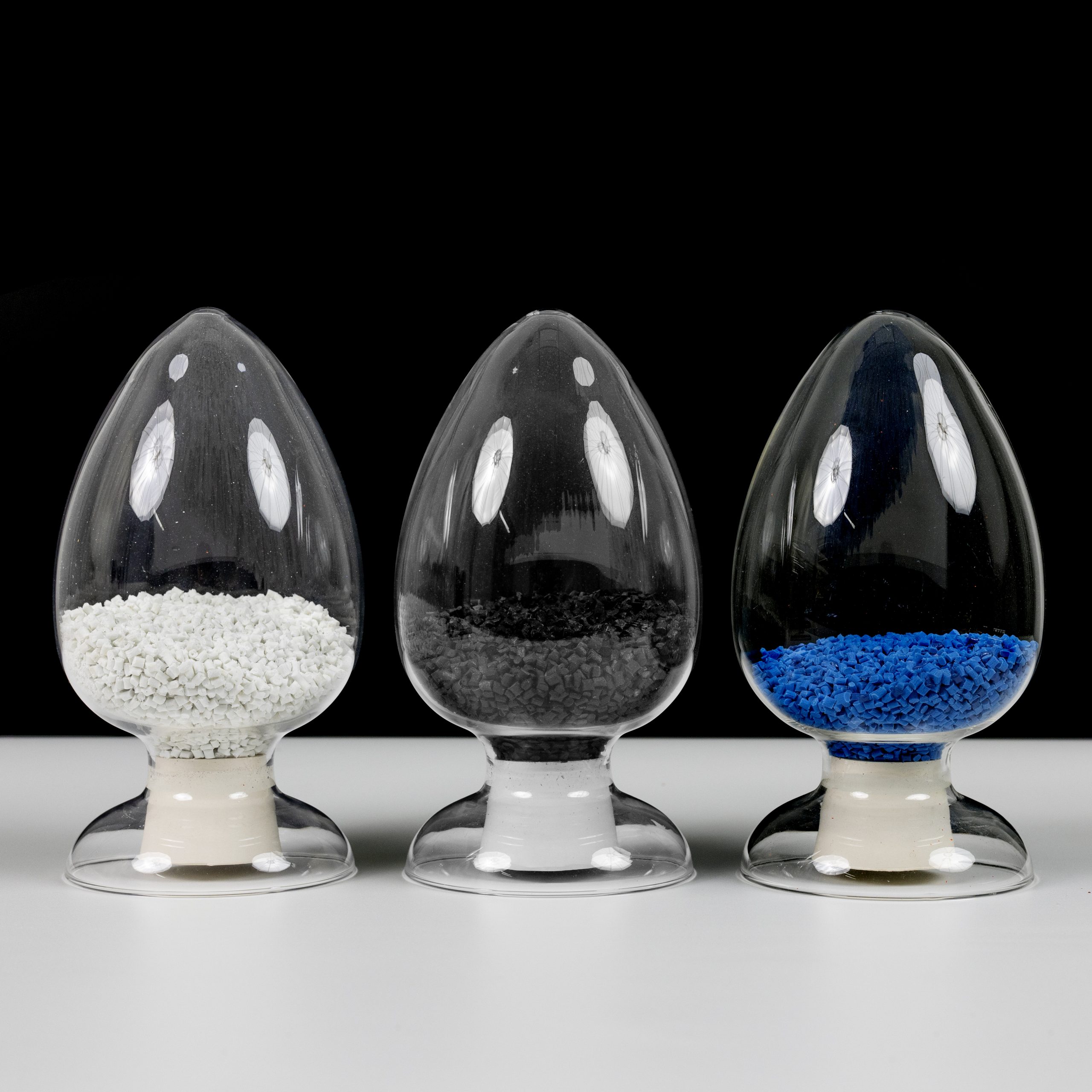
ABS GF10 Technical Data (Estimated Typical Values)
| Property | Value | Test Standard |
|---|---|---|
| Glass Fiber Content | 10% | ISO 1172 |
| Tensile Strength | 55 – 70 MPa | ISO 527 |
| Flexural Modulus | 4,000 – 5,000 MPa | ISO 178 |
| Notched Impact Strength | 10 – 15 kJ/m² | ISO 180 |
| HDT @1.8 MPa | 95 – 105 °C | ISO 75 |
| Mold Shrinkage (flow) | 0.3 – 0.5% | ISO 294-4 |
ABS GF Series Performance Comparison Table (Estimated Typical Values)
| Property | ABS GF10 | ABS GF20 | ABS GF30 | ABS GF40 | ABS GF50 |
|---|---|---|---|---|---|
| Glass Fiber Content | 10% | 20% | 30% | 40% | 50% |
| Tensile Strength | 55 – 70 MPa | 70 – 85 MPa | 85 – 100 MPa | 95 – 115 MPa | 105 – 125 MPa |
| Flexural Modulus | 4,000 – 5,000 MPa | 5,500 – 6,800 MPa | 7,000 – 8,500 MPa | 8,500 – 10,500 MPa | 10,000 – 12,500 MPa |
| Notched Impact Strength | 10 – 15 kJ/m² | 8 – 12 kJ/m² | 7 – 10 kJ/m² | 6 – 9 kJ/m² | 5 – 8 kJ/m² |
| HDT @1.8 MPa | 95 – 105 °C | 100 – 110 °C | 105 – 115 °C | 110 – 120 °C | 115 – 125 °C |
| Mold Shrinkage | 0.3 – 0.5% | 0.2 – 0.4% | 0.1 – 0.3% | 0.1 – 0.25% | 0.05 – 0.2% |
| Key Profile | Stiffness upgrade | Balanced performance | Structural benchmark | High rigidity | Maximum performance |
ABS GF10 Key Advantages
✅ Enhanced Stiffness & Dimensional Stability: Offers a significant and cost-effective increase in rigidity and reduces warpage compared to unfilled ABS, providing better part flatness and fit.
✅ Maintained Toughness & Processability: Retains good impact resistance and the relatively easy processing characteristics of ABS, making the transition to reinforced materials straightforward.
✅ Improved Thermal Performance: Provides a higher heat deflection temperature, allowing parts to maintain shape and strength in warmer environments.
Industry Applications:

Explore the ABS Glass Fiber Series in Detail
Click on the links below to view comprehensive technical data, key advantages, and application details for each specific grade.
| Grade | Best For | Overview | Full Details |
|---|---|---|---|
| ABS GF10 | Cost-effective enhancement of stiffness & dimensional stability for structural parts. | The most accessible GF grade, offering a clear boost in rigidity and heat resistance while maintaining good impact strength and processability. | View ABS GF10 Full Data Sheet → |
| ABS GF20 | Parts requiring a balanced upgrade in mechanicals, surface finish, and precision. | A balanced performer, providing significantly higher stiffness and strength than GF10 with very good dimensional stability for engineering components. | View ABS GF20 Full Data Sheet → |
| ABS GF30 | High-performance structural applications demanding stiffness, strength, and stability. | The benchmark grade, delivering an optimal balance of high mechanical properties, thermal resistance, and minimal warpage for demanding uses. | View ABS GF30 Full Data Sheet → |
| ABS GF40 | Ultra-stiff components where metal-like rigidity and creep resistance are critical. | Engineered for maximum rigidity and exceptional long-term dimensional stability under load, ideal for structural metal replacement. | View ABS GF40 Full Data Sheet → |
| ABS GF50 | Maximum mechanical performance for the most demanding structural designs. | The pinnacle grade, offering the highest stiffness and strength in the series for applications where performance is the primary driver. | View ABS GF50 Full Data Sheet → |
Powering Innovation Across Industries (ABS GF Series)
| Industry | Key Applications |
|---|---|
| Automotive | Structural interior brackets (IP supports, seat frames), under-hood components (sensor housings, brackets), lamp housings, connectors. Explore Automotive Solutions → |
| Electrical & Electronics | High-strength enclosures for power supplies and tools, structural chassis for printers and copiers, connector bodies, circuit breaker housings. Discover E&E Solutions → |
| Industrial Equipment | Pump housings, gearboxes, conveyor components, robotic arm segments and end-effector frames, machine guards and covers. See Industrial Uses → |
| Consumer Durables & Tools | Structural frames for power tools (drills, saws), vacuum cleaner motor housings and handles, high-strength appliance components, sports equipment. Explore Consumer Applications → |
| Furniture & Business Machines | Office furniture structural components (chair bases, frame reinforcements), internal frames for large printers and medical devices. Inquire About Specialty Uses → |

How to Choose the Right ABS GF Grade?
In simple terms:
For a cost-effective step into reinforced ABS with noticeably improved stiffness and stability for housings or brackets, consider ABS GF10.
For the optimal balance of enhanced mechanical properties, good surface quality, and dimensional precision in technical components, choose ABS GF30. It is the performance benchmark for most structural applications.
For the ultimate stiffness and strength approaching that of metals in high-load structural applications, consider ABS GF50.
Unsure which is perfect for your part? Describe your application to our engineers for a tailored recommendation.
Why Choose Us?


ABS GF10 FAQ
Q1: What are the main benefits of adding glass fiber to ABS?
Adding glass fiber to ABS primarily increases stiffness (flexural modulus), tensile strength, and heat deflection temperature (HDT). It also significantly reduces molding shrinkage and warpage, improving dimensional stability and part precision.
Q2: Does ABS GF10 have a good surface finish?
The surface finish of ABS GF10 is acceptable for many technical parts but will show some fiber pattern compared to unfilled ABS. For Class-A surfaces, post-processing like painting or texture finishing is often used. Grades with lower fiber content or specific surface-modified formulations provide better aesthetics.
Q3: How does processing ABS GF10 differ from standard ABS?
Processing is similar but requires attention: Drying: May require slightly longer drying times (2-4 hours at 80-85°C). Abrasion: Use hardened or abrasion-resistant screws and tooling. Melt Temperature: Slightly higher range, typically 230-250°C. Injection Speed: Moderate to high speeds help achieve a better surface.
