
Carbon fiber nylon parts are usually selected when a project needs more stiffness than unfilled nylon, lower weight than metal, and faster iteration than traditional tooling can support. Buyers most often use them for brackets, fixtures, housings, end-of-arm tooling, covers and lightweight structural parts.
This guide explains how to source carbon fiber nylon parts, when to choose 3D printing or machining, what design limits matter, and how to evaluate a supplier before RFQ. The goal is not to treat carbon fiber nylon as a generic miracle material, but to match the grade and process to the actual load, tolerance and volume requirement.
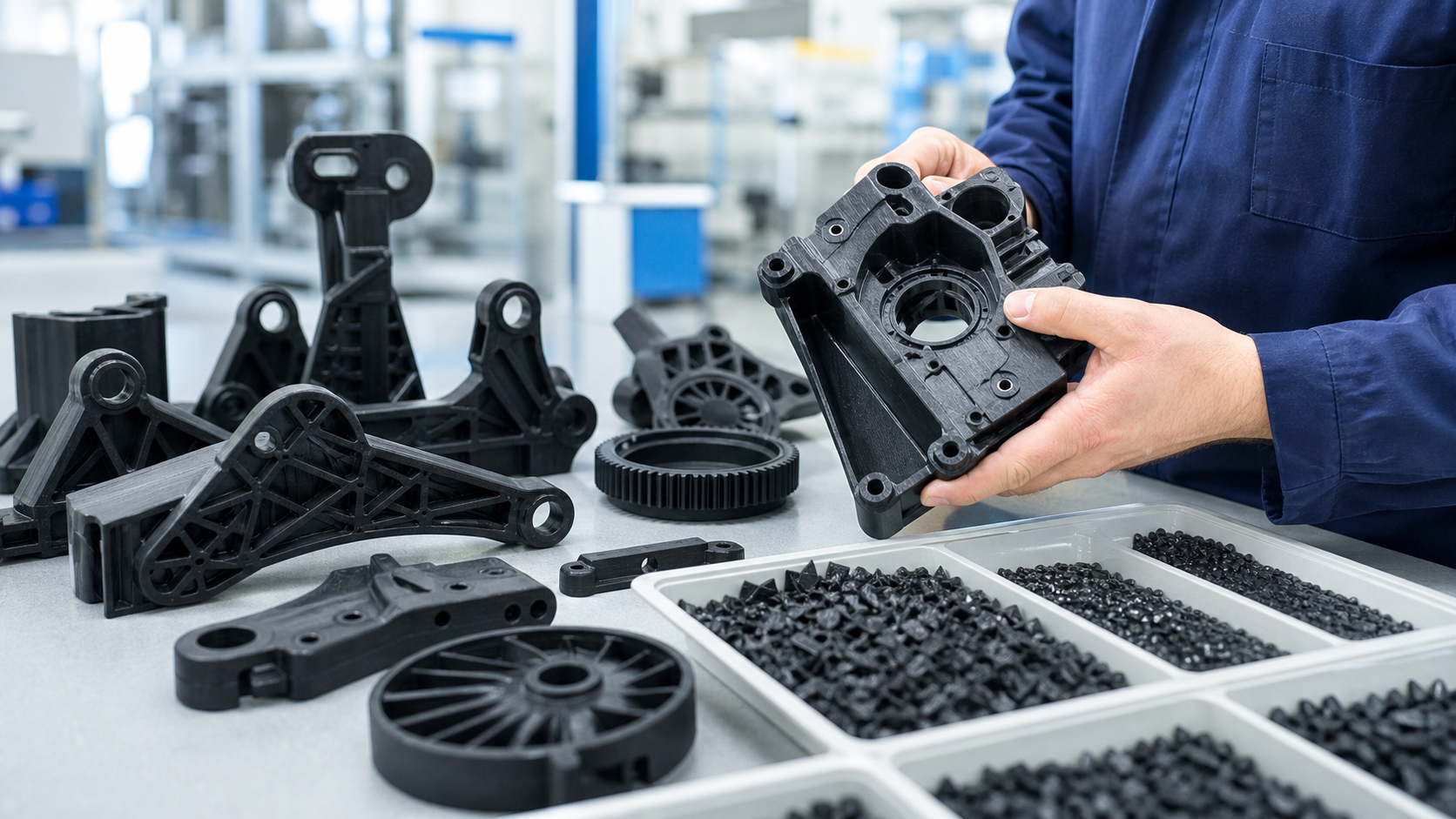
Carbon Fiber Nylon Parts at a Glance
| Decision Area | Common Options | Buyer Check |
|---|---|---|
| Base materials | PA6-CF, PA12-CF, short-fiber reinforced nylon compounds | Confirm stiffness, moisture sensitivity, impact needs and environment |
| Manufacturing route | FDM, SLS, MJF, CNC machining, molding with reinforced resin | Match process to geometry, volume and tolerance target |
| Best-fit parts | Jigs, fixtures, lightweight brackets, covers, robotic tooling | Check whether the load is static, repeated or impact-heavy |
| Main risks | Layer-direction weakness, moisture movement, brittle edge details | Review fiber orientation, wall design and post-processing plan |
| RFQ inputs | CAD model, load case, tolerance notes, surface requirement, quantity | Send functional requirements, not only geometry |
When Carbon Fiber Nylon Is the Right Choice
Carbon fiber filled nylon makes sense when standard nylon is too flexible and aluminum would add unnecessary weight or machining cost. It performs well in tooling, automation and low-to-mid volume functional parts where stiffness matters more than cosmetic appearance.
It is less suitable when the part needs glossy surfaces, high impact toughness at sharp corners, or long-term outdoor use without confirmed UV and moisture controls. If the part will be under continuous high heat, chemical exposure or aggressive wear, the supplier should review whether another engineering plastic is more stable.
Compare the reinforcement trade-offs with the glass-filled nylon guide before fixing the material family.
First Clarify What You Are Buying
The phrase carbon fiber nylon can describe compounded pellets for injection molding, filament or powder for additive manufacturing, reinforced stock for machining, or a finished part. These are not interchangeable purchase items. The RFQ should identify both the PA matrix and the intended manufacturing route.
| Purchase Item | Typical Specification | What the Supplier Needs |
|---|---|---|
| Modified nylon pellets | PA6-CF30, PA66-CF30, or PA12-CF30 compound | Processing route, annual volume, color, approvals, COA, and packaging |
| 3D-printing feedstock | Qualified filament or powder for a named printer and process | Printer route, orientation, drying, surface, and property target |
| Finished carbon fiber nylon parts | Drawing-controlled printed, machined, or molded components | CAD, critical tolerances, load case, environment, quantity, and inspection plan |
For a drawing-controlled finished part, review the custom plastic components scope alongside the material designation.
Material Options and Process Routes
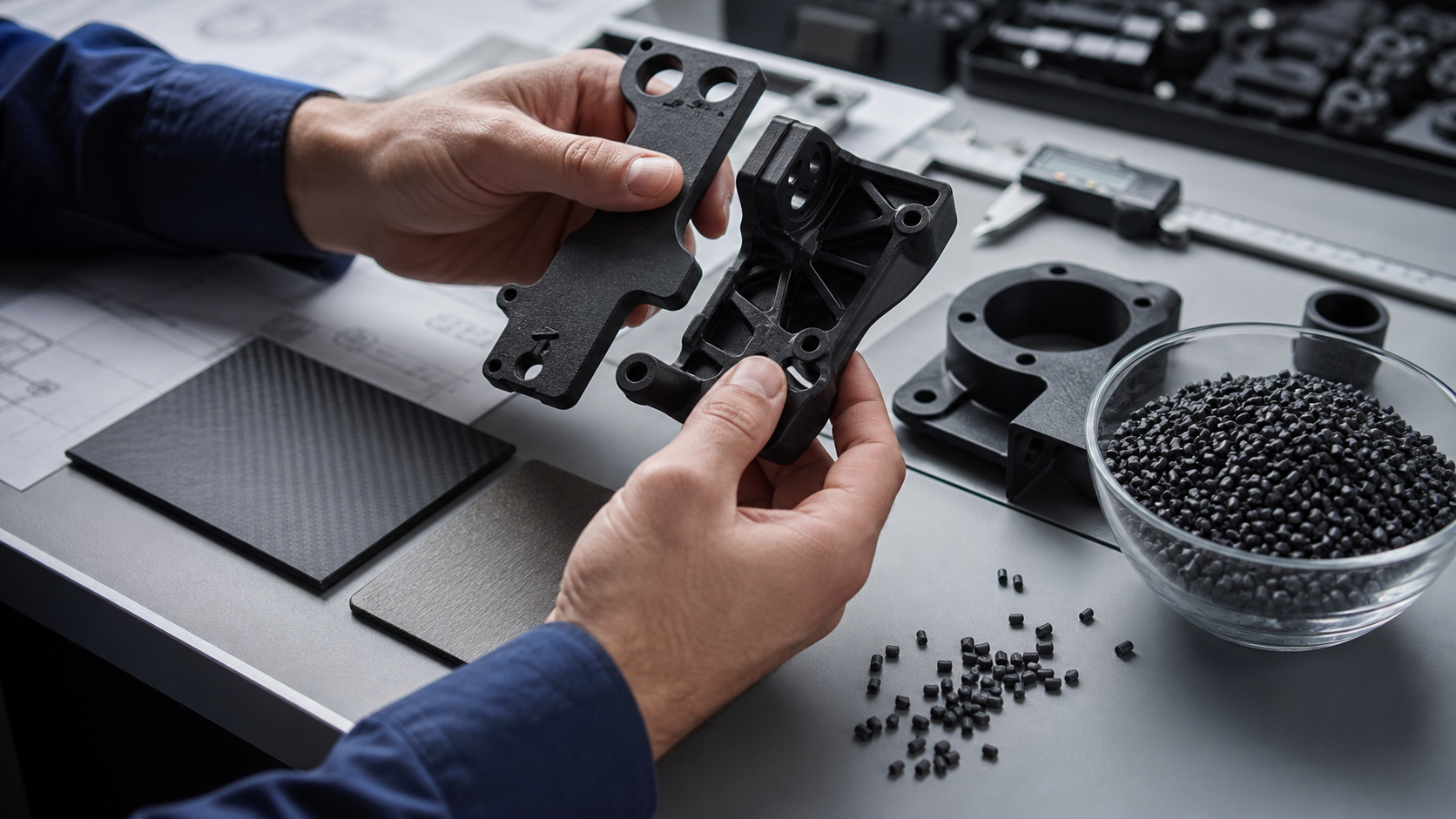
Buyers often compare PA6-CF and PA12-CF based on stiffness, moisture behavior and printability. PA6-CF can deliver high rigidity but is more moisture-sensitive. PA12-CF is often preferred for more stable environmental performance and better process consistency in additive manufacturing.
- 3D printing: best for prototypes, fixtures, complex lightweight structures and low-volume production.
- CNC machining: useful when stock shape is available and critical features need controlled finishing.
- Injection molding: better when demand is stable and tooling cost can be justified.
For many custom-part projects, the fastest path is to validate the part with additive manufacturing first, then decide whether a machined or molded version is justified by annual usage.
For the printed route, the PA6-CF 3D printing guide covers feedstock and build considerations; it does not qualify a molded compound as printer filament.
Design Rules That Matter
- Keep wall transitions gradual to reduce stress concentration.
- Avoid extremely thin unsupported ribs on highly loaded parts.
- Mark bolt zones, clamping areas and wear interfaces on the drawing.
- Share the actual load direction if the part will be additively manufactured.
- State whether flatness or stiffness matters more when tradeoffs appear.
Common Problems and Practical Fixes
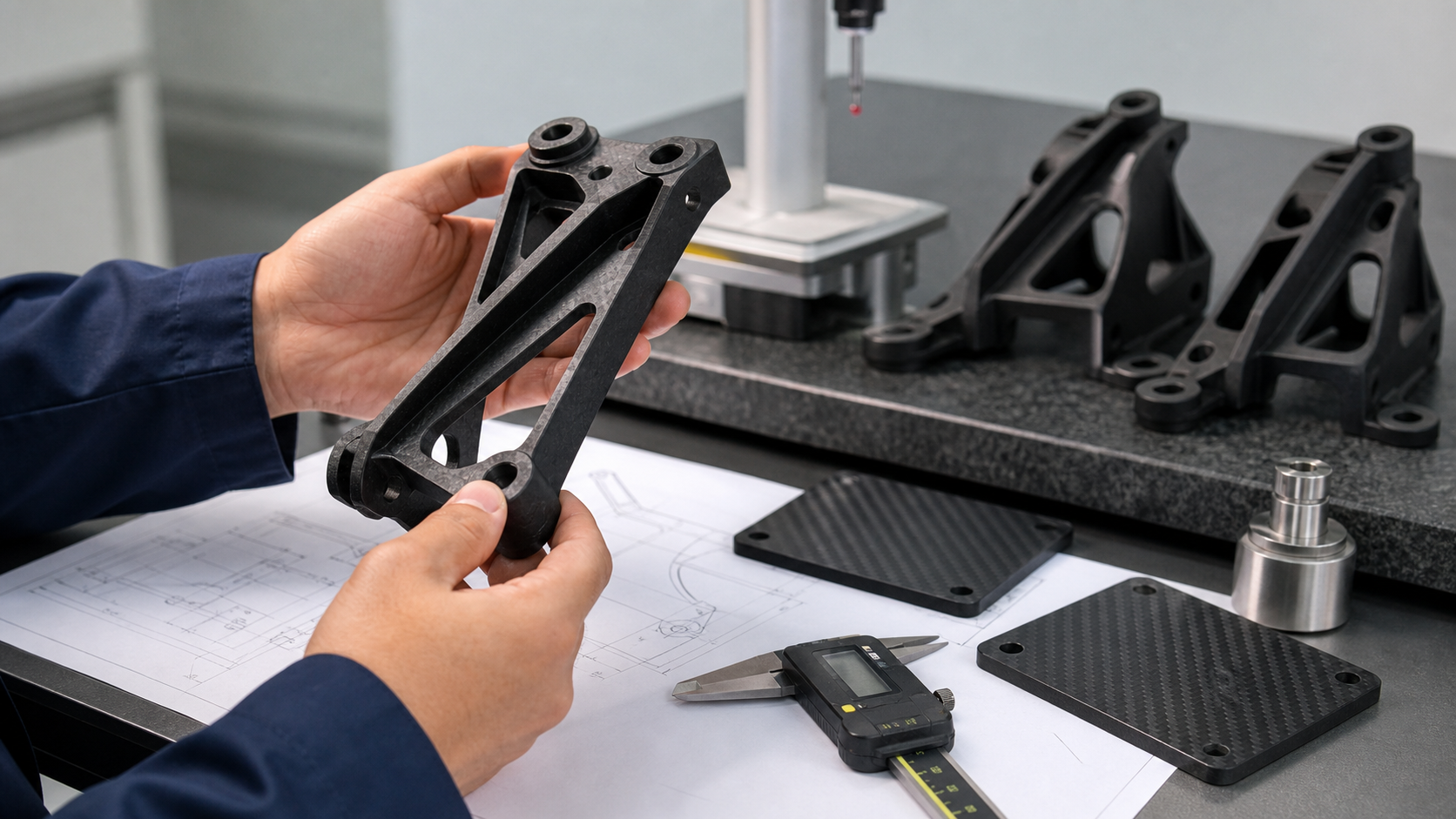
| Problem | Likely Cause | Practical Fix |
|---|---|---|
| Part cracks at an edge | Sharp geometry or wrong fiber-reinforced grade | Add radii, increase local section, review impact load |
| Unexpected deflection | Load path not aligned with process capability | Review orientation, section thickness and support points |
| Dimension drift | Moisture absorption or post-process change | Define inspection condition and final environment |
| Overpriced quote | Process selected before function review | Ask supplier to compare additive, machining and molding routes |
Frequently Asked Questions
Are carbon fiber nylon parts stronger than standard nylon parts?
They are usually stiffer and can hold shape better under load, but they are not automatically better in every direction. Impact behavior and anisotropy still need review.
Can carbon fiber nylon parts be used for production?
Yes, especially for fixtures, brackets, automation parts and low-volume functional components. The correct process depends on volume, tolerance and environment.
What files should I send for a quote?
Send a 3D model, a drawing with key tolerances, quantity, load information and any assembly requirements such as inserts or fasteners.
Should I choose printed or machined carbon fiber nylon parts?
Printed parts are usually better for complex geometry and quick iteration. Machined parts can be better when stock forms exist and feature control is more important than geometric freedom.
Request a Carbon Fiber Nylon Part Review
For finished carbon fiber nylon parts, send the drawing and load case. Nylon Plastic can compare a printed prototype, a machined component where suitable stock exists, and a molded production part against the same functional requirements.
What to include and agree before quotation
Since 2005, Nylon Plastic has combined engineering-plastic material support with finished-part manufacturing. A single review can compare custom compounding, 3D printing, CNC machining, and injection molding against the same drawing, volume, and validation requirement.
State the current PA matrix and fiber content, exact grade or permitted alternative, environment, measurement condition, surface requirements, first order, annual demand, destination and timing.
| What to Send | Why It Matters |
|---|---|
| STEP file and revision-controlled drawing | Supports process review and tolerance planning |
| Load case or application note | Prevents quoting the wrong grade or build direction |
| Quantity and reorder expectation | Helps decide whether to print, machine or mold |
| Critical dimensions | Focuses inspection on functional features |
| Assembly details | Confirms inserts, fasteners and mating conditions |
Compare PA6-CF30, PA66-CF30 and PA12-CF30 as separate material routes. These compound designations do not establish qualification as printer filament or powder. Confirm the exact feedstock and process before comparing property data.
Agree the proposed grade and process, orientation, critical-feature inspection, inserts and finishing in the quotation. Qualify the intended production route separately: a printed prototype does not establish the properties of a molded PA-CF30 part.

