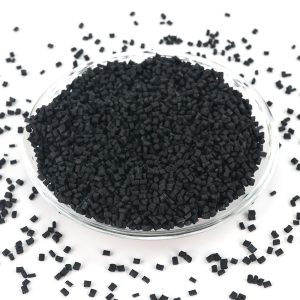


PA66 CF30 Technical Data (Estimated Typical Values)
| Property | Value | Test Standard |
|---|---|---|
| Carbon Fiber Content | 30% | ISO 1172 |
| Tensile Strength | 240 – 270 MPa | ISO 527 |
| Flexural Modulus | 21,000 – 24,000 MPa | ISO 178 |
| Notched Impact Strength | 10 – 13 kJ/m² | ISO 180 |
| HDT @1.8 MPa | 260 – 270 °C | ISO 75 |
| Volume Resistivity | 10^1 – 10^3 Ω·cm | IEC 60093 |
PA66 CF Series Technical Data Table (Estimated Typical Values)
| Property | Test Standard | PA66 CF10 | PA66 CF20 | PA66 CF30 | PA66 CF40 | PA66 CF50 |
|---|---|---|---|---|---|---|
| Carbon Fiber Content | ISO 1172 | 10% | 20% | 30% | 40% | 50% |
| Tensile Strength | ISO 527 | 160 – 180 MPa | 200 – 230 MPa | 240 – 270 MPa | 260 – 290 MPa | 280 – 320 MPa |
| Flexural Modulus | ISO 178 | 11,000 – 13,000 MPa | 16,000 – 19,000 MPa | 21,000 – 24,000 MPa | 25,000 – 28,000 MPa | 29,000 – 33,000 MPa |
| Notched Impact Strength | ISO 180 | 8 – 11 kJ/m² | 9 – 12 kJ/m² | 10 – 13 kJ/m² | 11 – 14 kJ/m² | 12 – 15 kJ/m² |
| HDT @1.8 MPa | ISO 75 | 250 – 260 °C | 255 – 265 °C | 260 – 270 °C | 265 – 275 °C | 270 – 280 °C |
| Volume Resistivity | IEC 60093 | 10^3 – 10^5 Ω·cm | 10^2 – 10^4 Ω·cm | 10^1 – 10^3 Ω·cm | 10^0 – 10^2 Ω·cm | 10^-1 – 10^1 Ω·cm |
PA66 CF30 Key Advantages
✅ Maximum Thermal & Dimensional Stability: Provides the highest heat deflection temperature and lowest thermal expansion in the mid-range series, ensuring precision in volatile environments.
✅ Advanced Conductivity for Demanding Uses: Offers tailored electrical properties suitable for grounding components and applications requiring consistent static dissipation and thermal management.
Industry Applications:

Explore the PA66 Carbon Fiber Series in Detail
Click on the links below to view comprehensive technical data, key advantages, and application details for each specific grade.
| Grade | Best For | Overview | Full Details |
|---|---|---|---|
| PA66 CF10 | High-temp capable parts needing stiffness & ESD on a budget. | The most accessible high-temperature CF grade, offering enhanced heat resistance, rigidity, and ESD protection over standard PA66. | View PA66 CF10 Full Data Sheet → |
| PA66 CF20 | Demanding metal replacement where heat, strength & weight matter. | A balanced performer for high-temperature environments, excelling in strength-to-weight ratio and functional conductivity. | View PA66 CF20 Full Data Sheet → |
| PA66 CF30 | Structural components under high thermal and mechanical stress. | The benchmark for high-temperature structural integrity, providing near-metallic stiffness and outstanding fatigue resistance. | View PA66 CF30 Full Data Sheet → |
| PA66 CF40 | Ultra-stiff, high-heat applications where deflection is critical. | Engineered for maximum rigidity and dimensional stability under extreme thermal and mechanical loads. | View PA66 CF40 Full Data Sheet → |
| PA66 CF50 | Mission-critical applications at the limits of thermal & mechanical performance. | The pinnacle grade, delivering peak specific strength and stiffness in the most severe high-temperature environments. | View PA66 CF50 Full Data Sheet → |
Powering Innovation Across Industries
| Industry | Key Applications |
|---|---|
| Automotive | Engine covers, intake manifolds, structural brackets, sensor housings, connectors. Explore Automotive Applications → |
| Electrical & Electronics | Circuit breakers, switches, connector housings, insulating components. Discover E&E Solutions → |
| Industrial Equipment | Gears, bearings, machine housings, rollers, mechanical components. See Industrial Uses → |

How to Choose the Right PA66 CF Grade?
In simple terms:
-
For a cost-effective upgrade into high-temperature capable carbon fiber composites with significantly improved stiffness, heat resistance, and ESD, consider PA66 CF10.
-
For the optimal balance of high strength, heat deflection temperature, and lightweight design in demanding metal replacement applications, choose PA66 CF30. It is the performance benchmark for most high-temperature structural uses.
-
For the ultimate high-temperature stiffness, strength, and dimensional stability where performance is critical under extreme conditions, consider PA66 CF50.
Why Choose Us?


FAQ Section:
Q1: When should I choose PA66 CF30 over CF20?
Choose PA66 CF30 when your application demands benchmark structural performance. It offers significantly higher stiffness, strength, and thermal stability than CF20, making it the preferred grade for high-stress components, critical structural brackets, and parts under continuous dynamic load.
Q2: Can PA66 CF30 be used in under-the-hood automotive applications?
Absolutely. Its high Heat Deflection Temperature (260-270°C) and excellent creep resistance make PA66 CF30 suitable for under-the-hood components like sensor housings, connectors, and structural parts that must endure long-term heat and vibration.
Q3: Does the higher carbon fiber content in CF30 affect processing?
Yes. While offering superior properties, PA66 CF30 has lower melt viscosity and is more abrasive.
-
Tooling: Hardened steel tooling is strongly recommended.
-
Injection Speed: Use moderate to high injection speeds to ensure good fiber orientation and surface finish.
-
Drying: Thorough drying (4-6 hours at 80-90°C) remains critical.