
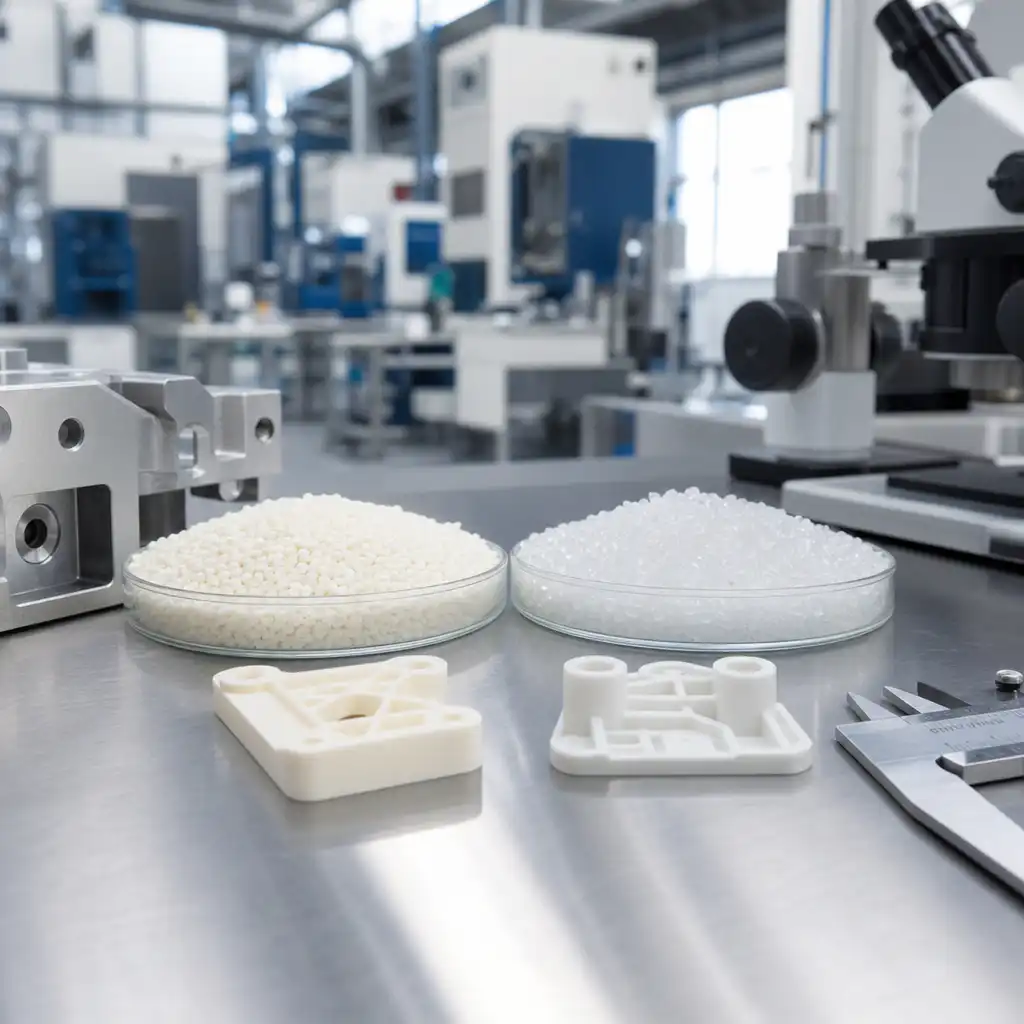
PA6 vs PA12 is a grade-selection decision for the actual part. PA6 is commonly considered for rigid mechanical components and material cost reviews. PA12 is often considered when moisture-driven dimensional change, flexibility or cold-temperature impact are important. Compare the exact grades in the same test condition, then validate the manufacturing route before purchasing resin or releasing a part order.
Material choice for a real part
Select PA6 or PA12 by Service Conditions
PA6 usually leads on stiffness, wear resistance and material economy. PA12 is often selected for lower moisture uptake, dimensional stability and low-temperature toughness. Confirm the choice against the drawing, environment and manufacturing route.
PA6 vs PA12: Compare Grades in the Same Condition
Generic family numbers are useful for orientation but cannot approve a purchase. Ask for grade name, manufacturer, reinforcement, test standard, units and dry or conditioned state. Where a required value is missing, mark it as needing evidence.
| Decision factor | PA6 | PA12 | What to verify |
|---|---|---|---|
| Humidity and dimensions | Moisture can change dimensions and mechanical behavior | Often selected for lower moisture uptake | Specify humidity, exposure time, conditioning and dimensional acceptance. Lower uptake does not eliminate validation. |
| Strength, stiffness and impact | Grade, reinforcement, temperature and conditioning determine performance | Grade, reinforcement, temperature and conditioning determine performance | Compare matching test methods and specimen states; do not apply an unfilled-resin figure to a reinforced part. |
| Thermal performance | Review the offered grade under the actual load and aging conditions | Review the offered grade under the actual load and aging conditions | Melting point is a processing-related property, not proof of continuous service temperature. |
| Chemicals and fluids | Check the named chemical, concentration and temperature | Check the named chemical, concentration and temperature | Neither family is resistant to every chemical. Review exposure duration, stress and application-specific test evidence. |
| Manufacturing route | Use a grade intended for molding, machining stock or the selected print process | Use a grade intended for molding, machining stock or the selected print process | Powder, filament, stock shape and injection grades are not interchangeable purchasing specifications. |
| Cost and supply | Compare the exact offered grade and accepted-part cost | Compare the exact offered grade and accepted-part cost | Quantity, reinforcement, scrap, inspection and qualification can change the economics. Request a scoped quotation. |
Manufacturer reference: Evonik describes its VESTAMID L PA12 family in terms of low water absorption, dimensional stability and low-temperature impact performance. These are family-level selection clues. They do not establish the properties or availability of a grade quoted by Nylon Plastic.
Choose by the Part Requirement
Rigid Mechanical Parts and Wear Applications
For gears, bushings, brackets or housings, a PA6 grade can be a starting candidate. Set the load, speed, mating surface, lubrication and working temperature before selecting an unfilled, reinforced or wear-modified grade. For a humidity-sensitive fit, include conditioned dimensions in the approval plan.
Humidity, Fluid Exposure and Low-Temperature Impact
PA12 can be a candidate for precision components exposed to changing humidity or applications needing flexibility and cold-temperature toughness. For fluid-contact parts, identify the fluid, concentration, pressure, temperature and exposure duration. An application example does not certify a proposed grade for a regulated or safety-critical use.
Review our PA6 material range and PA12 material range as starting points, then request the exact grade evidence for the project.
Replacing PA6 with PA12: What Needs Revalidation?
A different resin family can change shrinkage, stiffness, assembly fit and process settings. Lower moisture uptake alone does not make PA12 a drop-in replacement for an existing PA6 part.
- Document the starting point. Supply the current grade TDS, drawing revision, critical dimensions and the problem the change must solve.
- Compare the same conditions. Review dry and conditioned properties where relevant, test temperature, reinforcement, impact method and exposure requirements.
- Check manufacturing and assembly. Trial the proposed grade with its own processing instructions. Inspect shrinkage, warpage, threads, press fits, seals and any mating components.
- Agree sample acceptance. Define functional tests and inspection condition before approving the production order or modifying the tool.
PA6 vs PA12 for Prototypes and Injection Molding
Drying and Molding
Follow the processing sheet of the offered grade for initial moisture limits, dryer conditions, melt temperature, mold temperature and residence time. PA12’s lower water uptake is not permission to omit drying or moisture checks. Filled and modified grades may require different controls from their base resin.
Printed, Machined and Molded Parts
A printed sample can answer an appearance, fit or selected functional question, but its layer orientation, porosity, reinforcement and processing history differ from an injection-molded part. A PA12 powder result is not a PA12 molding-grade TDS. Likewise, a machined prototype needs identified stock material and condition.
Nylon Plastic supports material selection and supply review alongside prototype, CNC, tooling and injection-molding project review. State what the prototype must demonstrate and what will change for production. See our nylon injection molding services for the molded-part route.
What the Material or Part Quotation Should Confirm
The review should identify a candidate grade or process, the evidence needed for approval and the scope to quote. Ask whether sample work, tooling, conditioning, inspection, packaging and delivery are included. Supplier TDS documents retain the manufacturer’s attribution; a document for another grade cannot approve the offered material.
PA6 vs PA12 FAQ
Which is more dimensionally stable in humidity, PA6 or PA12?
PA12 generally absorbs less moisture and is usually the safer option when humidity-driven dimensional change is the main concern.
Which material is usually more cost-effective?
Compare quotations for the exact offered grades. Total accepted-part cost also depends on drying, scrap risk, tolerances, inspection, qualification and the production process.
Can both PA6 and PA12 be glass- or carbon-fiber reinforced?
Yes. Reinforcement can increase stiffness and strength, but it also changes shrinkage, warpage, surface finish and tooling wear.
What information is needed to choose between PA6 and PA12?
Provide the drawing, load, temperature, humidity or chemical exposure, dimensional tolerance, manufacturing process and annual volume.
PA6 vs PA12: Decide on an Approved Grade
Choose the grade that meets the agreed part tests and commercial scope. PA6 can be a candidate for rigid mechanical work; PA12 can be a candidate when moisture stability or flexibility is central. Reinforcement, modification and service conditions can change the outcome.
Use the existing project review form below to request a datasheet, grade alternative, material supply review or a custom-part quotation. The drawing and operating conditions help the technical team return a relevant response.
Related Reading
- Nylon Injection Molding Services
- Moisture Absorption in Nylon
- Nylon Parts Manufacturer Guide
- Engineering Plastic Materials and Selection
Request a PA6 vs PA12 Project Review
Send the requirements that can change the material decision. The technical team can compare the resin, reinforcement and manufacturing route before quotation.
Drawing or CAD, critical dimensions and tolerance.
Load, temperature, humidity and chemical exposure.
Current grade or TDS, or PA6/PA12 requirements; reinforcement, color and required documents.
Order and annual quantities, sample approval requirements, destination and target timing.
Use the form below to request material guidance, samples, datasheets or a manufacturing quotation.
