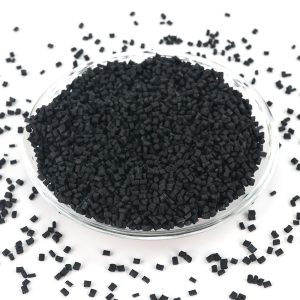


PA66 CF10 Technical Data (Estimated Typical Values)
| Property | Value | Test Standard |
|---|---|---|
| Carbon Fiber Content | 10% | ISO 1172 |
| Tensile Strength | 160 – 180 MPa | ISO 527 |
| Flexural Modulus | 11,000 – 13,000 MPa | ISO 178 |
| Notched Impact Strength | 8 – 11 kJ/m² | ISO 180 |
| HDT @1.8 MPa | 250 – 260 °C | ISO 75 |
| Volume Resistivity | 10^3 – 10^5 Ω·cm | IEC 60093 |
PA66 CF Series Technical Data Table (Estimated Typical Values)
| Property | Test Standard | PA66 CF10 | PA66 CF20 | PA66 CF30 | PA66 CF40 | PA66 CF50 |
|---|---|---|---|---|---|---|
| Carbon Fiber Content | ISO 1172 | 10% | 20% | 30% | 40% | 50% |
| Tensile Strength | ISO 527 | 160 – 180 MPa | 200 – 230 MPa | 240 – 270 MPa | 260 – 290 MPa | 280 – 320 MPa |
| Flexural Modulus | ISO 178 | 11,000 – 13,000 MPa | 16,000 – 19,000 MPa | 21,000 – 24,000 MPa | 25,000 – 28,000 MPa | 29,000 – 33,000 MPa |
| Notched Impact Strength | ISO 180 | 8 – 11 kJ/m² | 9 – 12 kJ/m² | 10 – 13 kJ/m² | 11 – 14 kJ/m² | 12 – 15 kJ/m² |
| HDT @1.8 MPa | ISO 75 | 250 – 260 °C | 255 – 265 °C | 260 – 270 °C | 265 – 275 °C | 270 – 280 °C |
| Volume Resistivity | IEC 60093 | 10^3 – 10^5 Ω·cm | 10^2 – 10^4 Ω·cm | 10^1 – 10^3 Ω·cm | 10^0 – 10^2 Ω·cm | 10^-1 – 10^1 Ω·cm |
PA66 CF10 Key Advantages
✅ High-Temperature Rigidity & Stability: Delivers exceptional stiffness and maintains dimensional precision under elevated temperatures, perfect for under-the-hood automotive and hot-running mechanical parts.
✅ Inherent Functional Conductivity: Offers built-in electrostatic dissipation (ESD) and improved thermal conductivity, critical for protecting sensitive electronics in demanding thermal environments.
Industry Applications:

Explore the PA66 Carbon Fiber Series in Detail
Click on the links below to view comprehensive technical data, key advantages, and application details for each specific grade.
| Grade | Best For | Overview | Full Details |
|---|---|---|---|
| PA66 CF10 | High-temp capable parts needing stiffness & ESD on a budget. | The most accessible high-temperature CF grade, offering enhanced heat resistance, rigidity, and ESD protection over standard PA66. | View PA66 CF10 Full Data Sheet → |
| PA66 CF20 | Demanding metal replacement where heat, strength & weight matter. | A balanced performer for high-temperature environments, excelling in strength-to-weight ratio and functional conductivity. | View PA66 CF20 Full Data Sheet → |
| PA66 CF30 | Structural components under high thermal and mechanical stress. | The benchmark for high-temperature structural integrity, providing near-metallic stiffness and outstanding fatigue resistance. | View PA66 CF30 Full Data Sheet → |
| PA66 CF40 | Ultra-stiff, high-heat applications where deflection is critical. | Engineered for maximum rigidity and dimensional stability under extreme thermal and mechanical loads. | View PA66 CF40 Full Data Sheet → |
| PA66 CF50 | Mission-critical applications at the limits of thermal & mechanical performance. | The pinnacle grade, delivering peak specific strength and stiffness in the most severe high-temperature environments. | View PA66 CF50 Full Data Sheet → |
Powering Innovation Across Industries
| Industry | Key Applications |
|---|---|
| Automotive | Engine covers, intake manifolds, structural brackets, sensor housings, connectors. Explore Automotive Applications → |
| Electrical & Electronics | Circuit breakers, switches, connector housings, insulating components. Discover E&E Solutions → |
| Industrial Equipment | Gears, bearings, machine housings, rollers, mechanical components. See Industrial Uses → |

How to Choose the Right PA66 CF Grade?
In simple terms:
-
For a cost-effective upgrade into high-temperature capable carbon fiber composites with significantly improved stiffness, heat resistance, and ESD, consider PA66 CF10.
-
For the optimal balance of high strength, heat deflection temperature, and lightweight design in demanding metal replacement applications, choose PA66 CF30. It is the performance benchmark for most high-temperature structural uses.
-
For the ultimate high-temperature stiffness, strength, and dimensional stability where performance is critical under extreme conditions, consider PA66 CF50.
Why Choose Us?


FAQ Section:
Q1: What is the main advantage of PA66 CF10 over standard PA66?
PA66 CF10 provides a multi-faceted upgrade with 10% carbon fiber reinforcement. Key benefits include:
-
Higher Heat Resistance: Significantly increased Heat Deflection Temperature (HDT) for use in hotter environments.
-
Enhanced Stiffness & Dimensional Stability: Greater rigidity and lower thermal expansion for precision parts.
-
Static Dissipation: Built-in conductivity protects electronic components.
It’s the ideal starting point for applications needing better heat and mechanical performance than standard PA66.
Q2: Is PA66 CF10 suitable for under-the-hood automotive parts?
Yes, it is an excellent candidate. Its inherent high heat resistance (HDT >250°C) combined with improved stiffness and ESD protection makes it suitable for sensor housings, connectors, brackets, and other components near the engine where temperatures are elevated.
Q3: How should I process PA66 CF10?
For optimal results:
-
Dry thoroughly at 80-90°C for 4-6 hours before processing to prevent hydrolysis.
-
Use a melt temperature in the range of 280-310°C.
-
A mold temperature of 80-110°C is recommended for best crystallinity and surface finish.
-
Use wear-resistant screws and barrels due to the abrasive nature of carbon fibers.