
What is ABS?
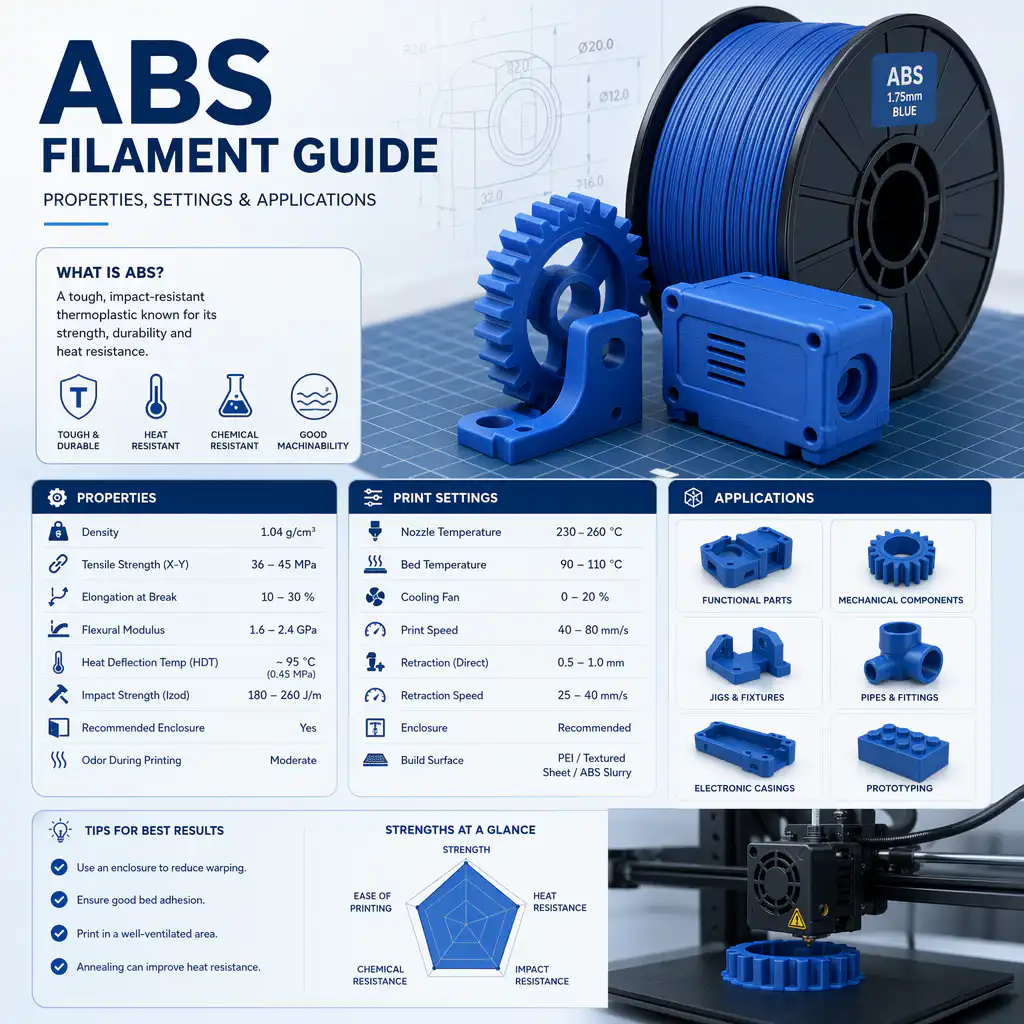
ABS (Acrylonitrile Butadiene Styrene) is a terpolymer combining three monomers for a balanced property profile:
- Acrylonitrile: Chemical resistance and thermal stability
- Butadiene: Toughness and impact resistance
- Styrene: Rigidity and ease of processing
Key Properties
| Property | Value |
|---|---|
| Tensile Strength | 40-50 MPa |
| Flexural Modulus | 2.0-2.5 GPa |
| Heat Deflection Temp | 85-95°C at 1.8 MPa |
| Glass Transition | 105°C |
| Density | 1.04 g/cm³ |
ABS Print Settings
Recommended Parameters
- Nozzle Temperature: 230-260°C
- Bed Temperature: 90-110°C
- Print Speed: 40-80 mm/s
- Cooling Fan: 0-30%
- Layer Height: 0.1-0.3mm
Troubleshooting Guide
Warping
Cause: Uneven cooling
Solutions:
- Use enclosed chamber
- Increase bed temperature
- Apply ABS slurry or glue
Layer Separation
Cause: Insufficient adhesion
Solutions:
- Increase nozzle temperature
- Reduce cooling fan
- Slow print speed
Post-Processing ABS
Acetone Smoothing
Acetone vapor smooths ABS surfaces, eliminating layer lines:
- Place part in sealed container
- Add acetone on paper towel
- Allow 10-60 minutes
- Remove and let dry
FAQ
When is ABS Filament Guide — Properties, Settings & Applications a good option?
ABS Filament Guide — Properties, Settings & Applications is a good option when fast iteration, complex geometry, low tooling cost, or low-volume production is more important than molded-part unit cost.
What should be checked before choosing ABS Filament Guide — Properties, Settings & Applications?
Check part size, material properties, surface finish, dimensional tolerance, heat exposure, load direction, and whether post-processing is required.
How does ABS Filament Guide — Properties, Settings & Applications compare with CNC machining?
3D printing can create complex shapes quickly, while CNC machining is often stronger for precise surfaces, tighter tolerances, and production-grade materials.
What affects the cost of ABS Filament Guide — Properties, Settings & Applications?
Cost depends on material, build volume, print time, layer height, support removal, finishing, inspection, and the number of parts in the build.
ABS Filament Guide — Frequently Asked Questions
Is ABS harder to print than PLA?
Yes. ABS requires higher temperatures, enclosed chamber, and careful attention to bed adhesion and cooling.
Can I smooth ABS with acetone?
Yes. Acetone vapor smoothing is a popular technique for ABS, eliminating layer lines.
Where can I buy quality ABS filament?
Nylonplastic supplies ABS in 1.75mm and 2.85mm. Free samples available.
 English
 Dutch
Dutch German
 French
 Korean
 Russian
 Japanese
 Spanish
 Vietnamese
 Chinese
 Portuguese
 Arabic