
Glass is a practical engineering topic when you need to compare options, check limits, and choose a process with less risk.
Both glass fiber and carbon fiber reinforced nylon offer significant property improvements over unreinforced nylon. Understanding the trade-offs helps you make the right material choice for your specific application.
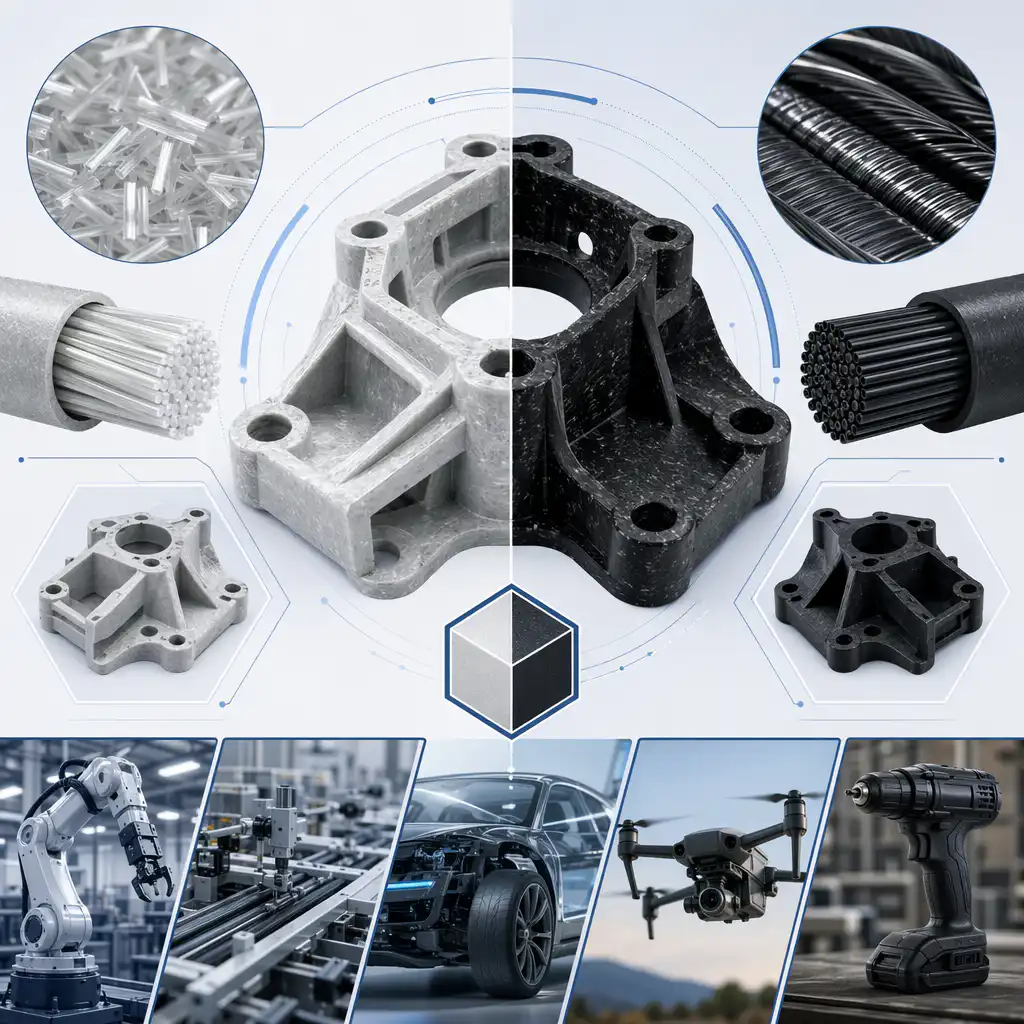
For engineering and sourcing teams
Choosing Reinforcement for a Nylon Production Part?
This reinforced nylon comparison is for procurement and early DFM decisions: glass fiber usually offers the lower-cost structural route, while carbon fiber may justify its premium when stiffness-to-weight dominates.
- Choose glass fiber for cost-effective strength and broad molding use
- Choose carbon fiber when stiffness-to-weight is the primary requirement
- Review conductivity, surface finish, fiber direction and tooling wear before release
Request a reinforced nylon sourcing review → View nylon injection molding services
Property Comparison
Tensile Strength: Carbon fiber reinforced nylon achieves 70-90 MPa tensile strength, compared to 40-60 MPa for glass fiber reinforced nylon. The difference is significant for structural applications.
Stiffness: Carbon fiber provides 2-3x the stiffness improvement of glass fiber at the same loading percentage. A 20% carbon fiber reinforced nylon approaches the stiffness of 30% glass fiber reinforced nylon.
Weight: Carbon fiber is approximately 70% lighter than glass fiber. Carbon fiber reinforced parts are notably lighter than their glass fiber counterparts — critical for aerospace and automotive weight reduction.
Thermal Properties: Carbon fiber reduces thermal expansion by 50-70%, compared to 30-50% reduction with glass fiber. Carbon fiber reinforced parts maintain dimensions better under thermal cycling.
Cost Comparison
This is where the trade-off becomes stark. Carbon fiber reinforced nylon costs 3-5x more than glass fiber reinforced nylon of equivalent grade. For many applications, the extra cost of carbon fiber cannot be justified by the performance benefit. Glass fiber reinforced nylon at 30% loading offers excellent value for most engineering applications.
Manufacturing Considerations
Both materials are abrasive and require hardened tooling. Glass fiber reinforced materials are easier to process with lower mold wear. Carbon fiber’s lower thermal expansion can actually simplify some manufacturing processes, but the abrasive nature accelerates equipment wear.
Application-Specific Recommendations
- Choose Glass Fiber Reinforced Nylon when: Cost is a primary constraint, part geometry is complex, standard structural strength is sufficient, high-volume production
- Choose Carbon Fiber Reinforced Nylon when: Weight reduction is critical, highest specific stiffness is required, thermal stability is paramount, low-volume high-performance applications
Hybrid Approach
Some applications benefit from hybrid reinforcement — combining glass and carbon fiber to optimize the cost-performance balance. This approach is common in sporting goods and premium automotive components.
Moisture Sensitivity
Both glass and carbon fiber reinforcement reduce moisture absorption compared to unreinforced nylon. Carbon fiber reinforced nylon typically shows better dimensional stability in humid environments.
Surface Finish
Glass fiber reinforced nylon can be injection molded to a smooth surface finish. Carbon fiber reinforcement results in a darker, matte appearance due to visible carbon fiber on the surface. Post-processing may be needed for cosmetic parts.
Conclusion
For most engineering applications, glass fiber reinforced nylon provides the best value proposition. Carbon fiber is reserved for applications where weight reduction and maximum stiffness justify the premium cost. At Nylonplastic, we supply both material types in various grades and can help you evaluate the right reinforcement strategy for your application.
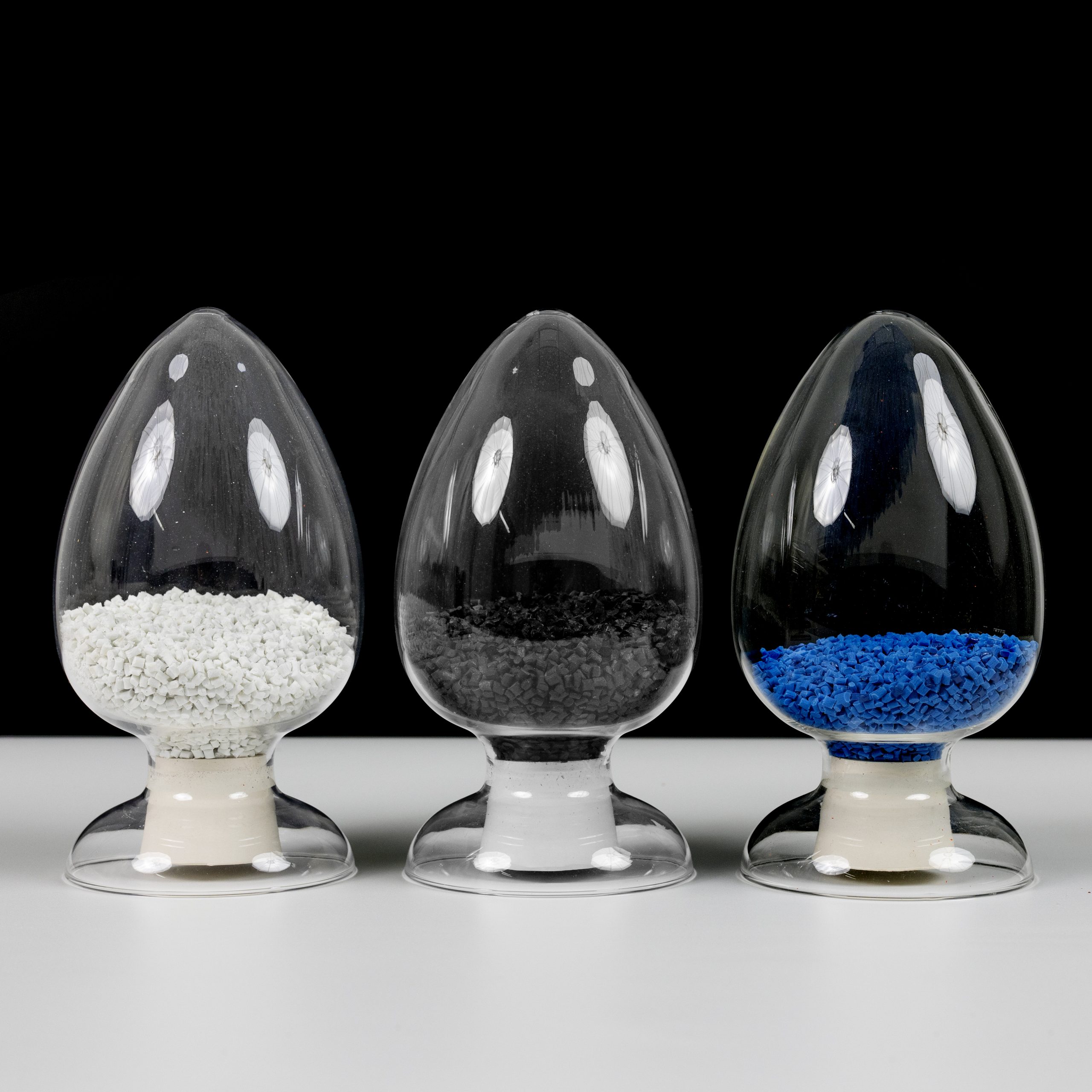
Ready to source? Nylonplastic supplies all the materials discussed in this guide — in standard and custom grades, with IATF 16949, ISO 9001, and ISO 14001 certified quality. Request a quote →
What Nylon Plastic Can Customize for This Project
Nylon Plastic combines material modification with product design, mold design and making, injection molding, CNC machining and 3D printing. The right scope is selected from the drawing and service conditions rather than promised from a generic material name.
| Customization Area | Options to Review | Information Needed |
|---|---|---|
| Reinforcement system | Glass-fiber, carbon-fiber or unfilled nylon comparison | Stiffness, weight, impact, conductivity and cost priorities |
| Base polymer | PA6, PA66, PA12 or another suitable nylon family | Moisture, heat, chemical and dimensional requirements |
| Prototype route | 3D printing or CNC evaluation before production tooling | CAD file, test quantity and the properties the prototype must represent |
| Production route | Material review, mold DFM, tooling and injection molding | Annual volume, surface class, tolerances and inspection plan |
RFQ Checklist
- CAD and load direction for the real component
- Stiffness, weight, impact and temperature targets
- Electrical conductivity or insulation requirement
- Surface, color, warpage and dimensional limits
- Prototype quantity, annual volume and tooling budget
DFM support, NDA arrangements, material or composition documentation and inspection requirements can be discussed during quotation. Availability depends on the project scope and agreed quality plan.
From Review to Production
- Define: share the drawing, application, environment and volume.
- Review: compare material, process, DFM and validation risks.
- Validate: use samples, 3D printing, CNC or prototype tooling where appropriate.
- Produce: release tooling or production only after the agreed checks are complete.
Glass Fiber vs Carbon Fiber Nylon: Select the Reinforcement Around the Load
Glass-fiber nylon and carbon-fiber nylon are not interchangeable “stronger nylon” options. Glass fiber is often the cost-effective route to higher stiffness, heat performance and dimensional control. Carbon fiber can offer higher specific stiffness, lower weight and conductivity potential, but it also increases cost, anisotropy and sensitivity to fiber orientation. Compare matched base resin, fiber content, test direction and moisture condition before choosing.
Begin with the load direction, allowable deflection, weight limit, temperature, ESD or conductivity requirement, tolerance, surface requirement, manufacturing process and budget. If the part is a molded bracket, the flow direction and weld line may control the result. If it is machined or printed, stock direction and layer or tool orientation must also be documented.
| Decision factor | Glass-fiber nylon | Carbon-fiber nylon | What to verify |
|---|---|---|---|
| Stiffness and heat | Strong stiffness improvement with broad grade availability | Often higher specific stiffness and lower weight potential | Matched fiber percentage, test direction and temperature |
| Weight | Usually heavier than comparable carbon-filled grades | Useful where stiffness per mass matters | Density, wall design and required deflection |
| Conductivity | Usually limited unless a conductive package is added | May provide ESD or conductivity potential | Surface and volume resistivity at the actual grade |
| Dimensional behavior | Fiber orientation and shrinkage still matter | Orientation and anisotropy can be pronounced | Flow direction, warpage and conditioned dimensions |
| Cost and tooling | Often lower material cost and broad supply | Often higher material cost and greater abrasive concern | Annual volume, tool steel, wear inserts and scrap value |
Orientation, Anisotropy and Mold Design
Short fibers align with melt flow in molded parts. The resulting stiffness, shrinkage and thermal expansion can differ along and across the flow direction. Gate location, runner balance, weld lines, ribs and wall thickness therefore belong in the material decision. A flat tensile coupon does not represent a bracket with a weld line or a housing with ribs and bosses.
For injection molding, request the gate and flow direction, fiber orientation assumptions, cooling layout and warpage review. For CNC machining, note how the stock was produced and whether machining releases stress. For 3D printing, define layer direction, infill, shell, chamber condition and post-processing. The same words “glass-filled” or “carbon-filled” can describe very different part behavior across processes.
Heat, Weight, ESD and Surface Requirements
Use carbon fiber when a weight or stiffness-per-mass target justifies the added cost and the electrical behavior is useful or manageable. Use glass fiber when a robust stiffness and heat solution with broad sourcing is more important. Neither reinforcement automatically solves creep, impact, chemical resistance or surface appearance. The base nylon, fiber length, fiber percentage, additive package and moisture condition remain important.
| Application | Starting comparison | Validation evidence |
|---|---|---|
| Lightweight bracket | Carbon fiber for stiffness per mass; glass fiber for cost control | Deflection, vibration, density and fatigue |
| Hot fixture or housing | Compare matched reinforced grades at temperature | HDT, creep, thermal cycling and conditioned dimensions |
| ESD enclosure | Carbon-filled grade may be a candidate | Resistivity, grounding, shielding and surface consistency |
| Visible molded component | Glass fiber may offer a more practical finish route | Texture, gloss, fiber read-through and gate appearance |
Cost, Tool Wear and Supplier Evidence
Material price is only one part of the decision. Carbon-filled grades may increase tool wear, require wear-resistant gates or inserts, affect polish and increase scrap cost when orientation or warpage is not controlled. Glass-filled grades can also be abrasive. Ask which steel, surface treatment, replaceable components, maintenance interval and spare parts are included in the tool plan.
Request a grade-specific data sheet, processing guide, moisture condition, test direction, fiber content, color, approved source and change-notification policy. Compare data under matched test methods and do not transfer a value from one base resin or fiber percentage to another. We can review the load direction, weight, heat, ESD, process, volume and candidate grades before the drawing is frozen.
GF Nylon and CF Nylon RFQ Checklist
- Base nylon, fiber type, fiber content, color and exact grade.
- Load direction, allowable deflection, fatigue, impact and temperature.
- Weight, ESD, conductivity, surface, texture and cosmetic zones.
- Injection molding, CNC machining or 3D printing route and orientation.
- Tool steel, wear inserts, dimensional inspection and conditioning state.
- Annual volume, price target, approved suppliers and change control.
Send the load direction, weight, heat, ESD, process, volume and candidate grades with CAD and the controlled drawing. We can compare glass-fiber and carbon-fiber nylon against measurable part requirements and define the validation coupons or molded samples needed.
Frequently Asked Questions
Can Nylon Plastic compare glass- and carbon-fiber grades for one drawing?
Yes. A useful comparison needs the load direction, wall sections, temperature, moisture, surface requirement, target weight and quantity. Fiber percentage alone is not enough to select a grade.
Which reinforcement is normally more cost-effective?
Glass fiber is usually the lower-cost structural route. Carbon fiber may be justified when stiffness-to-weight, lower density or a specific electrical behavior is more important than material price.
Why do gate location and fiber direction matter?
Reinforced polymers are directional. Flow orientation affects stiffness, shrinkage, warpage, weld lines and failure location, so material selection and mold DFM should be reviewed together.
Can a prototype be made before production tooling?
Nylon Plastic offers 3D printing and CNC routes that can support geometry and assembly review. The team should clarify which prototype properties will and will not represent the final molded reinforced material.
Request a Custom Project Review
Send the drawing, application, operating conditions and expected quantity. Nylon Plastic can review material modification, prototyping, tooling and production options within the agreed project scope.

