
Nylon (polyamide) is one of the most versatile and widely used engineering thermoplastics — but it carries a critical design consideration that surprises many engineers: it absorbs moisture from the air, and that moisture fundamentally changes its mechanical properties. At equilibrium in 50% relative humidity at 23°C, unfilled nylon 6 can absorb up to 2.7% water by weight, while nylon 66 absorbs approximately 2.5%. These seemingly small percentages translate to dramatic shifts in tensile strength, impact resistance, and dimensional geometry that must be accounted for during the design phase — not discovered during field failures.
If your part also sees liquid exposure or outdoor cycling, pair this guide with our nylon chemical compatibility chart and the main nylon chemical resistance guide before finalizing the grade. Moisture, heat, and chemicals often change the answer together.
This article provides a comprehensive engineering reference on nylon moisture absorption: the molecular mechanism that drives it, the quantitative property changes you should expect at various humidity levels, proven conditioning methods to stabilize parts before service, and practical design strategies to ensure your nylon components perform reliably in real-world environments. Whether you’re designing snap-fits, gears, structural brackets, or fluid-contact components, understanding moisture effects on nylon is fundamental to predicting part behavior over its service life.
For engineering and sourcing teams
Controlling Nylon Dimensions in Humid Service?
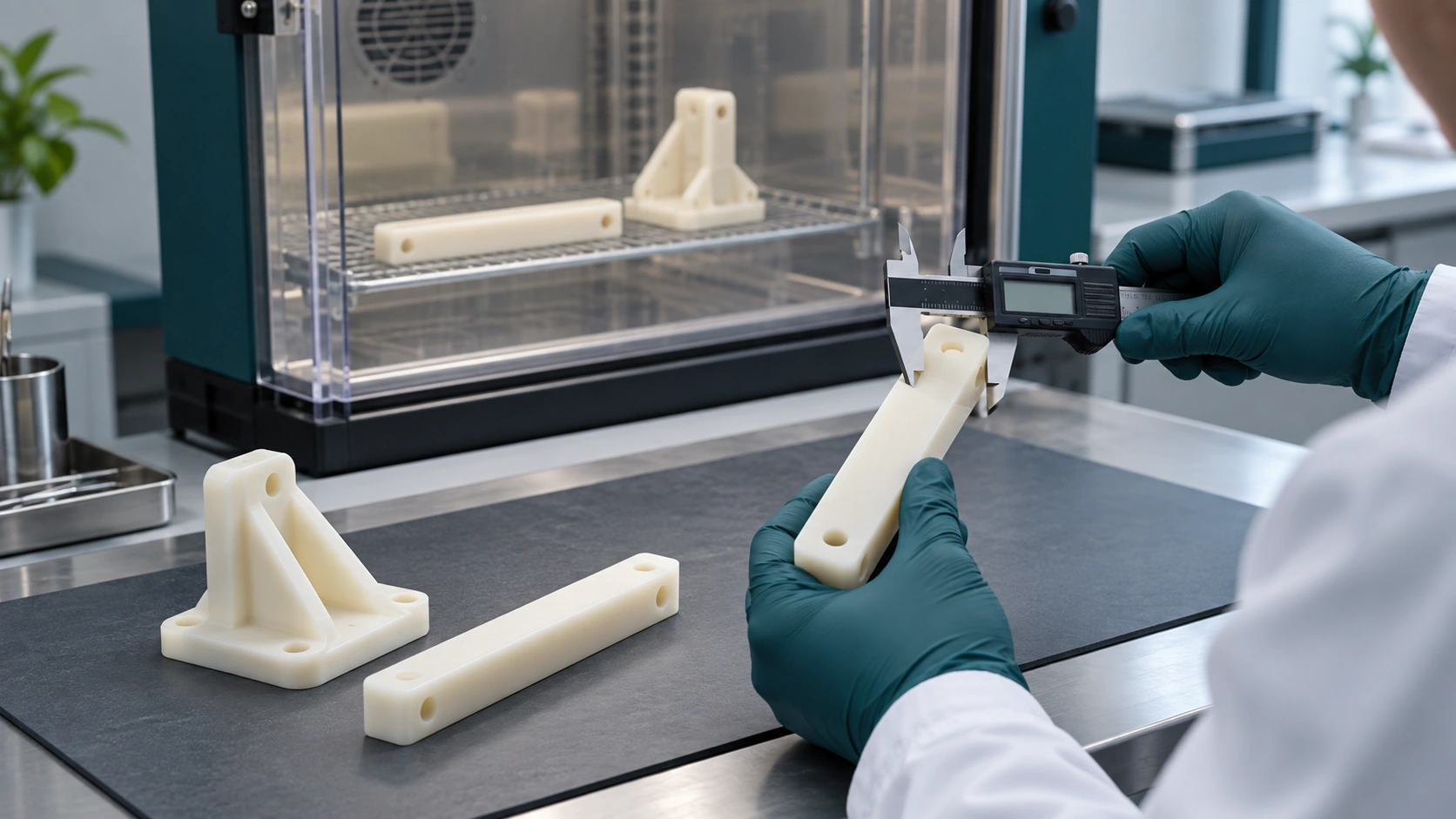
Nylon moisture absorption changes both dimensions and mechanical behavior. A production drawing should state the material grade, inspection condition and expected humidity rather than relying on dry datasheet values alone.
The Moisture Absorption Mechanism in Nylon
Nylon’s moisture absorption is not a surface phenomenon — it’s a bulk material property driven by the polymer’s molecular structure. The polyamide backbone contains repeating amide groups (-CONH-) that are highly polar. The carbonyl oxygen and amine hydrogen in each amide linkage form strong hydrogen bonds with water molecules. In dry nylon at room temperature, approximately 95% of these amide groups participate in inter-chain hydrogen bonding, creating the crystalline structure that gives nylon its strength and stiffness. When water molecules penetrate the polymer matrix, they compete for these hydrogen bonding sites — each water molecule can disrupt one inter-chain amide-amide hydrogen bond, replacing it with two water-amide hydrogen bonds.
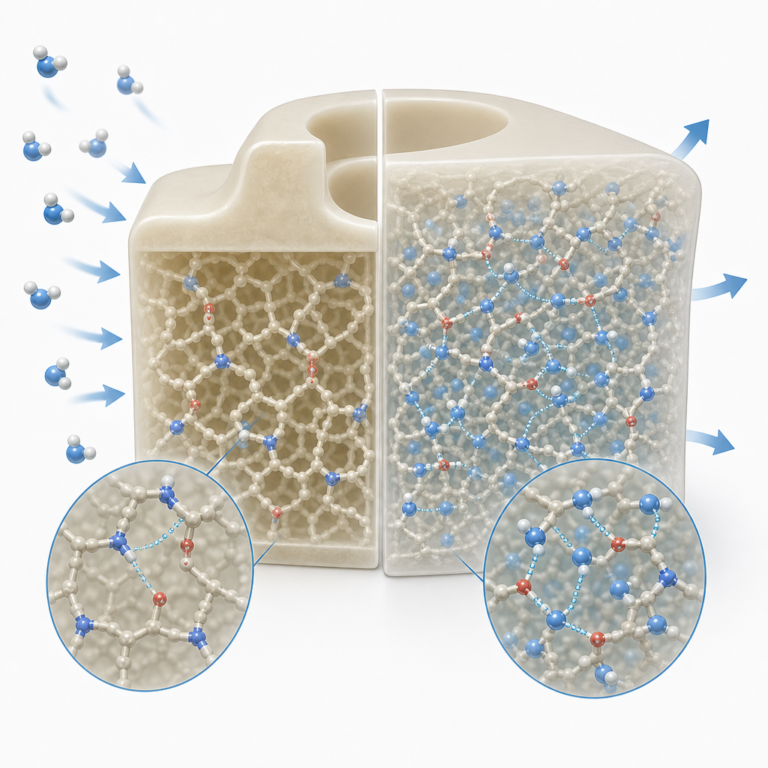
The result is a plasticizing effect: water molecules act as internal lubricants between polymer chains, increasing chain mobility and free volume within the amorphous regions of the semi-crystalline structure. Nylon 6 typically absorbs more moisture than nylon 66 (2.7% vs. 2.5% at 50% RH equilibrium) because nylon 6 has a lower degree of crystallinity (30-40% vs. 40-50% for nylon 66) — moisture primarily penetrates the amorphous regions, leaving crystalline domains largely unaffected. This explains why glass-fiber-reinforced nylon grades show proportionally lower moisture uptake (e.g., PA66-GF30 absorbs approximately 1.5-1.7% at 50% RH) — the non-absorbent glass fibers displace absorbent polymer volume. The absorption rate follows Fickian diffusion kinetics: 1mm-thick parts reach 50% of equilibrium moisture in 2-4 hours at 23°C/50% RH, while 4mm-thick sections require 24-48 hours, and 10mm sections may take 7-14 days.
For PA66-specific grade, reinforcement and dry-versus-conditioned selection, use the PA66 material properties and grades guide together with the exact supplier datasheet.
Quantitative Property Changes at Service Humidity
The mechanical property shifts caused by moisture absorption are substantial and must be designed around. The table below summarizes the most critical changes for unfilled nylon 6 and nylon 66 at three common service conditions. Note that properties partially recover upon re-drying, but repeated moisture cycling can cause permanent dimensional growth and micro-void formation over thousands of cycles.
| Property | Dry-as-Molded (DAM) | At 50% RH, 23°C | At Water Saturated (100% RH / Immersion) |
|---|---|---|---|
| Tensile Strength (PA6) | 80-85 MPa | 50-55 MPa (~35% reduction) | 35-40 MPa (~55% reduction) |
| Tensile Strength (PA66) | 83-90 MPa | 55-60 MPa (~30% reduction) | 40-45 MPa (~50% reduction) |
| Flexural Modulus (PA6) | 2,800-3,000 MPa | 1,200-1,400 MPa (~55% reduction) | 700-900 MPa (~70% reduction) |
| Notched Izod Impact (PA6) | 4-6 kJ/m² | 12-20 kJ/m² (~200-300% increase) | 30-50 kJ/m² (No break typical) |
| Dimensional Change (PA6) | Baseline | +0.5% to +0.7% linear growth | +1.0% to +1.5% linear growth |
The impact toughness increase is particularly noteworthy — moisture-conditioned nylon becomes significantly more ductile, often transitioning from a brittle failure mode to ductile yielding. This explains why “dry-as-molded” nylon parts that pass initial QC can fail in the field during winter months when ambient humidity is low and the material remains in its brittle state. Conversely, the stiffness reduction means that load-bearing components designed using dry property values will exhibit significantly more deflection in service, potentially exceeding functional clearances or causing creep under sustained load.
Conditioning Methods to Stabilize Nylon Parts
Conditioning is the process of deliberately introducing moisture into nylon parts before they enter service, bringing the material to its equilibrium moisture content and thus to its stable service-condition mechanical properties. Without conditioning, parts will gradually absorb moisture from the environment over days to weeks, causing continuous dimensional drift and property changes that complicate assembly fit and functional performance. Three primary conditioning methods are used in production:
Ambient Conditioning (Slowest, Lowest Cost): Parts are stored in a controlled environment at target humidity for 7-30 days depending on wall thickness. For 50% RH target, this requires a humidity-controlled storage room at 23 ± 2°C and 50 ± 5% RH. 2mm-wall parts reach near-equilibrium in approximately 7-10 days; 4mm-wall parts require 15-20 days. This method is suitable only for low-volume production where storage space and time are not constraints. The key risk is non-uniform moisture distribution — outer surfaces absorb moisture faster than part cores, creating temporary stress gradients that can cause warpage in thin-walled, complex geometries.
Accelerated Water Conditioning (Moderate Speed, Moderate Cost): Parts are immersed in temperature-controlled water baths at 50-80°C for 2-24 hours depending on thickness and target moisture content. At 80°C, 2mm-wall PA6 parts reach 50% RH-equivalent moisture content in approximately 2-3 hours; 4mm-wall parts in 6-8 hours. Post-immersion, parts must be surface-dried and allowed to equilibrate internally for 24 hours before dimensional inspection or assembly. Critical consideration: water bath temperature above 90°C can cause hydrolysis degradation in nylon 6 and nylon 66, reducing molecular weight and permanent strength loss of 5-15% per 100 hours of exposure. Never exceed 80°C for conditioning baths.
Steam Conditioning (Fastest, Highest Cost): Parts are exposed to saturated steam at 100-110°C in a pressure vessel for 30 minutes to 4 hours. This is the fastest method and achieves the most uniform moisture distribution, but requires specialized equipment and careful process control. Steam pressure of 0.5-1.0 bar above atmospheric is typical. This method is used for high-volume automotive and industrial components where conditioning throughput cannot become a production bottleneck. Post-steam parts require a 2-hour ambient stabilization period before dimensional verification.
Design Strategies for Moisture-Compensated Nylon Parts
Rather than fighting moisture absorption, successful nylon part design embraces and compensates for it. The following design strategies are proven across decades of industrial application:
Design to conditioned properties, not dry properties: Always use the 50% RH equilibrium mechanical properties as your design basis, not the dry-as-molded values. If your part will see water immersion or continuous high humidity (>80% RH), design to saturated properties. The dry strength advantage is temporary — within weeks of installation, your part will operate at conditioned properties. Using dry values in FEA or hand calculations produces parts that are over-stressed in service by 30-50%. Your safety factor must be applied to the conditioned strength, not the DAM strength.
Accommodate dimensional growth in clearances and fits: A 100mm nylon 6 part will grow 0.5-0.7mm in length from dry to 50% RH equilibrium. For press-fit assemblies, snap-fit joints, and bearing fits, this growth must be accounted for in the nominal clearance. Design snap-fit undercuts deeper by 0.3-0.5mm for nylon to account for reduced stiffness at service humidity. For gear meshes, increase center distance tolerance bands by 0.2-0.4% to prevent binding at high humidity. For shafts running in nylon bearings, add 0.5% of bearing diameter to the running clearance at minimum.
Use glass fiber reinforcement to reduce moisture sensitivity: Glass-fiber-filled nylon grades reduce moisture absorption proportionally to fiber loading — GF30 reduces absorption by approximately 30%, GF50 by approximately 50%. Additionally, the fibers constrain dimensional growth: GF30 PA66 exhibits linear growth of only 0.2-0.3% at 50% RH vs. 0.5-0.7% for unfilled PA66. For applications requiring tight dimensional control, specify GF30 minimum. For the best balance of mechanical properties and moisture stability, PA66-GF30 or PA66-GF35 is the most commonly specified automotive and industrial nylon grade.
Design Rules for Moisture-Sensitive Nylon Applications
- Use conditioned mechanical properties for all FEA and hand calculations: Design yield strength should be based on 50% RH equilibrium values (50-55 MPa for PA6, 55-60 MPa for PA66), not DAM values (80-90 MPa). Applying a safety factor of 2.0-2.5 on conditioned yield strength provides reliable long-term performance across the full humidity range.
- Add 0.5-0.7% linear growth allowance to all critical dimensions for PA6: For a 200mm long part, this means 1.0-1.4mm of expected growth from dry-as-molded to 50% RH equilibrium. Reduce to 0.3-0.5% for PA66 and 0.2-0.3% for GF30 grades. Mating metal components require corresponding clearance gaps.
- Specify moisture conditioning on the part drawing: Include a note: “Parts shall be moisture conditioned to 50 ± 5% RH equilibrium at 23°C prior to dimensional inspection. Dimensional tolerances apply to conditioned state only.” Without this note, QC will measure dry parts, pass them, and the field failures will be yours.
- Allow 24-48 hours post-conditioning for dimensional stabilization: Moisture distribution through part thickness requires diffusion time. Parts measured immediately after conditioning will read smaller than true equilibrium dimensions for thick sections. The thicker the part, the longer the stabilization period required.
- Verify snap-fit performance at both dry (winter) and conditioned (summer) extremes: Dry nylon is brittle with 4-6 kJ/m² notched Izod; conditioned nylon is tough with 12-20 kJ/m². Snap-fits designed for conditioned assembly can fracture during dry winter assembly. Design engagement strain to stay below 1.5% for dry nylon and 3% for conditioned nylon.
- Seal or coat nylon parts in continuous water immersion applications: For submersed applications, nylon will reach 100% RH equilibrium in 7-14 days for thin walls, losing 50-55% of tensile strength. Apply conformal coating (silicone, acrylic, or parylene at 5-25µm thickness) or specify a hydrolysis-resistant grade such as PA12 or PA612, which absorb only 1.5% and 1.2% water respectively at saturation vs. 8-9% for PA6.
Measuring Moisture and Deciding When PA12 Is the Better Choice
Moisture control requires two different measurements: the resin moisture level before processing and the dimensional or property state of the finished part after conditioning. A dryer display alone does not prove that pellets reached the target condition, and a single dry-as-molded dimensional result does not predict the part after humidity exposure.
| Decision | Method or evidence | What it confirms | Buyer requirement |
|---|---|---|---|
| Pellet readiness | Grade-appropriate moisture analyzer or validated loss-on-drying method | Whether resin is ready to process without moisture-related degradation or splay | Record resin lot, dryer settings, transfer method and measured moisture |
| Finished-part stability | Dimensional measurements before and after the agreed conditioning cycle | Movement caused by humidity rather than tooling or measurement error | Define temperature, relative humidity, exposure time and measurement timing |
| PA6 or PA66 remains suitable | Conditioned properties and dimensions meet the functional limits | The higher moisture uptake can be managed by design, reinforcement and conditioning | Approve the part in its service-relevant state, not only dry as molded |
| Consider PA12 or another low-moisture material | PA6/PA66 movement exceeds fit, sealing or calibration limits | Material substitution may reduce moisture sensitivity more effectively than tighter tooling | Recheck strength, temperature, chemical, cost and processing requirements before changing resin |
The correct test method and acceptance limit depend on the resin supplier, reinforcement, part geometry and contract requirements. Filament dryer settings remain a separate 3D-printing workflow covered by the nylon filament drying guide.
Industry Application Matrix
| Application | Recommended Grade | Moisture Strategy | Service Humidity Range |
|---|---|---|---|
| Automotive fuel line clips | PA66-GF30, heat stabilized | Steam condition 2h; design to conditioned | 30-90% RH; occasional fuel splash |
| Electrical connector housings | PA66 FR V-0, GF25 | Ambient condition 14 days; tight dimensional control | 20-80% RH; indoor/engine bay |
| Food processing wear strips | PA6-GF30, MoS₂ filled | Water condition 4h at 70°C; tolerate full saturation | Washdown; 100% RH intermittent immersion |
| Power tool gear housing | PA66-GF50, impact modified | Ambient condition; design to DAM for assembly, conditioned for service | 20-60% RH; indoor use |
Cost Decision Framework
Balancing moisture compensation against part cost:
Designing for moisture effects often pushes engineers toward glass-filled grades or alternative polymers — but each option carries a cost premium. Unfilled PA6 costs approximately $2.50-3.20/kg; PA66-GF30 runs $3.80-4.50/kg; and moisture-resistant PA12 costs $8-12/kg. The most cost-effective path is almost always: (1) design to conditioned unfilled nylon properties with adequate growth allowances; (2) if dimensional stability is the limiting factor, step to GF30 before switching polymer families — the $1.00/kg premium for glass fill is far cheaper than switching to PA12 at $8+/kg; (3) only switch to PA12 or PPA when chemical resistance (continuous water immersion) or high-temperature performance drives the decision. Conditioning cost itself is modest: ambient conditioning adds $0.02-0.05 per part in handling/storage; water conditioning adds $0.08-0.15 per part; steam conditioning adds $0.15-0.30 per part. The real cost of not accommodating moisture is far higher — field failures, warranty claims, and requalification expenses that easily exceed $50,000 per incident.
Common Troubleshooting for Nylon Moisture Issues
| Issue | Likely Cause | Solution | Prevention |
|---|---|---|---|
| Snap-fit fractures during winter assembly | Parts in DAM state; strain at engagement exceeds 1.5% limit for brittle nylon | Condition parts to 50% RH before assembly; reduce engagement strain to 1.2% for dry assembly | Specify conditioning before assembly in work instructions; validate snap-fit at -10°C and DAM state |
| Gear binding after 2 weeks in service | Moisture-induced growth closing design clearance; insufficient center distance tolerance | Increase center distance by 0.3-0.5% of pitch diameter; re-cut gear with modified profile | Calculate conditioned dimensions during design phase; test gear mesh with conditioned parts |
| Bearing journal too tight after humidity exposure | Bore diameter shrinking as OD grows; moisture growth constrains ID in thick-walled sections | Ream bore 0.5% oversize post-conditioning; use GF-grade to reduce dimensional change | Allow 0.4-0.6% bore growth in design for unfilled nylon; machine critical bores post-conditioning |
| Splay marks and surface defects after molding | Inadequate material drying; moisture content > 0.20% at molding | Verify dryer dew point < -30°C; dry PA6 4-6h at 80°C; check moisture analyzer | Inline moisture monitoring; dried material hopper residence time < 30 min; < 0.15% moisture target |
Why Choose Nylon Plastic for Your Project
Precision Manufacturing
30+ CNC & injection molding cells under one roof
ISO 9001:2015 Certified
Certified quality system, full inspection reports
15-25 Day Lead Time
Fast turnaround with expedited options available
Global Shipping
Air & sea freight to North America, Europe, Asia
Download Our Nylon Moisture Compensation Guide
Free PDF reference guide covering material selection tables, design rules, and supplier evaluation checklists.
What Nylon Plastic Can Customize for This Project
Nylon Plastic combines material modification with product design, mold design and making, injection molding, CNC machining and 3D printing. The right scope is selected from the drawing and service conditions rather than promised from a generic material name.
| Customization Area | Options to Review | Information Needed |
|---|---|---|
| Material and grade | PA6, PA66, PA12 or reinforced nylon review | Humidity, temperature, load, chemical exposure and cost target |
| Moisture control | Drying, conditioning, sealed handling and packaging plan | Incoming resin condition and required final inspection state |
| Part and tooling | DFM, shrinkage allowance, fit review and mold strategy | CAD file, critical fits, inserts and mating-component information |
| Production validation | Prototype, dimensional inspection and batch-control planning | Sampling quantity, measurement method and acceptance limits |
Frequently Asked Questions
Can dimensions be specified in the dry and conditioned state?
Yes. The drawing or quality agreement should state which condition controls acceptance. For critical fits, it may be useful to define both the production inspection condition and the expected service condition.
Can drying and conditioning requirements be customized by grade?
They should be. PA6, PA66, PA12 and reinforced grades do not share one universal moisture plan. Resin history, wall thickness, packaging and the required final properties all affect the process.
Can Nylon Plastic review a moisture-related tolerance problem?
The team can review the drawing, material, fit, environment and manufacturing route as a DFM and material-selection problem. A physical sample or representative measurement history is helpful when the part already exists.
What should a moisture-control RFQ include?
Include the nylon grade, CAD and drawing, use humidity and temperature, critical dimensions, inspection condition, packaging requirement, annual volume and any failure symptoms.
Technical Sources and Verification
Use supplier data to verify the exact grade and test condition. Final approval should reflect the production process, part geometry and service environment.
Request a Nylon Moisture and Fit Review
For a new material purchase or an existing part that changes fit in humidity, share the application and the acceptance condition. Nylon Plastic can review material selection and manufacturing questions together before quotation.
Nylon Material or Grade Replacement
Send: the named grade and TDS if available, reinforcement, color, humidity or liquid exposure, load, temperature, purchase quantity and destination. Describe the performance target if no grade is fixed.
Review scope: candidate nylon grades, relevant dry and conditioned data, required documentation and supply scope. Application details can start the material enquiry before a drawing is available.
A Part with Fit or Dimensional Drift
Send: drawing/CAD revision, affected fits, current material, when the change occurs, measured dimensions and their conditions, packaging/storage history, quantity and destination.
Review scope: material, geometry and process questions; the drying, conditioning and inspection assumptions to agree; and whether a molded, CNC-machined or prototype route should be reviewed.
Useful evidence: identify whether measurements were taken dry-as-molded or after a defined exposure, and which condition controls acceptance. Any conditioning or validation work must be agreed for the named grade and actual part; the review does not guarantee a dimensional result.
In the form below, identify Material supply or Part fit review. Include order and annual quantities, required material or inspection records, and packaging or incoming-inspection requirements. NDA arrangements and sample validation can be discussed during quotation; the agreed sample checks come before tooling or production release.

