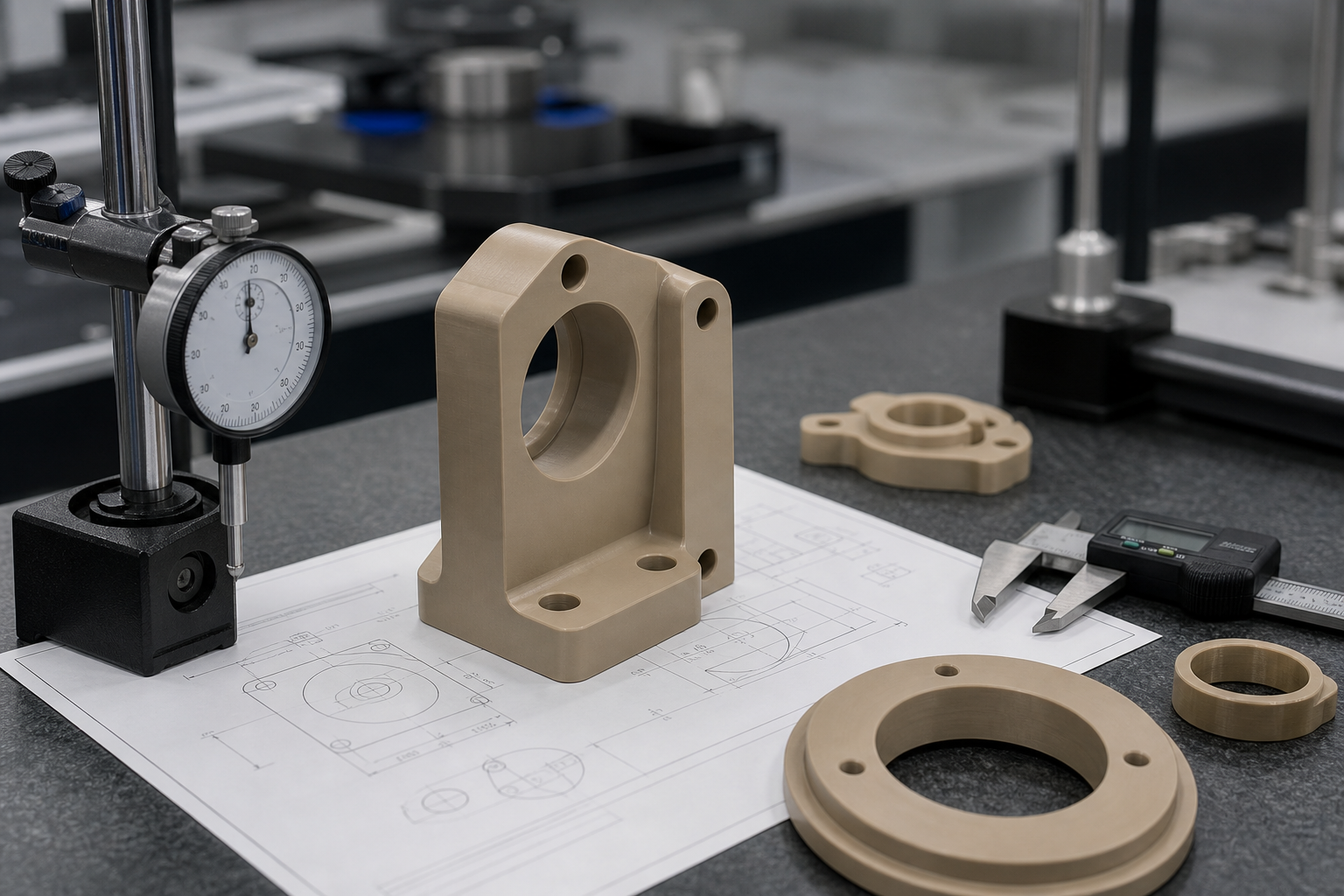
PEEK CNC machining services are appropriate when a plastic component must manage high temperature, aggressive media, sterilization, wear, electrical isolation, or dimensional demands that lower-cost materials cannot reliably meet. The decision is not simply whether PEEK is a premium polymer. It is whether the service requirement justifies PEEK and whether the machining plan controls stock condition, heat, clamping, residual stress, inspection temperature, and the actual functional tolerances.
Nylon Plastic supports machined PEEK parts from grade review and stock selection through CNC setup, stress management, dimensional inspection, cleaning, and recurring supply. Send the drawing, service conditions, quantity, and tolerance priorities so the route can be evaluated before material is committed.
When to machine PEEK instead of molding
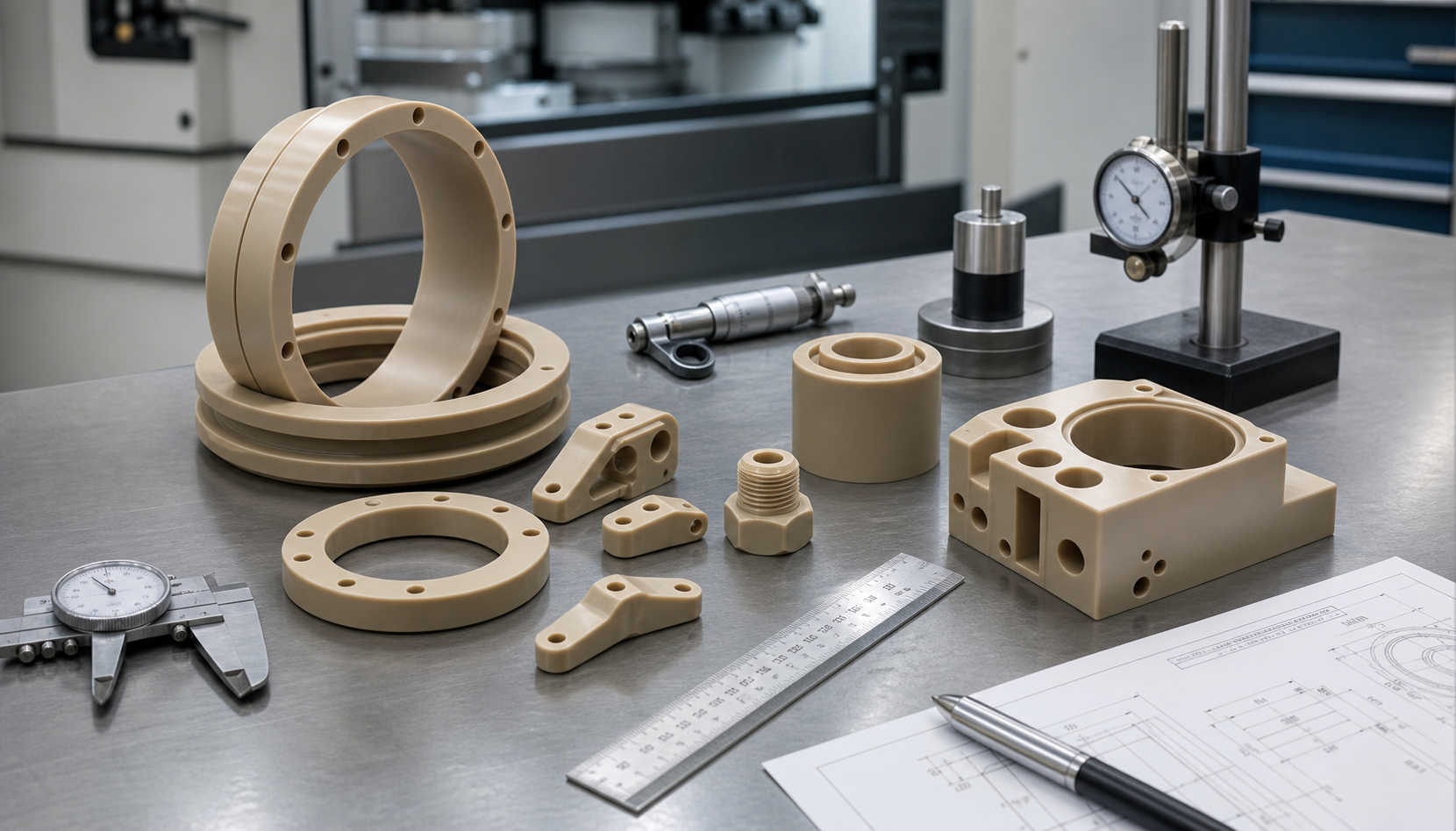
CNC machining is usually a strong first route for prototypes, replacement parts, low-volume production, large solid sections, and designs that may still change. It avoids production tooling and can expose fit, sealing, and thermal behavior before a larger manufacturing commitment. Injection molding can become more attractive when the design is stable, the annual volume is predictable, and the geometry can be molded without compromising performance.
| Project condition | Machined PEEK fit | Buyer decision point |
|---|---|---|
| Prototype or low recurring volume | Strong fit | Tooling is avoided and the drawing can be revised between builds. |
| Large plate, ring, block, or one-off assembly | Often practical | Confirm stock availability, material utilization, workholding, and scrap risk. |
| Stable high annual volume | Compare with molding | Model tooling, unit cost, inspection, and transition risk at realistic demand. |
| Very thin or complex geometry | Requires process review | Check deflection, support, cutter access, and free-state measurement before promising a tolerance. |
| Critical heat or chemical service | Good candidate when grade is correct | Validate grade, filler, temperature, media, sterilization, and mating materials. |
For some applications, the best answer is not molded PEEK but a different engineering plastic and process. PEI, PPS, POM, nylon, or filled grades may fit a defined duty cycle at lower cost, while a genuinely demanding application may need PEEK despite the higher material and machining cost.
PEEK grade selection and stock condition
State the exact PEEK grade before accepting a machining quotation. Unfilled PEEK, glass-filled PEEK, carbon-filled PEEK, and bearing-modified PEEK do not behave identically during cutting or in service. Reinforcement can change stiffness, thermal movement, tool wear, friction, electrical behavior, and directional properties. A trade name without grade, filler percentage, stock form, and certificate requirements is not a complete material specification.
| Grade family | Potential application fit | Machining and validation points |
|---|---|---|
| Unfilled PEEK | Balanced toughness, chemical resistance, electrical isolation, and high-temperature components | Review section thickness, stock stress, heat control, and dimensional conditioning. |
| Glass-filled PEEK | Higher stiffness and selected structural or wear applications | Expect more abrasive tool behavior and direction-dependent properties; confirm the material certificate. |
| Carbon-filled PEEK | Stiffness, wear, thermal behavior, and selected conductivity requirements | Clarify filler content, electrical requirements, counterface, surface finish, and tool life assumptions. |
| Bearing or lubricated PEEK | Moving interfaces where friction and wear are important | Define lubrication, mating material, load-speed combination, cleanliness, and wear evidence. |
Stock condition also matters. Ask whether the bar, plate, tube, or blank was supplied stress relieved, how it was stored, and whether a thermal conditioning step is part of the quote. Large stock, heavy material removal, and asymmetric sections may release stress during machining even when the original material certificate is correct.
Workholding, tooling, and heat control
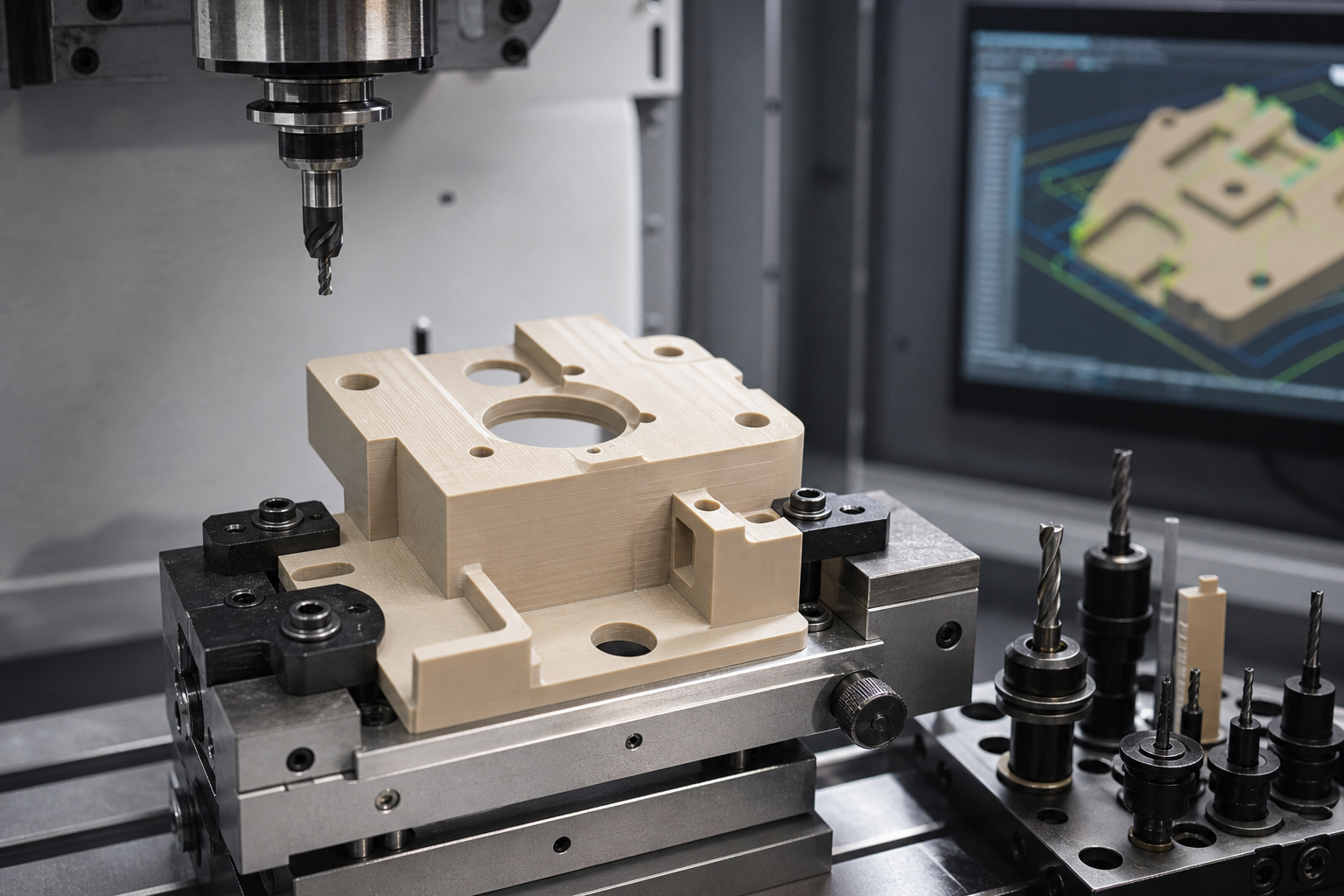
PEEK should be machined with a setup that controls heat without distorting the part. Sharp carbide tooling, suitable positive geometry, controlled chip evacuation, and stable feeds help limit local temperature. Excessive rubbing, a dull tool, or chips trapped in a pocket can damage the surface and change dimensions before the part reaches inspection.
- Support functional datums and thin walls without applying clamp pressure that temporarily changes the geometry.
- Use a stable datum setup and machine from balanced sides where the part geometry and stock allow it.
- Control chip evacuation in deep pockets and holes so recutting does not add heat or scratch sealing surfaces.
- Agree coolant, dry-machining, cleaning, and contamination rules for medical, semiconductor, food-contact, or high-purity work.
- Record the tool material, inspection condition, and any process limitation that affects recurring production.
| Machining control | Risk when it is missed | Evidence to request |
|---|---|---|
| Tool sharpness and chip evacuation | Heat, rubbing, surface damage, and dimensional drift | Tooling plan, process notes, and visual or surface acceptance record |
| Fixture support and clamp load | Temporary flattening, deflection, or movement after release | Fixture method, free-state condition, and setup inspection record |
| Roughing and finishing sequence | Residual stress release changes related features | Operation sequence, stabilization assumption, and first-off comparison |
| Cleaning and handling | Particles, chips, scratches, or contamination on functional surfaces | Cleaning method, packaging specification, and lot traceability |
PEEK machining tolerances by feature
There is no universal PEEK tolerance that applies to every feature. Section thickness, overall length, stock stress, filler orientation, tool access, inspection temperature, and datum strategy all affect capability. Critical characteristics should be identified selectively, with general dimensions given enough room for thermal movement and realistic process variation.
| Feature | Main risk | Planning direction | Inspection evidence |
|---|---|---|---|
| Bearing or sealing bore | Heat, tool pressure, ovality, and measurement temperature | Leave finish stock and finish bore or ream in a stable setup. | Bore gauge or CMM report tied to the approved datums and temperature. |
| Thin wall or web | Deflection during cutting and movement after release | Support locally, reduce clamp load, use balanced cuts, and define the free-state condition. | Profile or thickness report with fixture method recorded. |
| Thread or tapped hole | Burrs, heat, limited engagement, and fastener stress | Specify thread class, depth, insert requirement, torque, and cleaning expectation. | Thread gauge plus functional torque or assembly check where required. |
| Sealing face | Flatness, cutter marks, edge damage, and handling distortion | Define flatness, surface finish, edge protection, and support during inspection. | Flatness or surface report and a controlled visual standard. |
| Positional relationship | Datum shift from multiple setups or stress release | Use a controlled datum sequence and minimize re-clamping between related features. | CMM or functional fixture result using the production datum scheme. |
Holes, threads, thin walls, and burr control
Holes and threads should be specified by function rather than by a generic statement that the part needs precision machining. Identify whether a bore locates a bearing, seals against a shaft, carries a fastener, or provides clearance. State the thread standard, depth, engagement, insert choice, and assembly torque. For thin walls and webs, specify whether the measurement is taken clamped, in a fixture, or in a free state after the part has equalized to the inspection environment.
Burrs can interfere with seals, electrical isolation, sliding motion, or cleanliness. Include edge-break limits, deburring method, particle limits, and protected packaging in the drawing or RFQ. A machined PEEK part may be dimensionally correct but still fail assembly if a burr, chip, or cutter mark is left on a functional surface.
Annealing and dimensional stabilization
Annealing is not mandatory for every machined PEEK part. It becomes more relevant when a component is large, heavily machined, asymmetric, thin in one area, required to hold close positional relationships, or exposed to elevated service temperature. A risk-controlled sequence may use rough machining, a stabilization or annealing step when justified, finish machining, and inspection after the part has equalized to the specified temperature.
The supplier should state whether the stock was already stress relieved, why an additional thermal cycle is or is not recommended, and how the process could affect color, crystallinity, surface condition, or final dimensions. If the customer requires a specific annealing cycle, record the time, temperature, equipment, lot, and acceptance criteria rather than describing the step only as “annealed.”
Inspection, cleanliness, and traceability
A reliable PEEK machining program connects each critical feature to a datum, measurement method, sample condition, and report. CMM, optical measurement, bore gauges, pin gauges, thread gauges, surface checks, and functional fixtures can each be useful when matched to the feature. Inspection temperature and conditioning time should be recorded when thermal movement could affect the decision.
- Verify the approved PEEK grade, filler, stock form, material lot, and certificate.
- Confirm drawing revision, datum scheme, critical characteristics, surface finish, and edge requirements.
- Record inspection equipment, calibration status, temperature, conditioning, fixture, and sampling level.
- Define cleaning, particle, packaging, and handling requirements for sensitive applications.
- Keep lot traceability from stock receipt through machining, inspection, packing, and replacement supply.
PEEK machining RFQ and quote-normalization checklist
| RFQ item | What to provide | What the supplier should state |
|---|---|---|
| Material | Exact grade, filler, stock form, certificate, and approved alternatives | Material source, lot traceability, stock condition, and substitution controls |
| Geometry | CAD, controlled drawing, datums, tolerances, threads, finish, and burr limits | Machining assumptions, setups, tooling access, and risks by feature |
| Service | Temperature, chemicals, sterilization, wear, load, speed, and mating materials | Grade suitability, cleaning method, testing, and packaging proposal |
| Quantity | Prototype quantity, annual demand, recurring schedule, and service life | Piece price basis, material utilization, lead time, capacity, and route change point |
| Quality | FAI, sampling, report format, cleanliness, certificates, and retention period | Measurement method, conditioning, calibration, nonconformance, and change control |
For quote comparison, require every supplier to state its grade, stock condition, annealing assumption, inspection method, exclusions, lead time, and packaging. This prevents a low quote based on a different material or an unrealistic interpretation of the drawing.
PEEK Quote Review: Grade, Stock and Inspection State
| Quote Item | Why It Changes the Result | Buyer Evidence |
|---|---|---|
| Exact PEEK grade | Virgin, glass-filled, carbon-filled and bearing grades differ in stiffness, wear and machining behavior | Manufacturer grade, certificate, color and stock traceability |
| Stock and annealing | Residual stress and dimensional movement can appear after roughing or service heat | Stock size, stabilization sequence, rest time and final inspection condition |
| Thin walls and holes | Clamping, burrs, tool access and heat can move critical features | Datum scheme, workholding plan, toolpath and feature-specific capability |
| Cleanliness and compliance | Handling, particles, packaging or certificates may be more important than surface finish | Cleaning method, packaging, certificate type, inspection and change control |
PEEK CNC machining should be quoted from the complete part package, not from the polymer name alone. Large stock removal, asymmetric sections, tight positional relationships and elevated service temperature can justify staged machining and annealing. The quote should state which dimensions are measured after stabilization and which are guaranteed in the service condition.
How Nylon Plastic Supports High-Performance Plastic Parts
Nylon Plastic reviews whether PEEK, modified nylon or another engineering plastic is the right route for the required load, heat, wear, chemical exposure and volume. When PEEK is not necessary, unfilled PA, PA-GF20 or PA-CF30 may provide a more economical path; when it is necessary, the grade and documentation must remain exact.
- Compare CNC machining with injection molding or 3D printing at the actual quantity and validation stage.
- Define annealing, conditioning, cleaning, inspection temperature, certificates and packaging before quote comparison.
- Use feature-specific tolerances and reports rather than one generic tolerance promise for the whole part.
Related Reading
Frequently Asked Questions
How tight can PEEK be machined?
It depends on the feature, section thickness, stock stress, filler, datum scheme, tool access, inspection temperature and the supplier’s controlled process. Define capability by critical feature.
Does PEEK need annealing before machining?
Not every part needs it. Large stock, heavy material removal, asymmetric sections, tight relationships and elevated service temperature justify a stabilization review.
How are thin PEEK walls controlled?
Use low-distortion workholding, balanced material removal, suitable toolpaths, local support and a defined free-state inspection condition after thermal equalization.
What should be included in a PEEK machining RFQ?
Provide CAD, a controlled drawing, exact grade and stock, quantity, tolerances, datums, finish, threads, temperature, media, cleanliness, certificates, inspection, packaging and delivery needs.
Which PEEK grade should be machined?
Choose virgin, glass-filled, carbon-filled or bearing-modified PEEK from load, wear, temperature, dimensional, electrical, chemical and cleanliness requirements. Confirm the exact supplier grade before quoting.
Request a PEEK Machining Review
Share the drawing, PEEK grade, stock condition, tolerance, service temperature, media exposure, quantity, cleanliness and inspection requirements for a quote review.