
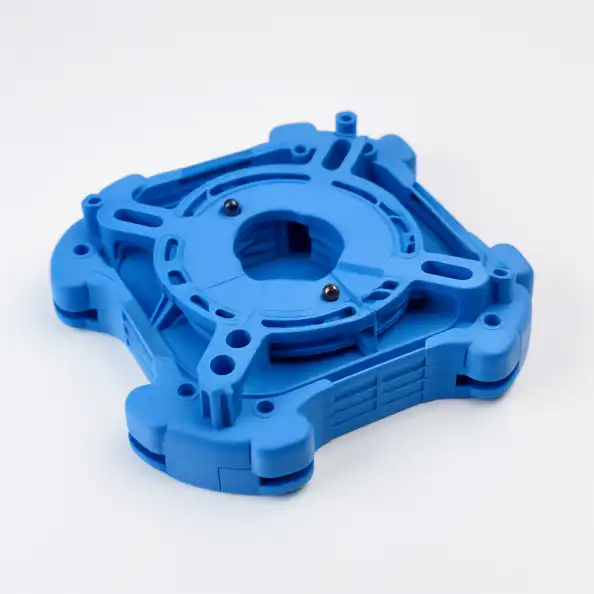
3D Printing Mold technology, also known as rapid tooling, is revolutionizing product development by bridging the gap between prototyping and mass production. By integrating additive manufacturing into the mold-making process, manufacturers can produce injection molds faster and more cost-effectively than traditional methods alone. This approach is ideal for low-volume production, pilot runs, bridge tooling, and functional testing of plastic parts using real production materials like ABS, PC, PP, PE, and PS. This guide explores how 3D printed molds work, their advantages, material options, and how they fit into a modern manufacturing strategy.

The Rapid Tooling Advantage: Speed, Cost, and Flexibility
Traditional steel mold manufacturing is time-consuming and expensive, often taking 4-8 weeks and costing tens of thousands of dollars. 3D Printing Mold technology offers a compelling alternative for certain applications by addressing these core challenges.
- Dramatically Reduced Lead Times: A mold created using 3D printing can be produced in days rather than weeks. The process eliminates complex CNC machining of the mold cavity, directly printing the core and cavity inserts from high-temperature resins or sintered materials. This acceleration allows for faster iteration and quicker time-to-market .
- Significant Cost Savings for Low Volumes: For production runs of tens to a few thousand parts, the cost of a fully hardened steel mold is often prohibitive. 3D printed molds, made from materials like reinforced resins or sintered metal powders, offer a fraction of the cost, making small-batch production economically viable .
- Design Freedom and Complexity: Additive manufacturing excels at creating complex geometries that are difficult or impossible to machine, such as conformal cooling channels. These channels follow the shape of the part, dramatically improving cooling efficiency, reducing cycle times, and improving part quality by minimizing warpage .
- Bridge Tooling to Production: A 3D printed mold can serve as bridge tooling, allowing production to start while a long-term, high-volume steel mold is being manufactured. This enables market testing, pre-sales, and early revenue generation without waiting for full-scale production tooling .

Comparison: 3D Printed Molds vs. Traditional Steel Molds
Understanding the strengths and limitations of each technology is key to selecting the right approach for your project.
| Feature / Aspect | 3D Printed Mold (Rapid Tooling) | Traditional Machined Steel Mold |
|---|---|---|
| Lead Time (Mold Fabrication) | Fast (1-2 weeks) | Slow (4-8+ weeks) |
| Relative Cost | Low to Moderate (Ideal for low volumes) | High to Very High (Amortized over high volumes) |
| Typical Production Volume | Low to Medium (10s – 1,000s of parts) | Medium to High (10,000s – 1,000,000+ parts) |
| Mold Material | Photopolymers (resins), sintered metals (e.g., steel/bronze composites) | Hardened tool steel (P20, H13, S136, NAK80, 2738, 2316) |
| Cooling Channel Design | Excellent (Conformal cooling possible) | Limited (Straight-line drilled channels) |
| Cycle Time | Moderate (but improved by conformal cooling) | Fast (Optimized for high-speed production) |
| Part Material Suitability | Excellent for common thermoplastics (ABS, PC, PP, PE, PS, Nylon) | Excellent for all engineering thermoplastics |
| Mold Lifespan | 100s – 1,000s of cycles (depending on material & part geometry) | 100,000s – 1,000,000+ cycles |
| Surface Finish | Good (may require secondary polishing) | Excellent (Can be textured, polished, or coated) |
Analysis: For companies needing to validate a design, produce parts for market testing, or fulfill small-batch orders quickly, 3D Printing Mold technology is a game-changer. It allows the use of actual production-grade materials—like ABS, PC, PP, PE, and PS—for functional testing, providing more accurate data than prototype parts made from different processes . When high-volume production is required, the investment in a traditional steel mold (using materials like P20, 718, or NAK80) becomes the logical next step .

The Rapid Tooling Process: From Design to Molded Part
The workflow for creating parts using a 3D printed mold integrates digital design, additive manufacturing, and traditional injection molding.
| Stage | Core Process & Technology | Quality & Performance Outcome |
|---|---|---|
| 1. Part & Mold Design | – Design the plastic part in CAD. – Design the mold core and cavity inserts, integrating features like sprue, runners, gates, and conformal cooling channels optimized for additive manufacturing. | A digital mold design that is specifically optimized for 3D printing and injection molding requirements. |
| 2. 3D Printing the Mold Inserts | – The mold inserts are printed using a high-resolution industrial 3D printer. – Common technologies include SLA (Stereolithography) for high-detail resin molds or binder jetting / DMLS for sintered metal composite molds. | Physical mold halves with complex internal cooling channels and precise cavity geometry. |
| 3. Mold Finishing & Assembly | – The printed inserts are cleaned, supports removed, and may be lightly sanded or polished. – They are mounted into a standard mold base (frame) that fits onto an injection molding machine. | A ready-to-use injection mold tool assembled into a production-ready frame. |
| 4. Injection Molding | – The assembled tool is placed in an injection molding machine. – Production-grade plastic (e.g., ABS, PC, PP) is melted and injected into the mold cavity under pressure. | Actual plastic parts produced in the target material for testing or low-volume use. |
| 5. Part Ejection & Iteration | – Parts are ejected, and the cycle repeats. Design feedback is gathered. – If design changes are needed, new mold inserts can be 3D printed rapidly for the next iteration. | Rapid design validation and iteration, enabling faster product development cycles. |
Material Options for 3D Printed Molds and Molded Parts
The versatility of rapid tooling extends to both the mold material and the final plastic part material.
| Mold Material Type | Properties & Best Use | Suitable for Molding Plastics Like: |
|---|---|---|
| High-Temperature Resins (e.g., for SLA) | Good surface detail, moderate thermal conductivity, suitable for 10s-100s of parts. | ABS, PC, PP, PE, PS, Nylon (with careful temperature control) |
| Sintered Metal Composites (e.g., Steel/Bronze) | High strength, good thermal conductivity, suitable for 100s-1,000s of parts. | ABS, PC, PP, PE, PS, Nylon, Glass-filled grades (depending on mold durability) |
| Production-Grade Thermoplastics (for the final part) | Part Material | Common Applications |
| ABS (Acrylonitrile Butadiene Styrene) | Good impact strength, toughness, machinable | Housings, consumer goods, automotive interior parts |
| PC (Polycarbonate) | High impact strength, optical clarity, heat resistant | Transparent covers, lenses, medical device components |
| PP (Polypropylene) | Excellent chemical resistance, fatigue resistance, living hinges | Containers, automotive parts, consumer products |
| PE (Polyethylene) | Flexible, good chemical resistance, low cost | Bottles, caps, industrial containers |
| PS (Polystyrene) | Rigid, easy to mold, cost-effective | Disposable cutlery, housings, packaging |
| Nylon (PA6, PA66) | High strength, wear resistance, self-lubricating | Gears, bushings, mechanical parts |

FAQ: 3D Printing Mold
Q1: What is the typical lead time for obtaining parts from a 3D printed mold?
A: The entire process can be remarkably fast. Mold design and 3D printing might take 3-7 days, with finishing and assembly taking another 2-3 days. This means first articles can be available in 1-2 weeks, which is significantly faster than the 4-8 weeks typical for traditional steel molds.
Q2: How many parts can a 3D printed mold produce?
A: The lifespan depends heavily on the mold material, part geometry, and the plastic being molded. Simple parts in non-abrasive materials like PP or PE made in a sintered metal mold might yield 1,000+ cycles. More complex parts or abrasive materials like glass-filled nylon might yield 100-500 cycles. They are designed for low-volume production, pilot runs, and prototyping.
Q3: Can 3D printed molds produce parts with undercuts or threads?
A: Yes, but the mold design must incorporate appropriate actions, just like a traditional mold. Features like side-cores or unscrewing mechanisms can be designed into the mold assembly. The 3D printed insert itself can create complex shut-off surfaces for simple undercuts.
Q4: Is the quality of parts from a 3D printed mold comparable to production parts?
A: Yes, the plastic parts themselves can be identical in material, appearance, and function to those from a production mold, provided the molding parameters are correctly set. The main difference is the potential for slightly different surface finish (depending on the mold’s finish) and the limited lifespan of the tool. This makes them perfect for functional and market testing.
Q5: Can you manufacture custom 3D printed molds for specific part designs?
A: Absolutely. The process begins with your part design. We specialize in custom rapid tooling solutions, designing and printing mold inserts tailored to your specific geometry, material requirements, and volume needs. We also offer Design for Manufacturability (DFM) support to optimize your part for this process. Contact our engineering team to discuss your project.
Q6: What is the cost advantage of using a 3D printed mold?
A: For low volumes, the cost advantage is substantial. While a steel mold might cost $10,000-$50,000+, a 3D printed mold for a similar part might cost $1,000-$5,000. This makes it economically feasible to produce small batches of parts for testing, niche products, or bridge production without a massive upfront investment .

Conclusion: Accelerate Your Product Development
3D Printing Mold technology is a strategic tool for modern product development. It empowers companies to iterate faster, test with real materials, and reach the market sooner with significantly lower initial tooling investment. For production runs requiring hundreds to a few thousand parts, it is often the most efficient and cost-effective path.
Ready to leverage rapid tooling for your next project? Nylon Plastic integrates advanced 3D printing mold capabilities with our comprehensive injection molding services. From initial design to finished parts, we help you navigate the fastest route from concept to reality.
Request a Consultation | Explore Our Injection Molding Services
Frequently Asked Questions
What is 3D printed mold (rapid tooling)?
Rapid tooling uses 3D printed molds to bridge prototyping and mass production. Additive manufacturing creates mold inserts faster than traditional machining, ideal for low-volume runs, pilot production, and functional testing with production materials.
What materials can 3D printed molds produce?
ABS, PC, PP, PE, and PS for plastic parts. Aluminum 3D printed molds for higher-volume applications. Material selection depends on part requirements and expected mold life.
How many parts can a 3D printed mold produce?
Direct 3D printed molds (metal): 100-10,000+ shots depending on material and part design. 3D printed plastic molds: typically 50-500 shots. Bridge tooling applications: designed for limited runs before steel tooling.
What are the advantages of 3D printed molds over traditional molds?
Faster lead time (days vs weeks), lower cost for prototypes, design iteration without re-machining, complex cooling channels possible, ideal for bridge production and low-volume runs.
How long does it take to produce a 3D printed mold?
3D printed plastic molds: 1-5 days. Metal 3D printed molds: 1-2 weeks. Significantly faster than traditional tool steel molds (4-8 weeks).
 English
 Dutch
Dutch German
 French
 Korean
 Russian
 Japanese
 Spanish
 Vietnamese
 Chinese
 Portuguese
 Arabic