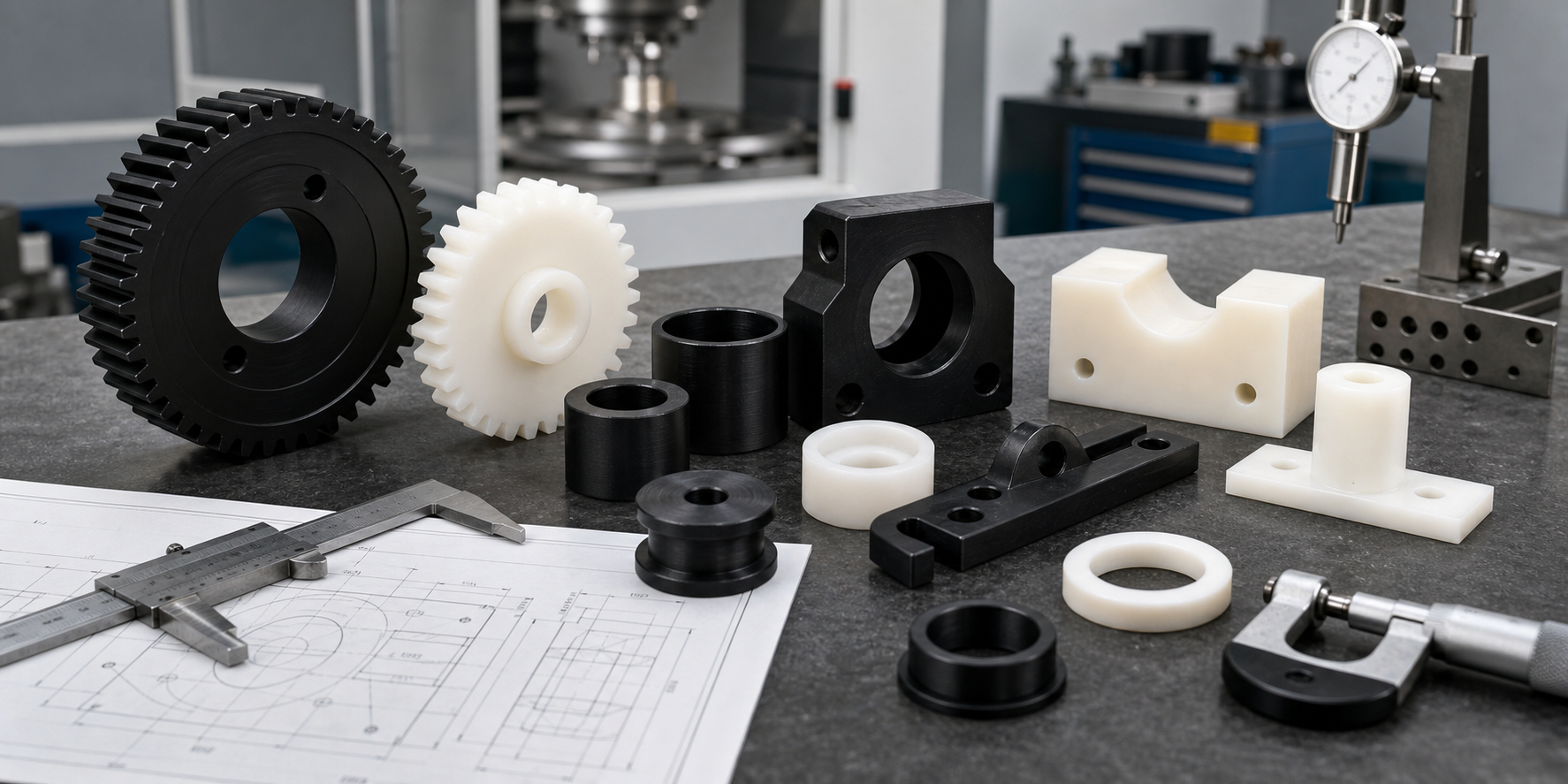
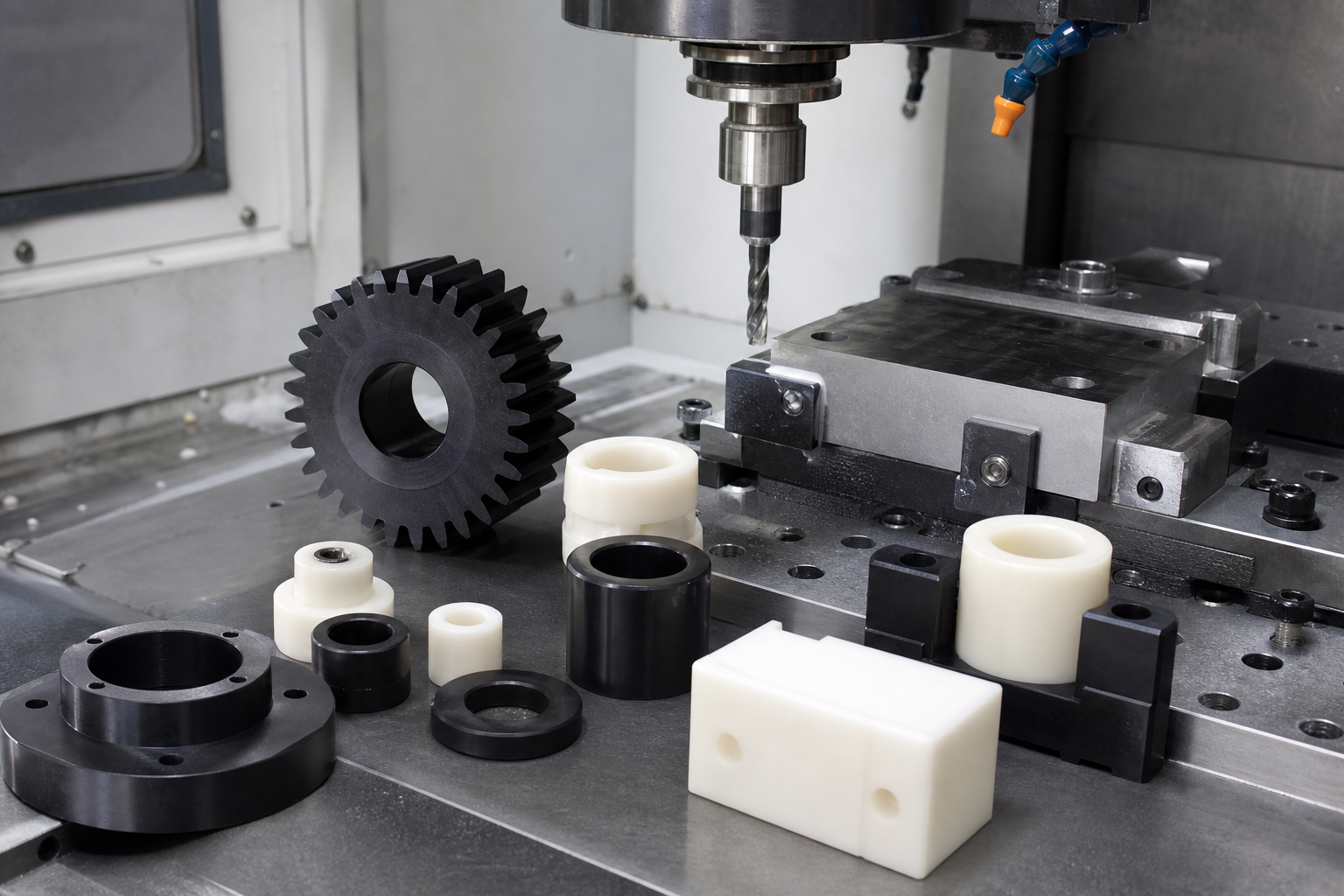
Delrin CNC machining services are commonly chosen for gears, bushings, sliders, valve components and other precision wear parts. Buyers often ask for Delrin by name, but the real decision may involve Delrin homopolymer, acetal copolymer or another engineering plastic that better matches moisture, wear or dimensional requirements.
The advantage of Delrin is not just that it machines cleanly. It is that the material often offers a practical balance of dimensional stability, low friction and production efficiency for custom machined parts.
At a Glance
| Decision Point | Delrin Machining Takeaway | Buyer Note |
|---|---|---|
| Machinability | Usually excellent | Good fit for repeatable precision parts |
| Wear and friction | Often strong for moving components | Useful for bushings, rollers, guides and gears |
| Moisture behavior | Better dimensional stability than nylon in humid use | Check environment before defaulting to nylon |
| Chemical limits | Good in many industrial cases, but not universal | Validate cleaners, fuels and solvents before release |
| Best fit | Precision mechanical plastic components | Not ideal for very high-heat environments |
For precision plastic components
Why Buyers Ask for Delrin
Delrin is often requested when the part needs cleaner machining and lower moisture sensitivity than nylon. It is a strong choice for mechanical parts, but it should still be screened against copolymer acetal, nylon, PEEK and filled grades based on the real duty cycle.
- Often a strong fit for gears, bushings, rollers and precision fixtures
- Useful where nylon moisture uptake creates fit risk
- Check whether homopolymer or copolymer is the better grade family
Delrin vs Acetal Copolymer in Machined Parts
Many buyers use Delrin as a shorthand for all acetal machining, but grade family matters. Delrin homopolymer can offer strong stiffness and wear performance. Acetal copolymer may offer better porosity resistance or chemical behavior in some applications. The right quote should clarify which acetal family is actually being supplied.
That distinction becomes more important when the part is in contact with fluids, when machining thin-wall precision features, or when long-term dimensional stability is critical.
RFQ Checklist for Delrin Machining Services
- Define the moving or wear function: friction and load path should drive the grade choice.
- Clarify whether you mean Delrin specifically or acetal broadly: that affects sourcing and substitute options.
- Call out moisture and chemical exposure: acetal and nylon differ here in practical use.
- Share tolerance zones by function: over-tolerancing raises cost without helping the part.
- Flag mating-part material: wear pairs matter for plastic-on-metal and plastic-on-plastic motion.
Common Delrin Machining Risks and Practical Fixes
| Risk | Why It Happens | Practical Fix |
|---|---|---|
| Wrong acetal grade supplied | Delrin and copolymer treated as identical | State homopolymer or copolymer needs in the RFQ |
| Unexpected wear or noise | Load pair and surface finish were not screened | Review mating material, lubrication state and speed |
| Chemical attack | Cleaner or fluid compatibility was assumed | Validate the actual media before release |
| Needless use of nylon instead | Material selected by habit rather than duty | Compare Delrin and nylon against moisture and wear requirements |
When Delrin Beats Nylon for Machined Parts
Delrin often beats nylon when the part needs better dimensional stability in humid environments, cleaner machining or lower-friction motion. Nylon can still win when toughness, fatigue behavior or broader structural performance is more important. The best supplier screens both rather than forcing one answer.
Why Choose Nylon Plastic
Nylon Plastic helps buyers compare Delrin, acetal copolymer, nylon and other engineering plastics before production starts. That lowers the chance of choosing a familiar name instead of the right material and process combination.
Related Reading
- Delrin vs Acetal Comparison Guide
- Acetal POM vs Nylon
- Custom Machined Plastic Parts
- Nylon CNC Machining Services
- Plastic Gear Design Guide
- CNC Machining Services
Delrin, Acetal Homopolymer and Copolymer Are Not Interchangeable by Default
Delrin CNC machining services should confirm whether the drawing requires a specific Delrin homopolymer grade or allows acetal copolymer. Homopolymer acetal is often selected for stiffness, fatigue and machinability. Copolymer grades can provide advantages in centerline porosity resistance, chemical exposure and dimensional behavior in some environments. Filled, antistatic, detectable, low-wear and compliance-qualified grades need separate approval and traceability.
Workholding, Chip Control and Thermal Stability
Acetal machines cleanly, but that does not make every tolerance easy. Sharp tools, low-friction chip evacuation and moderate cutting heat reduce smearing and burrs. Clamp against stable datum surfaces with enough support to resist cutting force without flattening thin sections. Long bars, plates and heavily pocketed components can move as internal stock stress is released, so balanced roughing and a stabilization interval may be more valuable than simply taking a lighter final pass.
Delrin/POM Feature and Inspection Matrix
| Feature | Primary Risk | Machining Control | Acceptance Method |
|---|---|---|---|
| Bearing bore | Heat, taper and elastic recovery | Finish in one stable setup; allow temperature equalization | Bore gauge and functional shaft fit |
| Gear or tooth form | Burrs, profile error and runout | Control cutter condition and datum concentricity | Profile, runout and mating check |
| Long guide | Bow from stock stress and uneven removal | Rough both sides and stabilize before finish | Free-state straightness on defined supports |
| Thread or insert | Creep, pull-out and damaged starts | Specify engagement, torque and insert method | Thread gauge plus torque/pull test if critical |
Thermal expansion and measurement temperature matter for long dimensions and precision fits. Tighten only the features that control function. A realistic drawing distinguishes assembly fits, wear allowances and noncritical envelope dimensions instead of assigning one blanket tolerance.
Stress Relief, Thin Walls and Burr Control
Routine small Delrin parts do not always need annealing. Review stress relief for large cross sections, deep pockets, thin walls, tight flatness or significant material removal. Thin rings and snap features should remain supported until late in the sequence. Burr expectations belong on the drawing: define allowable edge break, sharp functional edges and surfaces that cannot be manually deburred without changing fit.
Delrin Machining RFQ and Quality Checklist
- Specify Delrin trade grade or approved POM alternative, color, filler and compliance evidence.
- Provide CAD, drawing revision, datums, mating parts and functional fits.
- State load, speed, temperature, moisture, chemicals and expected wear life.
- Define surface finish, edge condition, cleanliness and cosmetic zones.
- Request material certificates, inspection method, sample report and lot traceability.
Normalize supplier quotes by grade, stock source, inspection scope, recurring quantity, packaging and any stress-relief assumption. This makes piece-price comparisons technically meaningful.
Frequently Asked Questions
When should I use Delrin CNC machining services?
Use them for precision machined plastic parts such as gears, bushings, guides and wear components where clean machining and dimensional stability matter.
Is Delrin the same as all acetal materials?
No. Delrin is a homopolymer acetal brand family. Some projects may be better served by acetal copolymer depending on the application.
Is Delrin better than nylon for machined parts?
Sometimes. Delrin often works better where moisture stability and low friction matter, while nylon may be better for some structural or fatigue-driven applications.
What should I send for a Delrin machining quote?
Send the drawing, quantity, tolerance, operating environment and mating-part information so the wear and material choice can be reviewed properly.
Can Delrin machined parts be used in food or medical applications?
They can in some cases, but the exact grade and compliance requirement must be screened with the supplier before production.