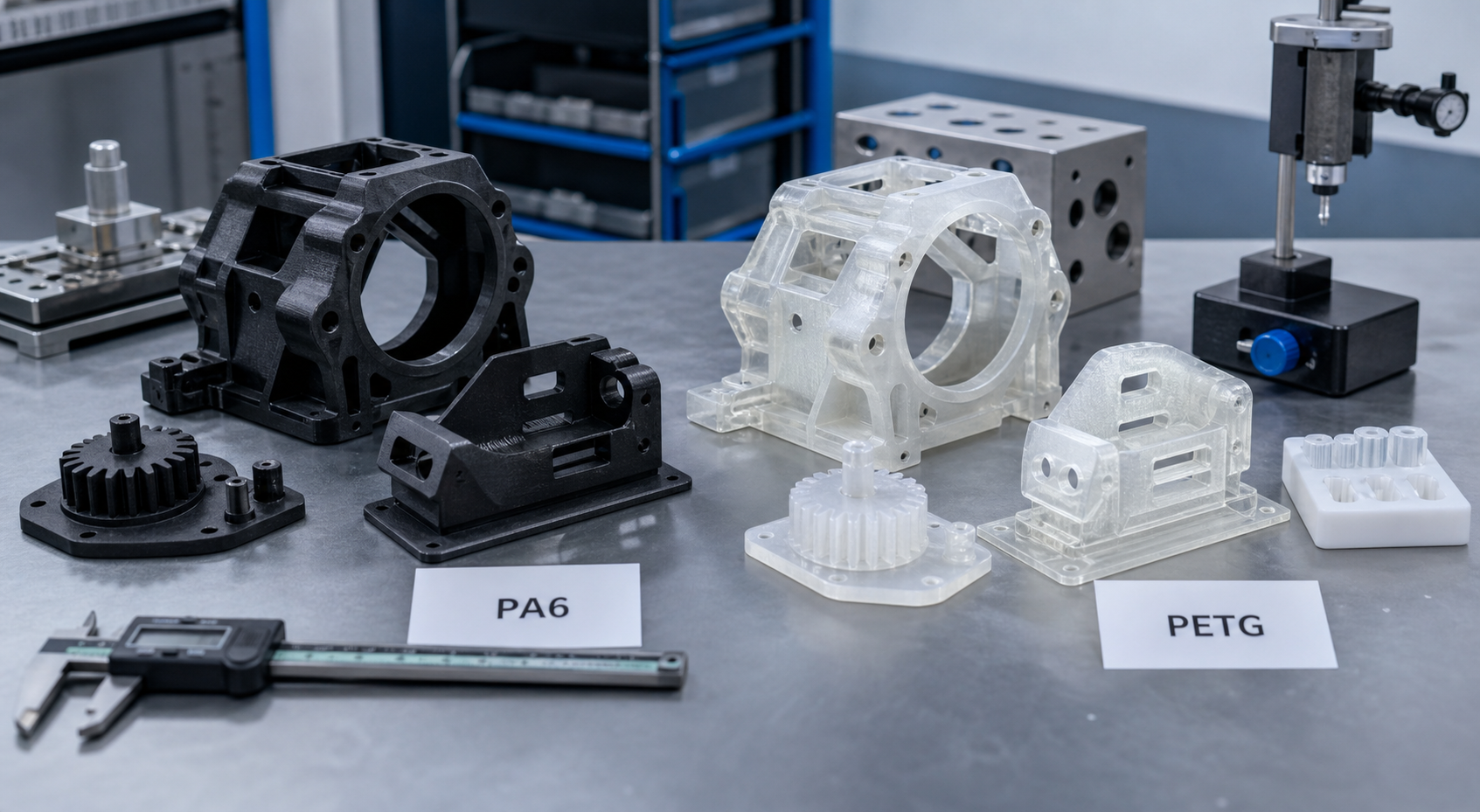
PA6 vs PETG is a decision between a more engineering-oriented nylon route and an easier, more stable PETG workflow. Teams compare these materials when a prototype must survive handling, fit checks and limited functional use without jumping straight to higher-cost industrial print routes.
PA6 can deliver better engineering credibility for tougher parts, but PETG often wins when print stability, speed and lower process risk matter more than ultimate performance.
At a Glance
| Decision Area | PA6 | PETG | Buyer Note |
|---|---|---|---|
| Toughness | Usually higher | Good | PA6 is often better for more demanding functional stress |
| Moisture sensitivity | High | Low | PETG is easier to store and run consistently |
| Print stability | More demanding | More forgiving | PETG is often the safer choice for simple prototypes |
| Heat resistance | Usually stronger | Lower | PA6 fits hotter or more demanding engineering use |
| Best fit | Tougher functional parts | Faster prototype and enclosure builds | Use PA6 when the prototype must act more like an engineering part |
When PA6 Makes More Sense
PA6 is usually the better option when the printed part must tolerate more load, abrasion, or repeated functional use. It is often closer to the material behavior expected in an eventual nylon production part, which makes it useful for tougher brackets, clips, wear items and mechanical validation builds.
The cost of that benefit is process sensitivity. PA6 drying, chamber control and warpage management all need more discipline than PETG.
When PETG Is the Better Prototype Choice
- Speed matters: PETG is often easier to run with fewer failed builds.
- The prototype is mostly for fit and appearance: PETG can be enough without nylon complexity.
- The shop lacks strong drying control: PETG reduces process instability.
- The part is not heat or wear critical: PETG can provide a faster commercial answer.
Common PA6 vs PETG Mistakes
| Mistake | Risk | Fix |
|---|---|---|
| Choosing PETG for a load-bearing engineering test | Prototype gives false confidence | Use PA6 or another stronger engineering route |
| Choosing PA6 without drying control | Weak prints and inconsistent quality | Plan the material handling workflow before quoting |
| Comparing only easy printability | Wrong material for the final application | Start from service condition and part function first |
| Using one prototype to represent final production behavior | Material mismatch in downstream manufacturing | Tie the print material to the expected production material path |
PA6 vs PETG for B2B Prototype Decisions
If the part is a commercial demo, fit check or light enclosure, PETG often keeps the project moving faster. If the prototype must test real-use strength, wear or more demanding assembly behavior, PA6 is usually the more credible engineering choice.
Why Choose Nylon Plastic
Nylon Plastic helps teams choose whether a prototype should optimize for speed, print yield or realistic engineering behavior before they spend time on the wrong print route.
Related Reading
- Nylon 3D Printing Guide
- Plastic 3D Printing Services for Functional Parts
- PLA PETG and Nylon Comparison
- 3D Printing Tolerances Guide
- Polyamide Molding
- Nylon 3D Printing Service
Drying Discipline: The Hidden Cost of PA6 Printing
PA6 filament absorbs moisture from ambient air within hours of opening a sealed package. Printing with wet PA6 produces parts with 30-50 percent lower layer adhesion, visible surface roughness from steam bubbles, and unpredictable mechanical properties. A proper PA6 workflow requires: storage in a sealed container with desiccant when not in use, active drying at 80°C for 4-8 hours before printing, and printing directly from a dry box that maintains sub-15 percent relative humidity. PETG, by comparison, can often be printed from open-air spool holders with acceptable results for prototype work. The drying infrastructure adds approximately $200-500 to the printer setup cost and 4-8 hours of preparation time per print job. Teams should factor this overhead into project timelines, not just material costs.
When the Prototype Must Predict Production Behavior
The most expensive mistake in a PA6 vs PETG decision is choosing PETG for a prototype that must validate an eventual injection-molded nylon production part. PETG’s lower stiffness, different friction behavior, and significantly different thermal expansion mean that a PETG prototype may pass fit and function checks that a nylon production part would fail. If the prototype is a stepping stone to injection molding, PA6 provides a more honest preview of production behavior. If the prototype is purely for form review, customer demonstration, or short-term use, PETG’s speed and simplicity often make better business sense. The key question is not which material is “better” but which material tells the truth about the production part the team is actually building toward.
Surface Finish and Post-Processing Comparison
PETG generally produces smoother surface finishes straight off the printer because its lower printing temperature and better flow characteristics reduce visible layer lines. PA6 parts often require sanding, vapor smoothing, or coating to achieve a comparable surface quality, adding 15-30 minutes of post-processing per part. For cosmetic prototypes, the surface finish advantage tips the scale toward PETG. For functional parts where surface finish is secondary to mechanical performance, PA6’s post-processing overhead is an acceptable trade-off. The team should decide whether the prototype will be judged primarily by appearance or by function before choosing the material.
Frequently Asked Questions
Is PA6 stronger than PETG?
PA6 is generally the better engineering choice for tougher functional parts, while PETG is usually chosen for easier printing and faster prototype throughput.
Is PETG easier to print than PA6?
Yes. PETG is usually easier to store, dry and print consistently than PA6.
When should I use PA6 instead of PETG?
Use PA6 when the part needs more demanding mechanical performance, wear resistance or closer alignment with a future nylon production part.
When is PETG enough?
PETG is often enough for fit checks, enclosure prototypes and non-critical printed parts where print speed and stability matter most.
What should I send for a PA6 vs PETG recommendation?
Send the model, intended use, service temperature, load condition and whether the part is a demo prototype or a functional validation build.
Send the part file if you want help deciding whether PA6 or PETG is the lower-risk prototype material.