Ultrasonic welding joins thermoplastic parts in under a second by converting 20-40 kHz electrical energy into mechanical vibration. The vibration generates frictional heat at the joint interface, melting and fusing the plastic in a fraction of the time required by adhesives, solvent bonding, or hot-plate welding. It is the dominant assembly method for consumer electronics, medical devices, and automotive components — anywhere that speed, cleanliness, and repeatability matter.
But ultrasonic welding is unforgiving of poor joint design. The energy director geometry, material pair, and amplitude setting must align precisely, or welds come out weak, inconsistent, or visually marred. This guide covers the parameters that separate a reliable production weld from a costly rework loop.
How Ultrasonic Welding Works
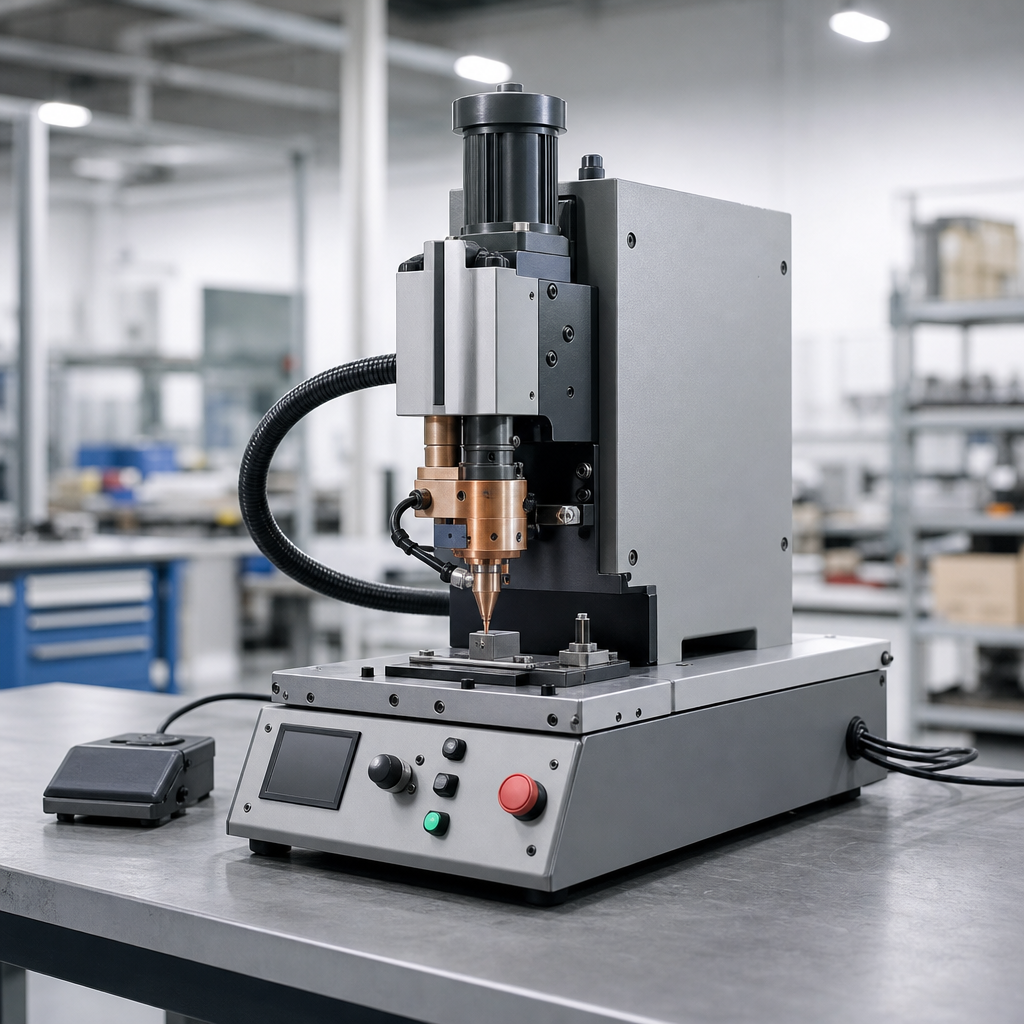
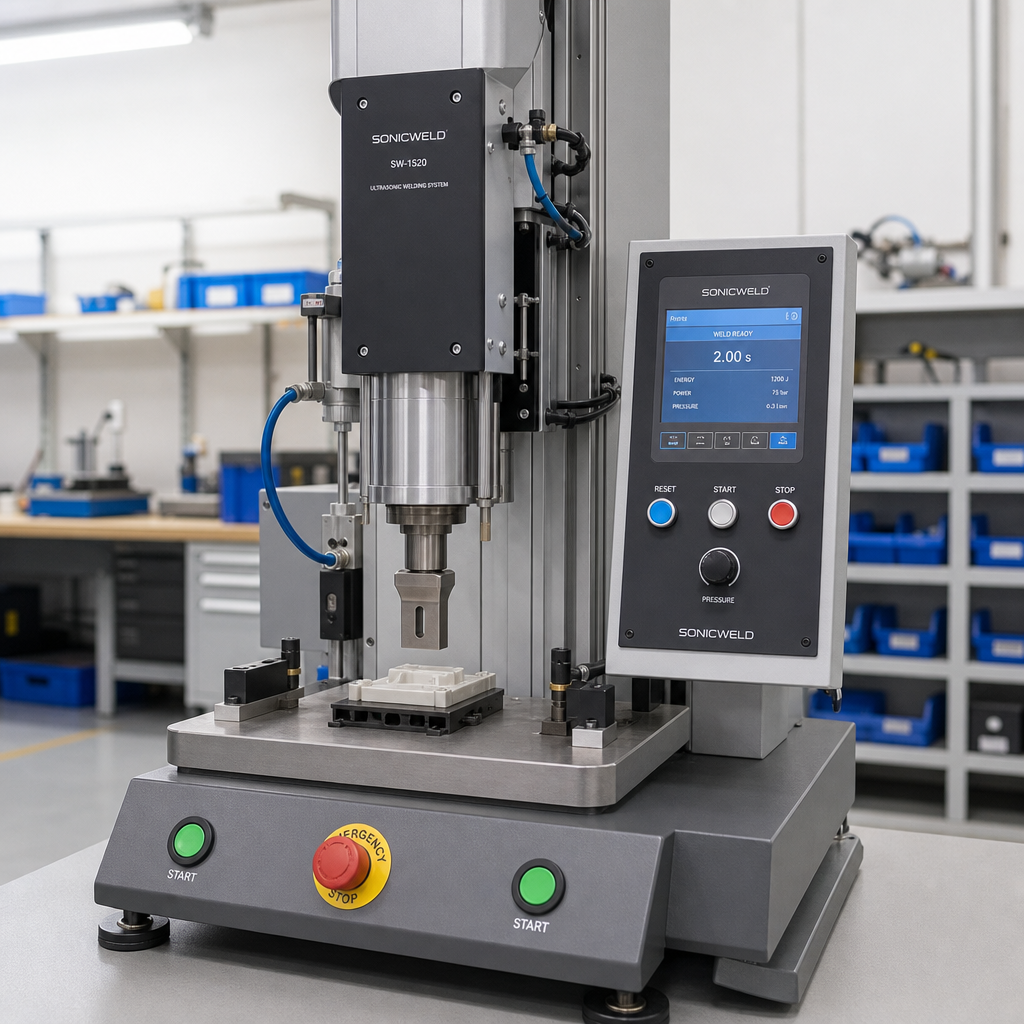
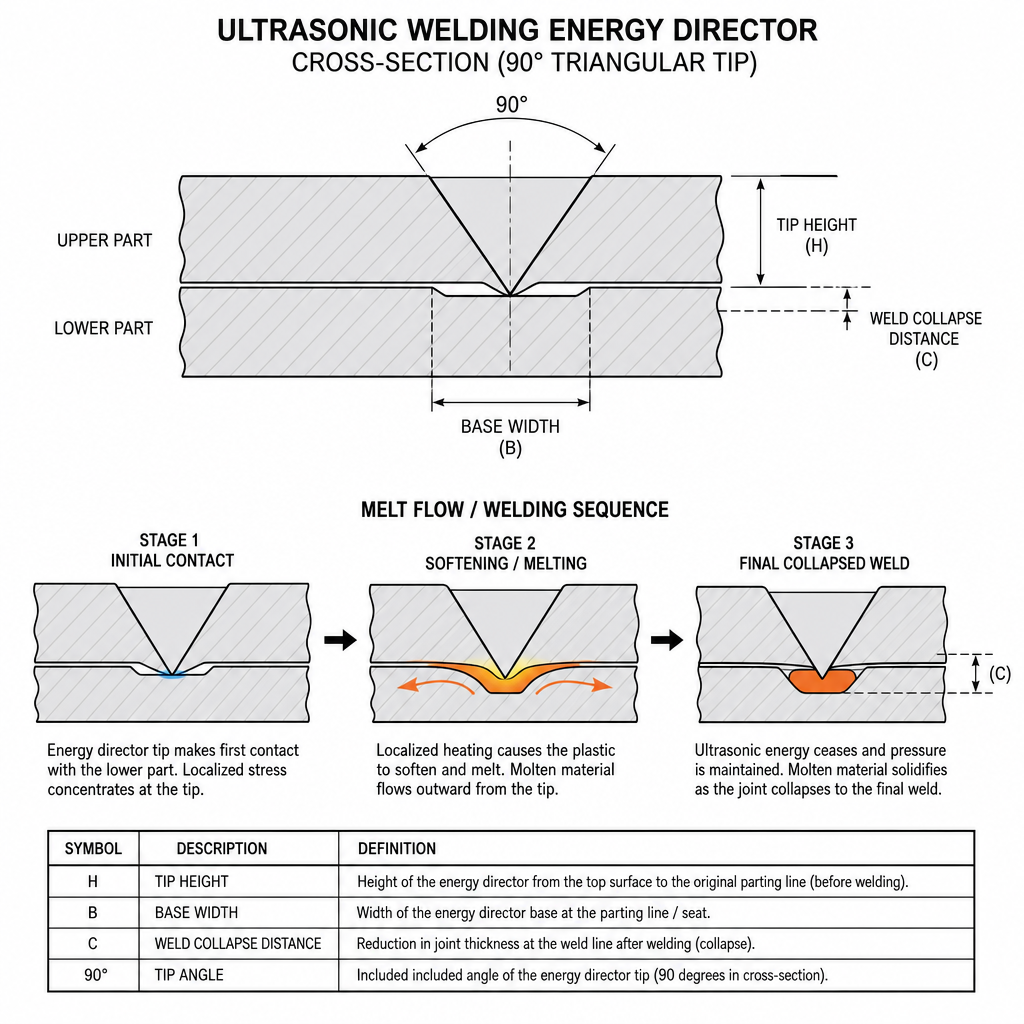
A piezoelectric transducer converts electrical power (typically 500-4,000 W) into high-frequency mechanical vibration. A booster amplifies or reduces the amplitude, and a horn (sonotrode) delivers the vibration to the part surface. The energy travels through the upper part to a molded-in energy director at the joint interface — a triangular ridge, typically 0.3-0.8 mm tall with a 60-90° peak angle. Friction melts this ridge first, and the molten material flows across the joint under pressure, solidifying into a homogeneous bond within 0.5-2.0 seconds.
Compare alternative joining routes in the plastic welding methods guide before fixing the assembly process.
Frequency Selection and Amplitude by Material
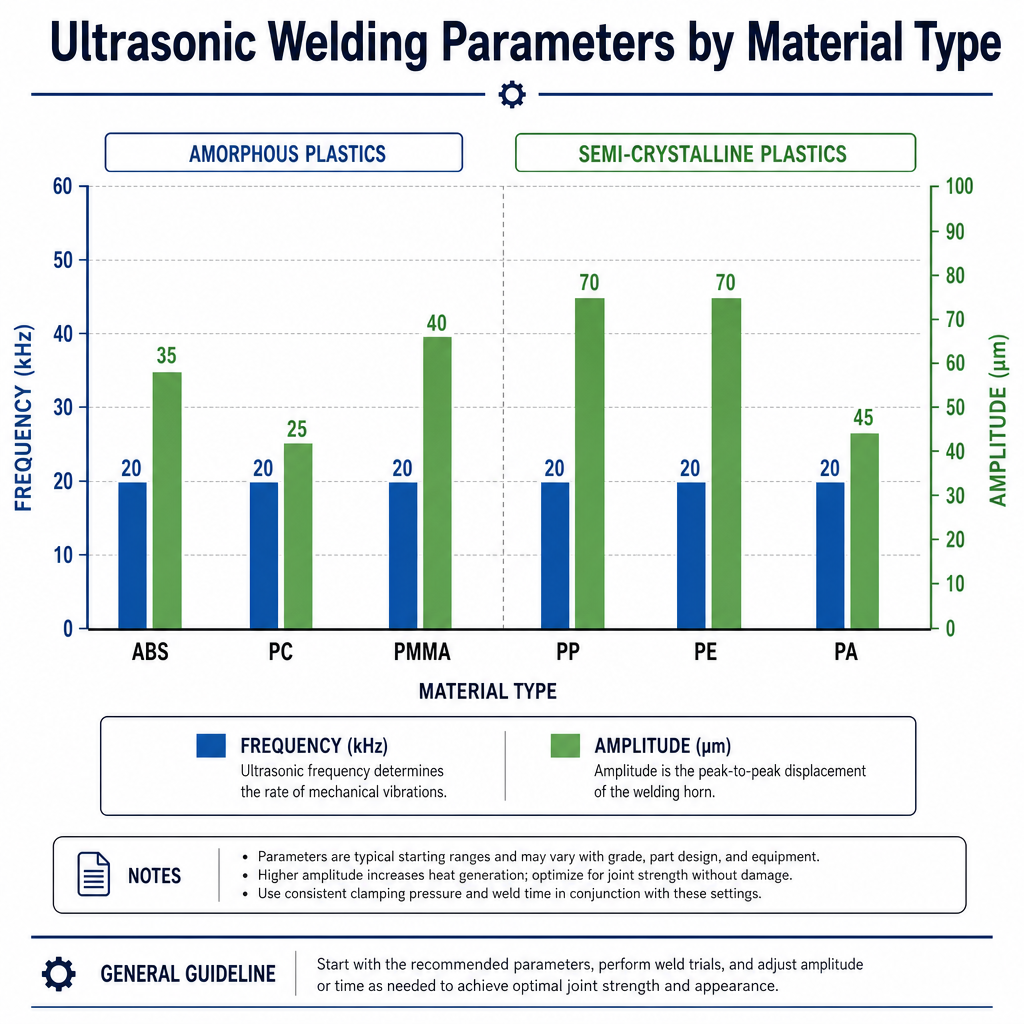
| Material | Recommended kHz | Amplitude (μm) | Weldability | Notes |
|---|---|---|---|---|
| ABS | 20-30 | 15-25 | Excellent | Best ultrasonic material; forgiving parameter window |
| PC | 20-30 | 20-35 | Good | Higher energy needed; prone to stress cracking if over-welded |
| PA66 | 20-30 | 30-50 | Fair (dry) | Must be dry (<0.2% moisture); requires higher amplitude |
| PP | 20 | 35-60 | Fair | Semi-crystalline needs high amplitude; near-field only |
| POM | 20-30 | 25-40 | Fair | Low friction coefficient requires aggressive energy director |
| PMMA | 20-30 | 15-25 | Good | Similar to PC; brittle — avoid over-welding |
| PEEK | 20 | 40-60 | Poor | High melt temp (343°C); requires very high energy input |
Use the engineering-plastic datasheet reading guide to identify the exact grade and test conditions in the material documents.
Energy Director and Joint Design
The energy director is a triangular ridge molded into one part half that concentrates ultrasonic energy at a precise point. Standard design: 90° included angle, 0.3-0.8 mm height, continuous around the joint perimeter. Shear joint: Used for semi-crystalline plastics (PP, PA, POM) where energy directors struggle — one part wedges into the other with 0.2-0.4 mm interference, creating shear heating along the sidewall rather than at a single point.
Near-field welding (horn distance <6 mm from joint) transfers energy efficiently and works with most materials. Far-field welding (horn >6 mm from joint) requires stiffer, amorphous plastics that transmit vibration well — ABS and PC work; PP and PE lose too much energy over distance. For semi-crystalline plastics, always design for near-field horn placement.
Design Rules for Ultrasonic Welding
- Energy director height: 0.4-0.6 mm: For parts up to 50 mm joint length. Increase to 0.6-0.8 mm for joints over 100 mm. Shorter directors melt too fast and produce weak bonds; taller directors require excessive energy and flash.
- Joint alignment within 0.05 mm: Misalignment of 0.1 mm or more creates inconsistent energy transfer, localized overheating, and weak spots. Use alignment pins or tongue-and-groove features to guide the horn and part halves.
- Keep horn-to-joint distance within 6 mm: Energy drops roughly 50% per 6 mm of travel through plastic. For parts taller than 6 mm, use a near-field horn contact point close to the joint line.
- Avoid sharp internal corners at joint: Radius all internal corners at the weld joint to at least 0.5 mm. Sharp corners act as stress risers that amplify vibration and cause cracking during or after welding.
- Wall thickness at joint: 1.5-3.0 mm: Thinner walls melt through; thicker walls transmit insufficient energy. The sweet spot for most amorphous plastics is 2.0-2.5 mm. Add a support rib 2-3 mm behind the weld surface for thinner walls.
- Vent the weld cavity: Trapped air compresses during the weld cycle and can blow out molten material, creating flash and weak bonds. A 0.02-0.05 mm vent gap on the non-cosmetic side of the joint relieves pressure without affecting weld quality.
Process Parameters by Application
| Industry | Typical Parts | Material/Grade | Key Requirement | |
|---|---|---|---|---|
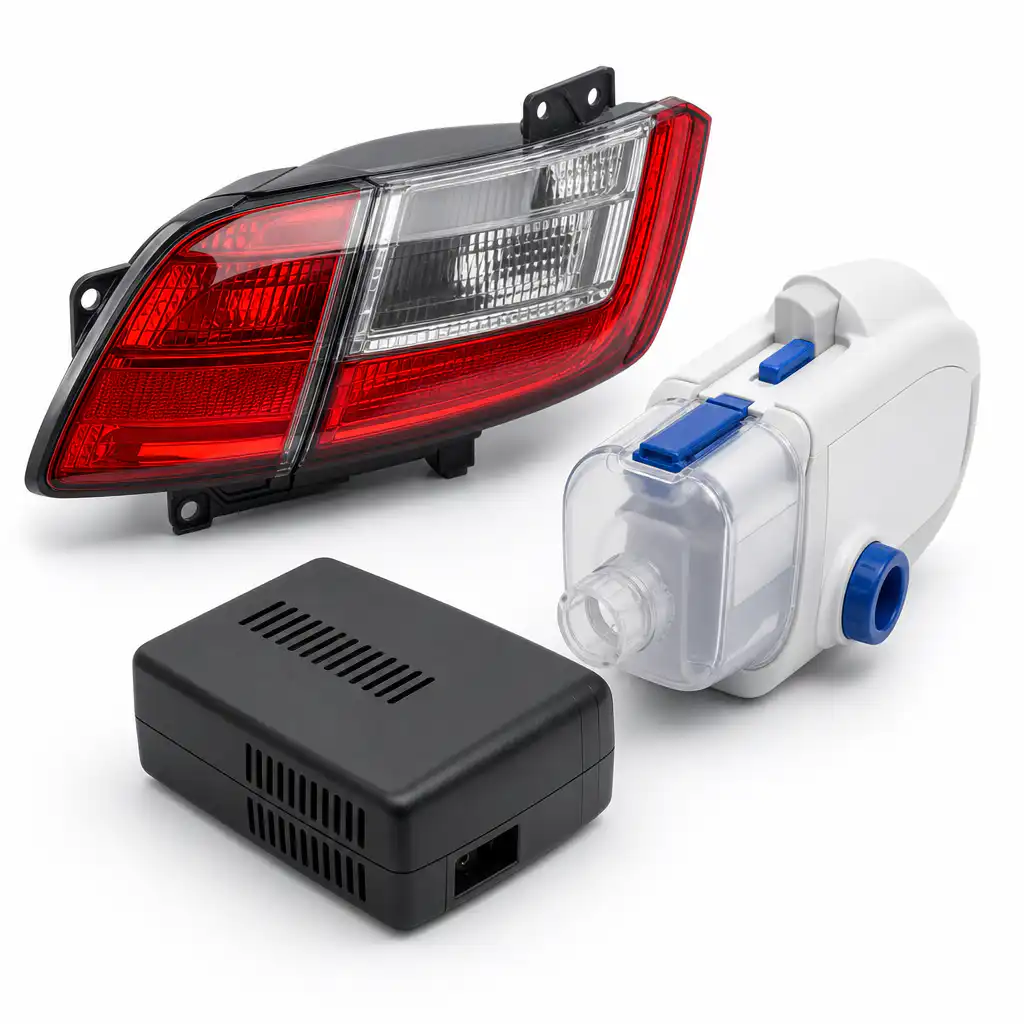
| Consumer Electronics | Phone/laptop housings, charger cases | ABS/PC | 20 kHz, 1.0s weld, 0.5s hold | Cosmetic surface, no flash |
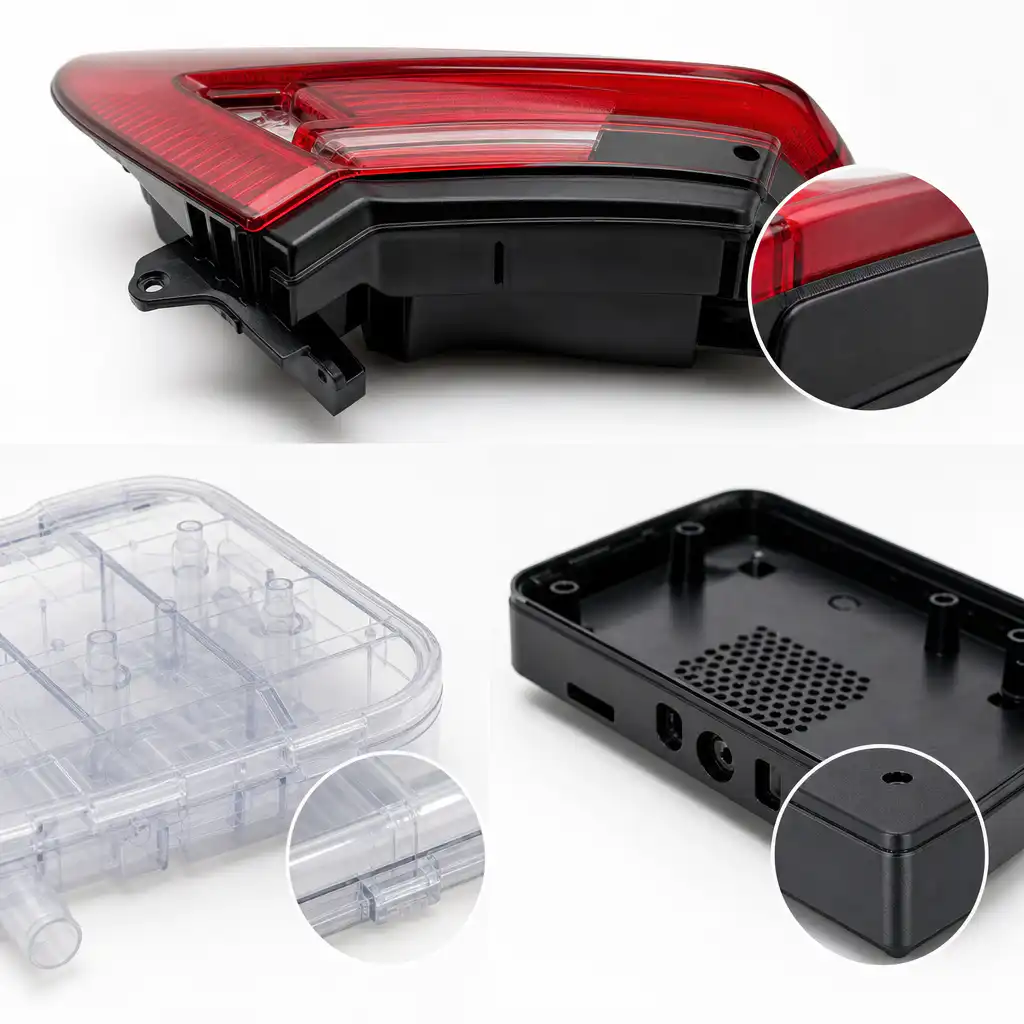
| Medical Devices | IV connectors, filter housings, syringes | PC, COC, ABS | 30 kHz, 0.5s weld, clean room | Particulate-free, validated process |
| Automotive | Sensor housings, lamp assemblies, fluid reservoirs | PA66, PP, PC-ABS | 20 kHz, 1.5s weld, high strength | Temperature cycling resistance |
| Packaging | Blister packs, tube sealing, tamper-evident caps | PET, PP, PVC | 30-40 kHz, <0.3s weld | Speed > sealing strength |
Cost Decision Framework
Equipment cost: Benchtop ultrasonic welder: $8,000-25,000 (20 kHz, 1,500-3,000 W). Automated system with handling: $40,000-120,000. Horn tooling: $500-3,000 per design (aluminum for prototypes, titanium for production).
Per-part economics: Ultrasonic welding costs $0.002-0.01 per cycle in electricity, plus horn amortization ($0.001-0.003 per part over 500,000 cycles). Compare to adhesive bonding at $0.05-0.50 per part (adhesive + cure time + labor). The break-even on equipment against adhesives is typically 50,000-100,000 parts.
Volume decision: Under 10,000 parts annually, adhesives or mechanical fasteners often win on upfront cost. Above 50,000 parts, ultrasonic welding dominates on speed, cleanliness, and per-part cost. Medical and electronics add an intangible: ultrasonic welds leave no chemical residue, simplifying regulatory compliance.
Common Defects and Solutions
| Defect | Appearance | Root Cause | Solution |
|---|---|---|---|
| Weak weld / no bond | Parts separate with minimal force | Insufficient amplitude; wet nylon; wrong energy director | Increase amplitude 20%; dry nylon to <0.2% moisture; verify ED at 90° |
| Flash / squeeze-out | Molten plastic extruding from joint line | Excessive energy; too-high pressure; no flash trap | Reduce weld time 15%; add 0.5mm flash trap groove; reduce trigger pressure |
| Part marking / damage | Horn contact area shows scuffing or dents | Horn surface worn or misaligned; excessive amplitude | Resurface horn; add PE film between horn and part; reduce amplitude 10% |
| Inconsistent weld strength | Bond varies ±30% part-to-part | Fixture movement; part dimensional variation; moisture | Lock fixture alignment; check molded part dimensions; control humidity |
Frequently Asked Questions
How does ultrasonic welding work for plastics?
An ultrasonic welder converts 20-40 kHz electrical energy into mechanical vibration through a piezoelectric transducer. This vibration travels through a horn (sonotrode) into the plastic parts. At the joint interface, a molded energy director (a triangular ridge) concentrates the vibration energy, creating frictional heat that melts the plastic at the contact point. The molten material flows and fuses under pressure, solidifying into a homogeneous bond in 0.5-2 seconds. No adhesives, solvents, or external heat sources are needed.
Which plastics can be ultrasonically welded?
Amorphous thermoplastics (ABS, PC, PMMA, PS) weld best because they soften gradually and transmit vibration efficiently. Semi-crystalline plastics (PP, PE, PA, POM) are more difficult — they melt sharply at a specific temperature and require higher amplitude (30-60 μm vs 15-25 μm) and shear joint designs instead of energy directors. PEEK and high-temperature nylons are the most challenging and may require 40+ μm amplitude. Dissimilar plastics generally do not weld unless they have compatible melt temperatures and chemical structures (e.g., ABS to PC works; PP to PE does not).
What is the correct energy director design?
Standard energy director: 90° included angle, 0.3-0.8 mm height (use 0.3-0.4 mm for small parts <30 mm joint, 0.5-0.8 mm for large parts), continuous around the full joint perimeter. The peak should be sharp (radius <0.05 mm) to concentrate energy. For semi-crystalline plastics, use a shear joint instead: 0.2-0.4 mm interference fit with a 30-45° lead-in angle on one half. The shear joint generates heat along the sidewall interface rather than at a single point, producing stronger bonds in crystalline materials.
How strong is an ultrasonic weld compared to the base material?
A properly designed ultrasonic weld in amorphous plastics (ABS, PC) achieves 85-95% of the base material tensile strength at the joint. Semi-crystalline plastics (PP, PA) with shear joints reach 70-85%. The strength depends more on joint design than on welding parameters — a well-designed energy director on ABS will outperform a poorly designed joint on any material. Key factors: continuous joint perimeter (no gaps), consistent wall thickness, and proper horn alignment.
Related Reading
Request an Ultrasonic Assembly Review
For ultrasonic welding of plastic components, send the mating geometry and the assembly test requirement before committing to a joint or horn. Nylon Plastic can review material compatibility, tool access and trial-assembly approval with the part manufacturing scope.
What should a plastic ultrasonic welding feasibility review include?
Send both mating parts, exact resin grades, joint geometry, available clamping surfaces and the assembly drawing. Define the required leak, pull, torque or appearance test and identify sensitive inserts or electronics. Ask the quote to separate joint-design changes, fixture or horn work, trial assemblies and production inspection. Material compatibility and a weldable joint must be demonstrated on the actual assembly before a production weld is approved.
- Identify whether molded components, welding on supplied parts or a complete manufactured assembly are required. Provide tool status, drawing revision, quantity, destination and timing.
- Mark supported and contacted surfaces, cosmetic areas, flash limits and alignment features. If electronics, membranes, inserts or delicate features are present, state the restrictions on loading and vibration.
- Agree how trial results are judged: leak, pull, torque, appearance or dimensional acceptance, plus sample condition and report format. Identify responsibility for horn/fixture changes, process trials and final assembly approval.
Manufacturing and delivery:
- Precision Manufacturing: 30+ CNC & injection molding cells under one roof
- ISO 9001:2015 Certified: Certified quality system, full inspection reports
- 15-25 Day Lead Time: Fast turnaround with expedited options available
- Global Shipping: Air & sea freight to North America, Europe, Asia
A listed frequency, amplitude or weld time is a starting point for review rather than approval of a different part. Release production only after the selected grades, joint and tooling have been evaluated on representative assemblies.